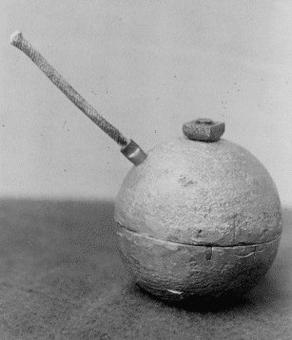
Not as a standard design, no. However, something rather close -- a cast-iron sphere packed with gunpowder and jammed with a wooden wick, itself packed with gunpowder -- was used as a typical design for mortar shells during the black-powder era (~1300s to ~1870 in the West). Further, something similar to what you're talking about did exist, but not as a "standard."
Spherical "Bombs"
According to Jack Kelly in his book Gunpowder (which I highly recommend if you're interested in the history of firearms and artillery), black powder can be set alight on its own, but in order to get a powerful explosion, it has to be tightly packed into a contained area, where the pressure from the gasses it releases as it burns can build and create a chain reaction.
As a result, exploding mortar bombs in the black powder era were often spherical in shape, and hollow, the center being filled with black power and a wooden wick. When fired, these mortar bombs (which were dark grey or black in color, being fashioned usually from cast-iron or other durable metals) would be deadly as ballistic projectiles, but also as explosives -- when their wicks detonated the charge inside them, they would explode with some force, and also send the cast-iron casing out as shrapnel.
Incidentally, these types of mortar and artillery rounds were initially forged of two half-spheres of metal, which could be filled with powder and then joined together, either at the forger or sometimes in situ. These two halves were referred to as "shells" because of their half-sphere shape, which is why we often refer to artillery ammunition as shells, by synechdoche.
Popular Imagery
Why does the popular image of the "bomb" look like one of these black-powder era artillery shells? One of the big reasons is the rise of the editorial cartoon in popular magazines right around the time of the American Civil War.
While political cartoons and engravings had been known in certain magazines for at least a century or two, Harper's Weekly became extremely famous both for its coverage of the Civil War (which was on everyone's mind in the mid-19th Century) and for its illustrations and cartoons. Harper's (and other political magazines like it), helped shape the popular consciousness about certain images, and one of them happened to be the "villain bomb" you're referring to.
Here is a cartoon from Harper's Weekly from 1865, showing Jefferson Davis in denial, with his country crumbling and Union "bombs" rolling toward him, fuses burning. Note the shape and color of the bombs (as an aside, note in the caption that Davis praises "Allah" here -- probably a satirical jibe by the cartoonist).
Another influencer was the rise of photography, which was a completely new form of transmitting images, and which had become available to the public in major cities through gallery shows and in some publications. Here is a photo of a Union mortar team, note the spherical, cast iron shells neatly stacked on the platform.
This popular image of bombs as dark, metal spheres, then, seems to date from the Civil War and the rise of popular imagery from that time. But cartoonists continued to use the image down through the next decades.
Why the String Fuse?
The mortar shells from the black-powder era, as we saw, had no string or wire fuses. So, where did this idea get into cartoonists' heads?
One likely possibility is that they combined images: they took the popular image of the spherical, black-powder bomb, and combined it with another explosive that had recently become popular: dynamite. Invented in 1867, Kelly states that dynamite was popularized in a huge marketing campaign by inventor Alfred Nobel as the "weapon and tool of the common people."
Indeed, it proved so popular that black powder explosives all but disappeared within just a few years. Yet, the spherical bomb had not completely gone. Recall that the purpose of that bomb was not just to build pressure for black powder (no longer needed with dynamite's nitroglycerin-based explosives), but also to throw shrapnel across a sphere on explosion. The secondary application still had merit.
So, in 1886, in the Haymarket Affair in Chicago, an unknown person threw a dynamite bomb into a crowd of protesters, sparking a riot and a gun battle. Though the bomb was dynamite based, onlookers said it was spherical in shape, and cartoons in Harper's Weekly (yes, again!) and other magazines depicted it as such.
In a trial that followed -- which was very problematic, but that's outside the scope of this piece -- the police found bombs in the dwelling of Louis Lingg, which looked like this. That is an actual photograph of one of the bombs. As you can see... they are spherical metal bombs with rope wicks. Despite their dynamite core, they had been constructed to throw off shrapnel. However, these were quite small, and would probably qualify more as grenades than bombs -- but for our purposes, we'll allow it.
The Haymarket Affair was major news in America, and it's not hard to see how this photo and cartoons of similar bombs could have locked down the imagery put in place in the popular consciousness around the time of the Civil War. Indeed, one has to wonder whether the bomb-maker himself was influenced by those images.
Conclusion
Why has the image of the spherical, wire bomb remained so popular? Well, with the rise of animation and moving pictures, the burning wick is a useful device for creating tension, spherical bomb or not, so it wasn't going anywhere. The spherical bomb itself had, by that time, simply become iconic and easily identifiable for many people around the world.
But it's worth remembering that it's far from the only bomb depiction we see in popular culture: bunches of dynamite wired to an old plunger detonator, bomb vests, "ticking time bombs," etc. The idea is to quickly convey to the viewer that this is a dangerous device -- and for whatever reason, the spherical bomb has remained easily recognizable since at least the mid-19th Century.
As for Batman, if he were around in Chicago in 1886, he might very well have been trying to prevent something like what you're describing from going off. Or capering around uselessly running into three-piece marching bands wherever he turned.
Sources:
Kelly, Jack: Gunpowder: Alchemy, Bombards, and Pyrotechnics : The History of the Explosive That Changed the World (Basic Books, 2005)
Messer-Kruse, Timothy: The Haymarket Conspiracy: Transatlantic Anarchist Networks (U. of Illinois Press, 2011)