So, I recently read that the beauty ideal for men in medieval Europe was to be fat since that showed that you were rich. Is this true? If not, what was the beauty ideals like?
This is one of those old saws that contains a germ of truth buried under a whole lot of qualifiers that render it basically false. At no point in the Middle Ages was it fashionable and sexy to look so thin that you looked like you could die at any moment, or to look like you were dying of plague -- there was no medieval version of heroin chic. (This is not to say that there are no medieval equivalents to eating disorders, but that's another story or another post.) There was no massive weight loss industry pressing down on men and women of all social classes telling them in quantified terms what they must weigh in order to be attractive, and clothing sizes don't exist when somebody's hand-sewing all your clothes to match the specifics of your body. But for much of the Middle Ages, beauty standards still prize slimness -- slim legs, high breasts, and narrow waists for women, and long lean legs, broad shoulders, and narrow waists for men. There was more of an emphasis on women's broad hips than was prevalent in, say, circa-1998 high fashion, and this necessitated a greater focus on the curve of women's bellies, something that would have been nearly taboo in late 20th century erotic art. Men's fashion of the 14th century in both France and England prized long, sexy lines -- this was great if you had them, but it kicked off a lot of polemic writing about men whose short doublets barely concealed their genitalia from the world or whose tight tight hose meant they couldn't even kneel down to pray without risking a wardrobe malfunction. This would have been a tough sell for heavier people, and in general shapely slimness seems to have been associated with fashionable youth and beauty because of its opposition to the heaviness and solidity associated with age.
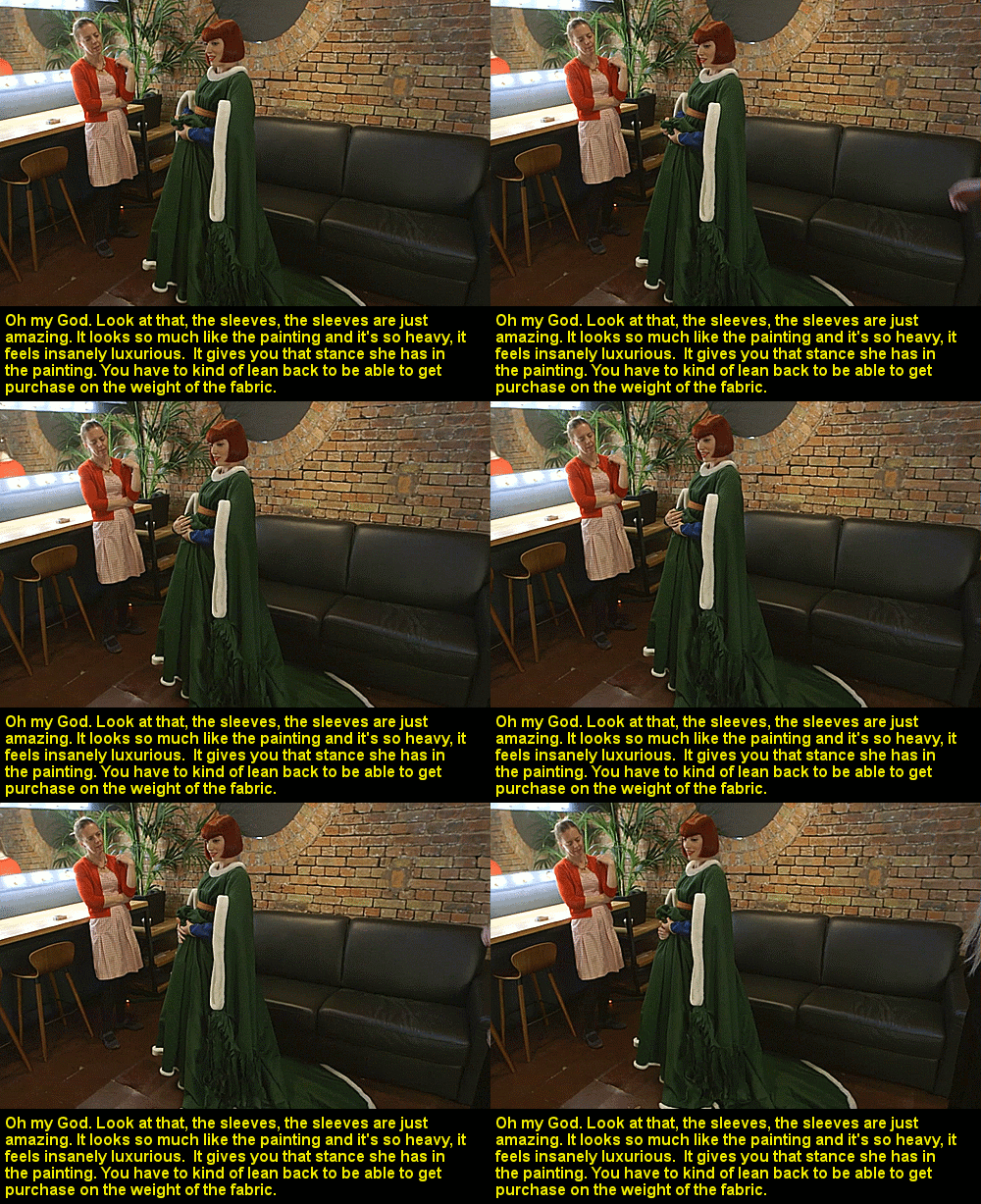
But if the general vogue was for slimness, then why did some people like the woman in Jan van Eyck's 1434 Arnolfini wedding portrait look like they were pregnant all the time? If you wanted to show off your wealth in the late Middle Ages and Renaissance there were easier ways to do it than putting on 20 pounds -- simply wear a lot more clothes than poor people do! This is likely another reason why people associate medieval and Early Modern beauty with chunkiness -- Tudor men might be wearing a shocking amount of clothing, and unseen features like extensive cartridge pleating or fur linings add significant volume. Historical costumers Ninya Mikhaila and Amber Butchart recreated the Arnolfini wedding gown for the BBC's A Stitch In Time and it's quite bulky as well as quite appealing. Cartridge pleated skirts will make anyone look massively hippy. There's also a tremendous amount of underlying structure to medieval and Early Modern garments (spiral lacing, underskirts and shifts, breastbags, later on stuff like stays and pairs of bodies) that's frankly unfathomable to 21th century people, but none of that necessarily suggests women's natural shapes any more than women were naturally more hourglass-shaped in the 1950s without taking into consideration a hundred different types of girdle.
Late medieval men could be quite anxious about weight -- Matthaüs Schwarz, the marvelous 16th century fashion plate, despaired about getting heavier because he associated it with getting older and losing his youthful charms. Henry VIII may have been a famous stud in his youth, but he was a famously athletic and lean stud -- he gained weight as he aged, likely due to a host of medical problems as well as the natural course of age. Men enlisted the help of tailors to obtain specific contours and shapes in the garments they wore -- in the 16th and 17th centuries this turns into stuff like the peascod belly, a shaped and padded addition to the doublet that helped maintain a sexy curve -- but these desired contours fluctuated in the course of fashion trends, by year as well as by region, so it would be incorrect to say that for all of the Middle Ages or even for all of the Late Middle Ages it was in vogue for men and women of wealth and fashion to look naturally heavy. They might be naturally heavy, but they were subject to the same fashionable contours as naturally thin people.
Later in the Renaissance is when we start to see the full-fleshed beauties that have become bywords for appealingly heavy bodies, the women painted by Rubens etc. -- there's a tremendous focus on the appearance of flesh itself, and again on the curves of women's bodies that in a 1990s high-fashion context would have been absolutely taboo. But this is in artwork, it's not even universal to artwork from that era, and it's keyed into a specific strain of sensuality. When I think of wonderfully fleshy Early Modern attractiveness I think of art depicting 16th and 17th century Dutch sex workers, and even they are not unilaterally "plus-size" even when their soft shoulders and soft chins are lovingly rendered with obviously-eroticized detail.
You might be interested in /u/chocolatepot's excellent series of posts on historical standards of beauty, especially: "Did heavier men and women used to be considered more attractive before industrialization? Are there representations of this in art or literature of the time period?"