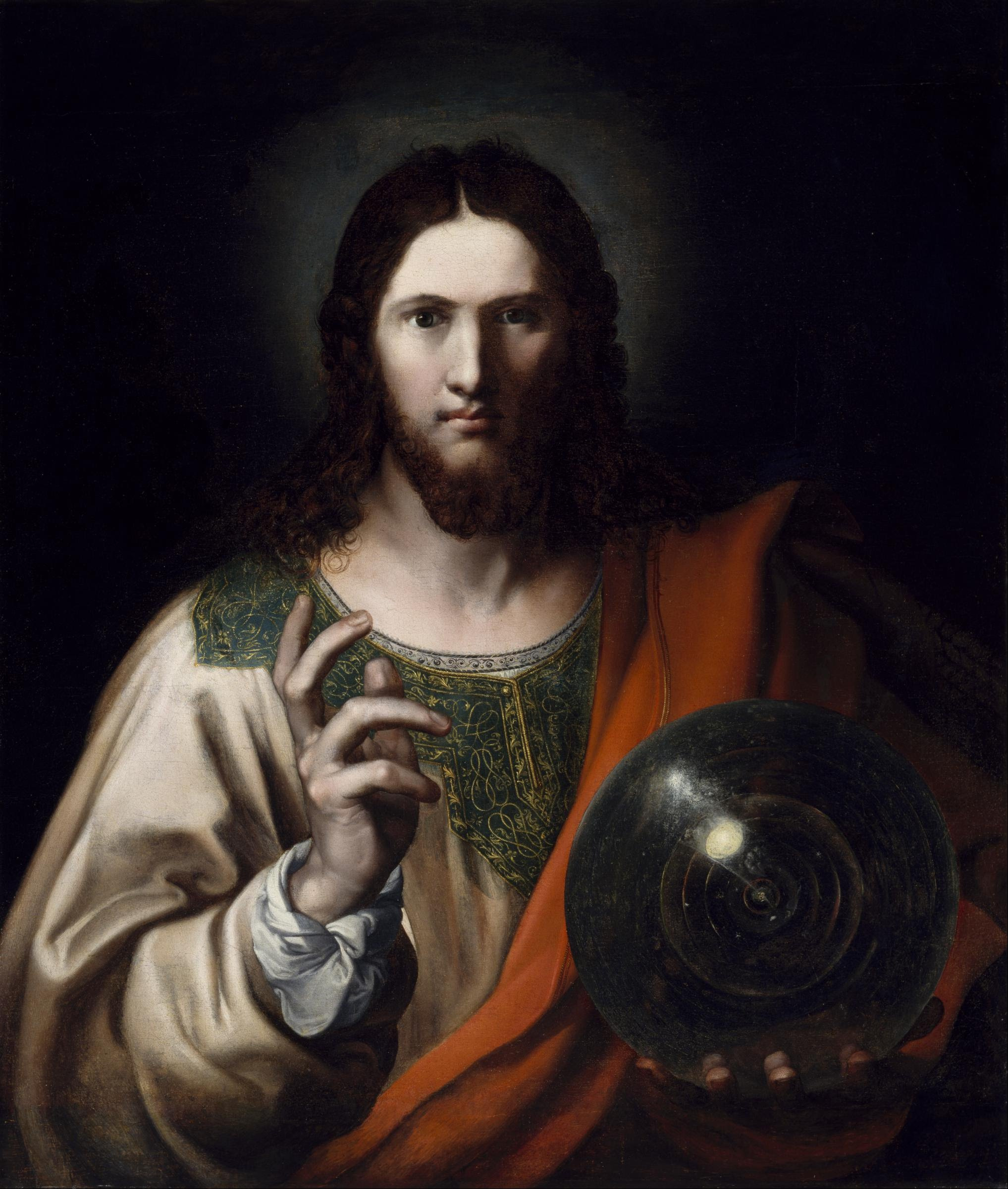
I ask after looking at this painting of Jesus as the Salvator Mundi, which is defined by his right hand’s gesture and left hand’s orb. The hand gesture looks similar to a mudra. Is this a real connection, or just a coincidence?
In this case, the specific connection seems unlikely to me, at least as a conscious point of cross-cultural reference. The Salvator Mundi motif predated this specific painting -- earlier instances of the motif with hand gesture exist, like one attributed to Leonardo in 1500, or Dürer's 1505 rendition. In both of these you can see a somewhat more traditional depiction of Jesus' gesturing hand -- first two fingers straight, last two fingers curled, with the thumb sometimes touching the fingertips of the curled fingers and sometimes not. Earlier images of Jesus, such as this sixth-century Byzantine Christ Pantokrator, or this eleventh-century Italian Jesus, or this twelfth-century Jesus from the Aberdeen Bestiary also have this two-fingered blessing gesture, and the presence of two-fingered Jesus gestures (along with some others) is pretty much continual through Western European medieval Christian artwork. These gestures were codified as gestures of Christian blessing by their use in religious art as well as their use in liturgy, probably a self-reinforcing pairing.
The use of hands in ritual gesture for both Christianity and Buddhism strike me more likely as unconnected parallel developments that in both faith traditions lend themselves well to depiction in artwork. However, in other areas where Christianity and Buddhism came into contact during the Early Modern period, traditions of religious art from both faiths did indeed cross -- either conscious cross-pollination of motifs and styles by artists and individuals commissioning artwork, or the more esoteric blending of the two for purposes of secret worship in areas where one or the other faith was discouraged or banned. This blossoming of Christian-Buddhist contact is not quite contemporary for the height of the Salvator Mundi genre's popularity, however, and given that the specific hand gesture predates the Salvator Mundi genre, any link would be tenuous. Earlier than this, there was a strain of Greco-Buddhist art where other artistic motifs, Buddhist and Hellenic, were blended beginning with the conquest of Alexander; there was also brief mutual awareness between Christianity and Buddhism in the days of the early Christian church, but this awareness dropped off rapidly outside of communities like the St. Thomas Christians and did not extend into Western Europe during the Middle Ages. If the visual language of gesture in early and later Christian art can be said to have a link to Buddhist iconography, rather than just overlapping in certain areas, it would have to date back far into antiquity and have been transmitted into the medieval church via the visual traditions of the early church, rather than directly from contemporary Buddhist influencers in Asia and India. That idea -- the spiritually significant hand gesture -- would have to be the one aspect of contact with Buddhism that was retained from antiquity, and not anything else.