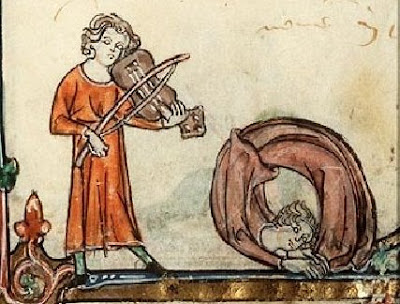
I've heard tell of the dark and scatological sense of humour that people seemed to have in the Middle Ages, evidenced by folk tales, sermons and exempla. But I am having trouble finding literature on the subject. So, what sorts of stories or jokes were sure to provoke laughter from the people of Late Medieval Europe?
This is perhaps a more complex question than it might first seem. The vast majority of comic material from the Middle Ages is found in literary sources, which produces a sort of inherent selection bias toward certain kinds of humour intended for certain kinds of people. Medieval literary sources almost always record the tastes of people who had (at least!) the benefits of a basic education and a secure income, and who lived in an urban centre or had easy access to one. Literary sources offer us no guarantee on the mass appeal of a particular piece of humour.
The other problem with literary sources is that they are inevitably stylised. Authors never just “tell jokes”. They tell stories with narrative arcs, make moral and rhetorical points, play into or against cultural conventions and expectations. Sometimes this makes it hard to know whether something is even meant to be funny, particularly if the author doesn’t model a reaction for their reader. Literary humour almost always isn’t just meant to be funny, and that circumstance may condition the ways in which it finds articulation. Literary jokes come with additional intentions, and we have to treat them with care and no little suspicion. This goes for visual artworks too. Are the sometimes sexual, scatological and irreverent images rendered in the margins of medieval books meant to be funny at all, or only funny? (This is one of questions worked toward by Michael Camille’s much-lauded Image on the Edge.)
By contrast, moments of organic and off-the-cuff humour are rare, disjointed and often hard to fit into any kind of general historical narrative. But their meanings are no less opaque. Not every doodle in a medieval manuscript is constructed with artful craft by illuminators and scribes, but that doesn’t necessarily make them easier to read. Are we looking at deliberate comedy, inexpert products of idle boredom, or rebellious acts of defacement of expensive books? We might treat graffiti the same way. What about utterance? When Robert Staffertone invited a London alderman to ‘kiss his rearward’ in 1388 or William Foucher referred to the previous lord mayor Nicholas Wotton as ‘Nicholas Wytteles’ (witless) in 1418, were they making merry or voicing genuine political anger? They both faced prosecution either way. Did the fifteenth-century scribe who wrote kys my ars sir Rafe (Kiss my arse, Sir Rafe!) at the top of a page do so in jest or in anger – and did they ever intend it to be seen by Sir Rafe? While we’re on scribbled notes, I was once shown a photo of a manuscript (although regrettably I don’t know its shelfmark) in which someone had written something like ‘turn the leef’ (turn the page) on one side and ‘fole thou lokest’ (made you look, fool!) on the reverse. The writer seems to have found that one funny – but did anyone else!? We have to resist the urge to find such instances funny just because they strike us as novel or incongruous and instead consider them carefully on their own terms.
But presumably you didn’t come here to hear me agonise about presentism. You came here for a good laugh! So, let’s get down to it. It’s certainly true that surprisingly (or not?) sexual, scatological, violent humour is well attested in literary works throughout the later Middle Ages in Europe. In fabliaux and more generically amorphous short tales (such as those in the Canterbury Tales and the Decameron), in beast fables and epics, in clerical and estates satire and in certain kinds of court poetry one finds humorous stories of all kinds. (Note that these forms/genres often interpenetrate and overlap.)
To try to account for all this material would be tedious and quite frankly beyond the limits of this post, but here’s a sweeping survey of the sort of things one can expect to find in the literary canon. The lupine anti-hero of the Latin Ysengrimus (c.1148, Ghent) has his greed repaid by being variously cheated, beaten, flayed and finally devoured by sixty-six pigs. Marie de France includes among her Anglo-Norman Fables (1160x1190) the story of a peasant who has a beetle crawl up his bottom while he sleeps lazily in the fields, and who convinces all and sundry (on the advice of a quack doctor) that he is pregnant. The French Romance of Eustace the Monk (1223x1235) chronicles the picaresque escapades of an outlaw-monk-wizard-pirate who variously swindles and outwits his nemesis the Count of Boulogne. The thirteenth-century French/Anglo-Norman fabliau and parody romance Le chevaler qui fist les cons parler (The Knight Who Could Make Cunts Speak) goes exactly as one might imagine. Boccaccio’s Italian Decameron (c.1353) includes a great many comic tales; the very first in the collection is of a wicked nobleman who deceives a friar with a cunning confession and is honoured as a saint after his death. Chaucer likewise includes several comic stories in the Canterbury Tales (1387x1400), most famously the Miller’s Tale; a husband is deceived, an affair committed, one bottom is kissed and another is scalded with a branding iron. Two fifteenth-century Scottish poets, Robert Henryson and William Dunbar, also wrote comic verse. Henryson’s fable The Wolf and the Wether features an uppity ram who pretends to be a sheepdog until the day an actual wolf appears; he defeats it through a fear-induced diarrhoeal torrent. Among Dunbar’s glut of bawdy verse is his Flyting of Dunbar and Kennedy, a blisteringly filthy poetic slanging match.
Edit: I had a feeling I'd slightly mis-remembered the Henryson – and I had! It is the wolf who suffers the explosive diarrhoea, as he flees the ram dressed in a sheepdog's skin.
Trying to compare such a long and varied tradition of humorous literature won’t necessarily get one anywhere productive, but a couple of trends stand out. Perhaps the most obvious is the punishment of hypocrisy. This is a trope that plays into some of the literary influences on humour that I mentioned at the start of this post; it makes for a neat narrative arc and it facilitates all sorts of moral, political and rhetorical point-scoring. Jill Mann has discussed how a great deal of medieval beast literature operates on the idea of luditor illusor, the topsy-turvy world of the deceiver deceived. Almost all clerical satire is about bad clerics punished for their sinfulness and luxury; think of the thousands of friars whose mendicant greed damns them to inhabit the rectum of Satan in Chaucer’s Summoner’s Prologue, or the single money-hungry friar who reaches into a peasant’s breeches for silver in the Summoner’s Tale but finds only a fart. The narrative neatness of fabliaux often depends on the meting out of some sort of justice. Possessive spouses get cheated on; cheating spouses get found out. The rich are brought low; the poor are made ridiculous. So it goes.
It’s worth noting here that while there is a good deal of punching-up in medieval comic literature (particular where the clergy is concerned) there’s no small amount of punching-down. Women in comic tales, whether they are the protagonists or not, are almost inevitably guilty of some kind of sexual promiscuity. The stereotypical poor of satirical literature desire to rise above their station and are punished for it; although Marie de France thinks poorly of the abuse of power by the rich, for instance, she consistently portrays peasants as almost mindlessly buffoonish and unable to take any responsibility for themselves. Rape and other forms of sexual violence (chiefly, although not exclusively, perpetrated against women) is often trivialised in comic narrative. In perhaps the most unsettling tale in the whole Decameron (Day 3, Story 6), Catella is deceived into having sex with Ricciardo disguised as her husband, is then blackmailed into continuing to do so, and eventually does fall in love with him. One of Eustace the Monk’s adventures involves seducing the Count’s servant in the guise of a prostitute, luring him into a ditch, then unveiling himself and threatening to go through with the act unless the servant gives him the Count’s best horse.
These various sources of humour, all of which can seem unsettling to us (and often hard to reconcile with the fact that writers like Chaucer are elsewhere more sympathetic to victims of the abuse of power), often owe something to the inherent privileges associated with a comedy that is not just literary but literate. The medieval written record belonged to the powerful, and this sometimes seems to predispose “humorous” narratives toward forms that would probably not have been palatable or funny to those that they ridiculed. This doesn’t mean that we don’t sometimes see people laughing at themselves (it’s been posited that the soldiers who make a botched job of putting together the cross in the York Crucifixion Play might have been played by local carpenters or other craftsmen, for instance), but this fits into a larger and not always wholesome tradition of comic literature. My apologies if that’s a slightly dark note on which to end, but I hope I’ve put in enough context there to justify the discussion.
Drat, I've just slightly overrun. Continued below.
Check out these threads on Medieval humour and what they found fun/funny. The first one will probably interest you the most:
Medieval Jesters - What kind of jokes did they tell? by /u/texpeare
Why are there so many medieval paintings of people battling large snails? by /u/sunagainstgold
What did people do for fun in their free time in the medieval ages? by /u/Whoosier