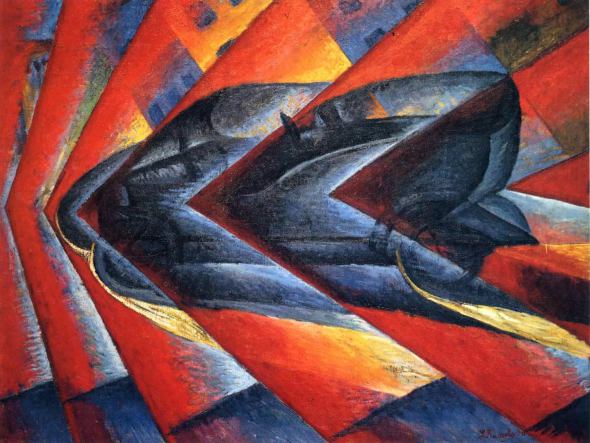
These two groups seem to often be mentioned briefly in connection with Spanish and Italian Fascism. But apart from the Carlists being some kind of royalist faction and the Futurists some kind of artistic movement, their identity and role never seem very clear.
I have posted on the Italian futurists during one of the "friday free for all" features. Since my post seems to address your exact question, I'll repost here, but it is essentially the same.
On February 11^th 1918 a “Manifesto of the Italian Futurist Party” was published. The header said only “MARINETTI”, from Filippo Tommaso Marinetti, poet, playwright, publicist, war veteran, interventionist and possibly anything else; as was to be expected for the founding father of the futurist movement. Marinetti had put the program together with the help of two of his closest – at the time – and more “political” collaborators: Mario Carli and Emilio Settimelli.
Nine years earlier – on February 20^th 1909 – Marinetti had created his artistic movement, futurism: a very Italian, but also international movement, as the publication of the futurist manifesto in “Le Figaro” in Paris clearly showed. A fact that mirrored Marinetti's formation and education; a man born in Alexandria where he had spent his youth, educated between Italy and France, passionate about both Italy and modernity – two things that at the beginning of the XX Century did not often go hand in hand.
He had soon met with a following among Italian artists; notably Umberto Boccioni, Carlo Carrà, Luigi Russolo and Gino Severini – and Giacomo Balla who isn't in the picture.
Around the core platform of the manifesto, they built an articulate artistic machine: literature, painting, sculpture, architecture but also what we may describe as performance art (a “futurist night” typically involved poetry reading, book publishing, paintings display and some outrageous, extreme manifestation by the futurists themselves – the futurists notoriously brought their claques not to applaud but to hoot their performances and often joined the crowd disapproval – with a bit of a scuffle in the end, for good measure). Without going into many details on the artistic movement itself, since the following will focus mostly on the political side of futurism, a few things should be kept in mind.
Futurism was a movement that not only looked forward to the future, as the name suggests, but refused and actively opposed any glorification or even consideration of the past, bringing the XIX Century anti academia polemics to the extreme.
“Future” was to them everything new, even things we may find at odds with our artistic sensibility: industrial production, machines, the might of the masses, new political theories as long as they felt radical and anti-traditional and allowed room for display of artistic individuality (thus the futurists sympathetic approach to anarchism and their hatred for the drab homogeneous official socialism). The key objects of their fascination were movement, speed, dynamism; that of a flag, a running mob, a car, a train, a plane, a projectile.
New meant a chance of renovation, brought about by the belief that the immense irrational forces of the new century were going to sweep away everything on their path like an unconstrained tide. Thus humanity was going to break away from its past: new cities for the new futurist man to inhabit; new words for the futurist poet to write; new subjects for the futurist painter to draw, and so on.
Destruction and creation were two sides of the same coin: the futurist art was a violent creation, of a men caught in a constant struggle with himself, forcing oneself into and onto the future. From this, their love of anything that was abrupt, strong, decisive, violent, an act of (irrational) will.
Due to their own personalities and artistic choices, the futurists had to be a minority, an avantgarde, often opposed and ridiculed by the masses and the establishment^1 – something they frequently sought to deliberately. They had no ambition to fit in, to be well liked or praised but aspired to be the ones “standing on the most extreme peak of the centuries” looking at the unrestrained world of tomorrow, awaiting for the tide to ride into the future.
War came to them as this much awaited tide.
And their reaction was immediate.
The conflictual nature of this fight for the future had been a core theme of the national radicalism since the beginning of the century, as Italian sociologist and nationalist Mario Morasso had explained in 1905: The XIX Century had been the century of a democratic-humanitarian utopia, the XX Century would be the century of might and conquest. Woes to those who weren't to prove themselves strong; individuals, social classes and peoples were going to be irresistibly swept away by the new and terrible currents of energy that would compete for mastery of life and world [in a] universal expansion of struggle, of violence, of conquest […] It was the struggle for the dominion of the world; that spring that would excite [to fight] the most advanced of human civilizations […] The century of might had begun.
Morasso's positive take on this “dark lord-ish” scenario was based on a rational-scientific approach to the irrational. What he described was in his mind, a necessary consequence of the unfathomable energies developed in the industrial age, energies that had shaken first and then destroyed the thousand years old balance of the world […] not only on an economic ground but also on a political and moral one, breaking entirely with uses and traditions that had appeared immutable before.
If the nationalists focused progressively more and more on the “technical”, social and political consequences of the new industrial production forces (so that their renovation became a renovation of the state and then the individual, as citizen), the futurists attention was drawn more to the individual, whose fight – both heroic and tragic – appeared almost Promethean in nature, but of a joyous, violent, sacrifice. Their renovation was one of the spirit – evolving almost in an anti-state direction, opposed to that of the nationalists like Rocco^2 .
The futurists had already been on the interventionist side at the time of the Libyan War of 1911-12; in their proclamation for the war the futurists had explained that “men had to be allowed any freedom except that of being cowards; that the word Italy ruled above the word Liberty; that the memory of the great past of Rome had to be destroyed by a present one hundred times greater”. The exaltation of (future) Italy remained a central theme of political futurism and, if the Italian primacy had taken in the past a federative accent with Italy looking for its place among the European nations – the futurist view mirrored the nationalist adversarial concept, where Italy had to fight for its place against the other European nations. Only through a “ten years long blood shower” could the peoples get accustomed to the new era.
The futurist sympathy for war was obvious: war was both destruction and creation, violent unleashing of the most powerful forces of modernity, clash of nations, of peoples, movement of innumerable masses and arena for individual glory. War would break with the past. According to Boccioni “One had to be brave enough to destroy and smash even those things one held dear out of habit. […] One needed to take side, to let passions burn, to push one's faith to the extreme, for that future glory that every Italian worth his name felt deep inside but wanted [for now] too feebly. […] There had to be blood, there had to be dead. The Italian Risorgimento had been done tiptoes, like good mannered people would, with too little blood.”
Blood was a necessary sacrifice to get rid of the past; as Giovanni Papini in his distinctive excessive style remarked, “life wasn't sacred […] industrial civilization, like warlike civilization, fed on carrion: cannon fodder and machine fodder.”