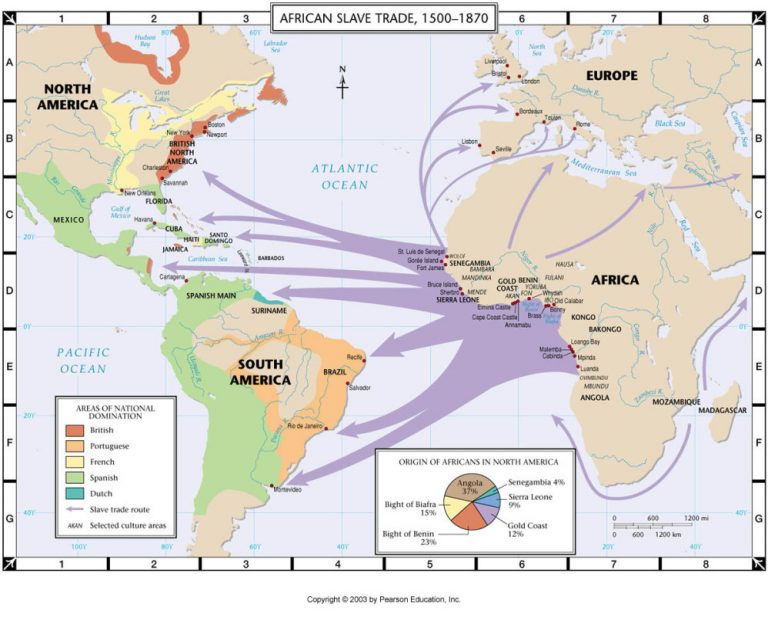
By the 17th and 18th Century, European powers established a series of forts along the West African coast that functioned as relay stations for ships to dock and purchase slaves from Native African slave traders, or otherwise used as midway points to journey upstream and barter further inland. By the 18th Century Native African traders were so accustomed to this that they demanded large quantities of goods such as textiles, weapons, tobacco, and alcohol in exchange for the slaves they sold.^[1] But which African societies were doing the capturing and selling?
I'm aware that slavery in West Africa has a considerable history prior to the arrival of Europeans slavers, although more through cast systems and debt bondage rather than the mass-scale chattel slavery of the Americas. Correct me if I'm wrong here, but weren't most of the slave-based societies in West Africa the larger Muslim states - Songhai, Mali, and Ghana? I've also read statements that in the later Sokoto Caliphate of the 19th Century, 40-50% of the population could be considered enslaved, although that's clearly influenced by the economics of centuries of the slave trade prior to then and not representative of the earlier Muslim states.
While voodoo folkways can still be seen in the Americas after the African diaspora in places like Louisiana, Haiti, and Brazil, Islam has little presence as far as I'm aware. This author estimates that around 20% of the slaves transported to the Americas were Muslim. Although not negligible, that's still rather small. If the slave-societies of contemporary West Africa were primarily the Islamic states, then shouldn't the majority of slaves sold to Europeans also be Muslim?
But I'm trying to read the power dynamics of this situation. Weren't the slaves sold to Europeans mostly captured immediately prior to their enslavement? A slaver probably wouldn't want to easily part with the slaves he's had for years. And the Islamic states were powerful - they had iron weapons and armor, domesticated horses and camels, and large organized militaries. The conclusion I'm reaching, tentatively, which is why I'm asking /r/askhistorians - were the West African Muslims the ones doing the capturing and selling, while smaller non-Muslim folk societies the victims?
Ok, so there are a few assumptions or oversimplifications in there that are leading you to false conclusions.
If the slave-societies of contemporary West Africa were primarily the Islamic states, then shouldn't the majority of slaves sold to Europeans also be Muslim?
There were lots of Islamic states in the larger region of West Africa, but Islam was not present in every corner of West Africa. This map gives a decent idea of which regions had large muslim populations. You'll notice that there is a stretch along the coast of West Africa that remains outside of Islam.
A second map now gives an indication of the regions where the majority of enslaved persons were being taken from. You will notice that the trade is strongly tied to the coast, where it was easy for ships to access. Yes, there are some forts in areas like Senegambia and Sierra Leone which were on the coast adjacent to Muslim populations, but the majority of enslaved persons came from that coastal area in what is now southern Ghana, Benin, and Nigeria, as well as Angola in central Africa.
And the Islamic states were powerful - they had iron weapons and armor, domesticated horses and camels, and large organized militaries. The conclusion I'm reaching, tentatively, which is why I'm asking /r/askhistorians - were the West African Muslims the ones doing the capturing and selling, while smaller non-Muslim folk societies the victims?
So, I'll give you one more map. This one is depicting states in West Africa in the 1830s, so after the slave trade is outlawed by Great Britain and the US. However, it will serve for our purposes.
Many of these states listed are Islamic states, like Futa Jallon and Futa Tooro, Masina, Segu, Sokoto and Bornu. However, only Futa Jallon and Futa Tooro and Khasso are states very near the coast, within easy range to interact with European ships. Also, these inland kingdoms already had Trans-Saharan trade networks established with Morocco and the rest of North Africa, or with the Sennar sultanate in what is now Sudan. So, while there was enslavement and slave trading going on in Islamic west Africa, it was oriented to interact with the wider Islamic world rather than the Atlantic.
On the other hand, look at that southern coastal region again. States like the Asante empire, Dahomey and Benin were all non-Muslim societies deeply involved in the slave trade.
You are sort of right that centralized, militarized states preyed on their weaker neighbors, but in Atlantic West Africa and Central Africa, those states tended not to be Islamic, and the enslaved persons tended to be non-Muslims, though there is plenty of evidence that Muslims did end up enslaved and brought to the Americas.
Edit- Also, I should make clear that in Islam, there historically were limitations on who could be enslaved. These limitations were subject to some debate among Muslim scholars, but one of the most durable limitations was that Muslims could not be enslaved, though non-Muslims who were enslaved and then converted were not automatically expected to be freed.
So, although states like Futa Jallon and Futa Tooro were logistically close enough to trade with French and British forts in Senegambia, there would be strong customary reasons for those states not to enslave Muslims and send them into slavery of Europeans. Particularly because Futa Jallon, Futa Tooro and the Sokoto caliphate were so-called "jihad states" that came about in the early 18th century (FJ and FT) and late 18th century (Sokoto), out of revivalist and reformist Islamist tendencies of Fulani populations in West Africa.