I'm wondering if any of the kingdoms and nations that filled the void left by the collapsing Western Roman Empire utilised the same tactics, armour or general style of the Roman Army.
1/2
I know this isn't really part of your question but I see this type of narrative a lot: there wasn't a void left by the Roman Empire. To start, the Roman Empire (henceforth RE) lost lots of territory in the fourth and fifth centuries AD, but the Eastern half of the Empire went to live on for another thousands years. The notion that the RE, declined and crumbled into ruin or vanished into a puff of smoke doesn't hold much weight. While there are hundreds, if not thousands, of theories for why the RE collapsed, the fact of the matter is that several strong and promising kingdoms waxed while the Western half of the RE waned. One of the more popular views in the historical community today is a narrative of continuity and transition between and Roman world, and the world of the these successor kingdoms who carried on Rome's legacy in a variety of ways.
To give a few examples of the state of the Empire just before the death of Constantine in 337 AD: the currency is stabilized by the creation of the solidus after being wracked by inflation; administrative reforms under Diocletian have broken up large provinces likely to rebel; a new, considerably more defensible capital in Constantinople is established; treaties (foedera) are used as a method of enlisting soldiers (federati) to supplement an army depleted by civil war and poor recruitment;. At this point the empire is in good shape, unified under one Emperor and not confronted with large scale foreign or domestic conflicts. While nowhere near the heights of the 2nd century, the empire is relatively stable and stronger than any of it's immediate neighbors. Few would have guessed that in 73 years the eternal city, Rome, would be sacked and the Empire would be on the verge of collapse. It is a tribute to the strength, competence, and good leadership that the many peoples who migrated west in the fourth and fifth centuries AD were able to overcome and defeat this strong adversary. They didn't just happen to find themselves walking through the ruins of a fallen empire in the void of western Europe.
The Visigoths and Ostrogoths are two examples of Germanic peoples came into contact with a strong and inimidating Roman Empire. Initially, both people came to the RE pleading for help and land to settle. For a variety of circumstances too complex to cover here, the Visigoths were at some points at war with the Empire, and sometimes fighting on its behalf. For the purposes of this answer, what is important is the end result, the Visigoths settled in southern Gaul by the Emperor Honorius in return for military service. They created a vibrant kingdom, with its own written law code, and largely adopted the culture of those they ruled, including converting to Christianity. They also stayed loyal to Rome during this period, and even defeated the Sueves in Spain at the request of the Roman Emperor around 455-456 AD. Again I want to stress that the Visigoths didn't move through an empty ruin and settle down in a part of it. They bled fighting for the RE and also bled fighting against it. Their story is much more complex than simply settling in a power vacuum.
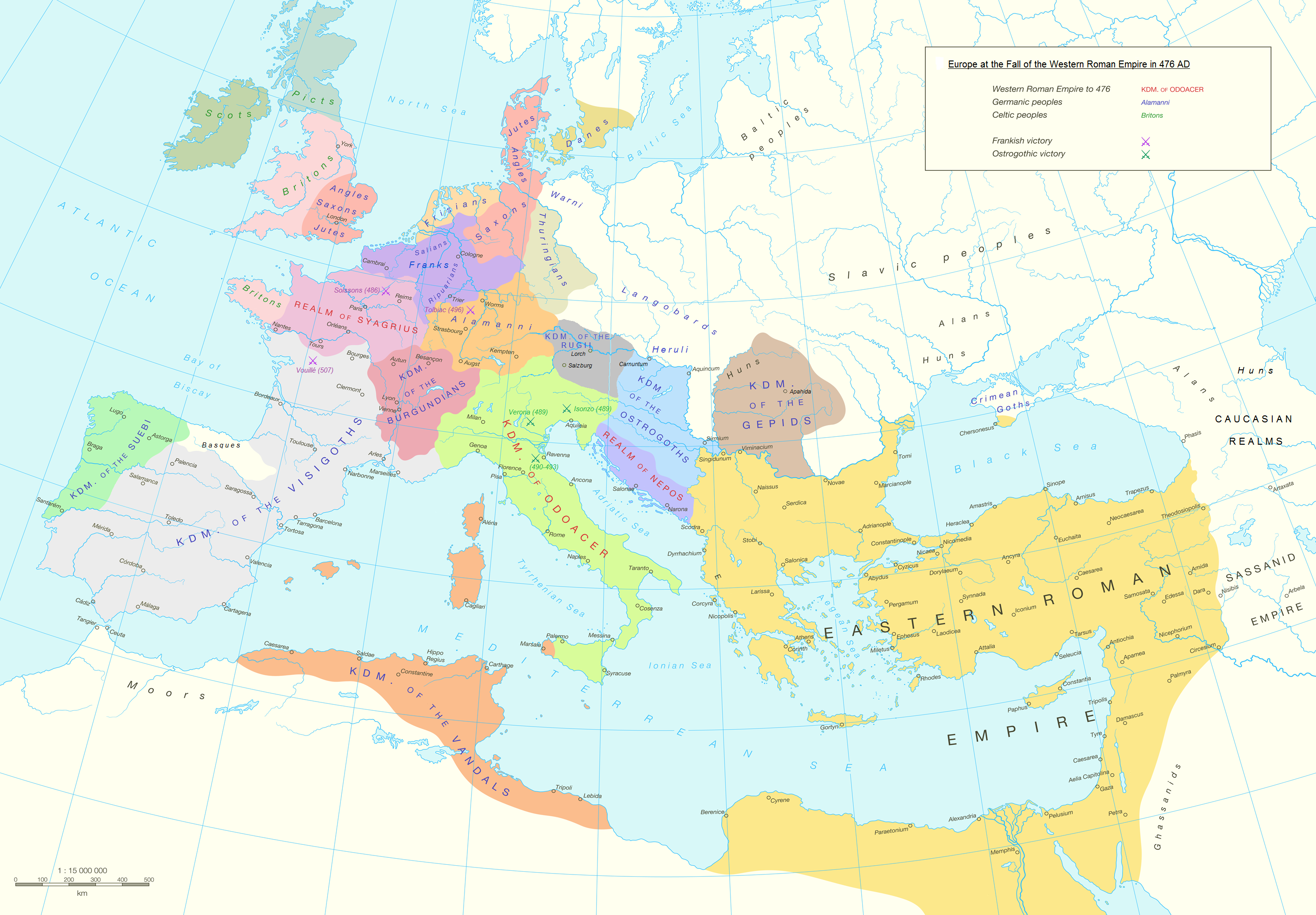
I would not advise taking maps of this time period too seriously but here's rough outline of the players involved when Romulus Augustulus is deposed as the last Western Roman Emperor in 476 AD.
Now we can see a clearer picture of western Europe, there is no power vacuum, but instead a collection of several strong (and several less strong), independent kingdoms. These kingdoms have provided stability and protection to territory previously under constant attack and uncertainty. To take this a step further, a large amount of effort over the last ~50 years has gone into studying the ways these kingdoms continued and evolved from the Roman tradition, rather than broke from it.
Now that we've got that out of the way, I can get back to your question. The history of Rome's military is long and complex, to have any chance of answering it I'll need to set a few points straight and make a few assumptions on what you're trying to get at. Trying to sum up the "tactics, armour or general style of the Roman Army" could mean a huge variety of things. From the hoplite and Triplex Acies (three lined battle formation) styles of Republican Rome, to the stereotyped Lorica Segmentata wearing, gladius hispaniensis wielding Legionaries of the Marian and Imperial periods, and on to the Germanic Foederati in the late imperial period, or even the kataphraktoi and Thematic soldiers that characterized the medieval Roman State.
I'm going to make an assumption that you're referring to the most common stereotype of the Imperial Roman Soldier of the late first century and early second century AD, made famous in part by their representation on Trajan's Column in Rome. These soldiers were armed with Iron helmets of the Imperial-Italic type; a cuirass made of laminations or iron (Lorica Segmentata); a short, stabbing sword, the Gladius Hispaniensis; a square but cylindrical shield, or scutum, and two pila or javelins. These soldiers were recruited into legions with a structure as follows. Legions of the imperial period were comprised of roughly 5,500 men at paper strength. Legions were generally led by a Legate and usually had a least six Tribunes reporting directly to him. The Legate may have also had several Prefects under their command as general aides or potentially as cavalry (prafectus equitum) or fleet (praefectus classis) commanders. During the later Empire, the Prefects sometimes led smaller Legions of ~1,000 soldiers. Under the Tribunes were roughly 60 Centurions, each in command of a century of about 80 men. The exception is for Centurions of the first cohort, who had centuries of 160 men. There were a multitude of other, non-command roles within the legion at this time but I simply don't have the time to go over them.
The legionaries of this time were equipped homogeneously as heavy infantry, relying on allies and auxilia for other battlefield roles. In battle, the legions were lined up in anywhere from one to four battle lines generally taking an aggressive approach to begin an engagement with enemy forces. The legions relied on their heavy infantry for the core of any tactical plan, with allies and auxilia playing a supplementary role. Once the battle lines met, the Romans relied on their superior resolve to stay in the fight while their superior flexibility and small unit tactics found opportunities to exploit. A few classic examples of the strength of the Roman system come from a slightly earlier period in Roman history: the battles of Cynoscephalae and Pydna in the second century BC. These examples showcase the Roman's system's ability to exploit opportunities at the century, and cohort level, without the need for the general to give explicit commands. While these battles predate the Imperial period, the tactical approach was used throughout. However, we must be very careful, Roman armies in the late Republican and Imperial periods fought in a wide variety of ways, trying to generalize the system in a few sentences really does not do us any favors and it is important to consider the context of the battles where these tactics were utilized.
Moving forward a few hundred years to the fourth and fifth centuries AD, the Roman army has undergone significant changes. Almost constant civil war combined with rampant inflation for almost the entire third century put the Empire into dire straits. Inflation rendered soldier's salaries worthless and constant battles, particularly between Roman armies, caused a critical manpower shortage, forcing Emperors to use forced conscription to fill the ranks. During the third century we also see a distinct scarcity of archaeological finds for Roman helmets and body armor. This could indicate the Roman State could not keep up with the pace of casualties, forcing new recruits into battle with little more than sword and shield. Forced conscription, coupled with poor pay and loss of experience through high casualty rates led to a gradual decline of the Roman Army's effectiveness in the late empire. While the army of the late Empire was still capable, (see the campaigns of Diocletian, Constantine, Julian) it was a not as effective as it had been in days past.
Once the large Germanic movements of the late fourth and fifth centuries began, the Roman army was not in a great position to deal with the threat. With state finances in a fragile state, equipment and pay suffered, the meat-grinder of the third century cost the legions most of their built up experience that was not able to be passed down to future generations, and finally, the new threat of Germanic tribes penetrating deep into Roman territory in many places at once left the Roman military establishment with an unprecedented task. The Legions of the late Republic and Empire were adept at fighting decisive, pitched battles, then forcing their opponents into highly favorably treaties with the Romans. The Germanic peoples coming over the Rhine and Danube frontiers were numerous, but fractured. Victory in one battle did not mean the end of the conflict but only many small engagements yet to be fought. Eventually the Germanic peoples were able to make their way deep into unprotected Roman territory, and pick the empire apart piece by piece. This is all a very long-winded to say the Germanic peoples that eventually picked apart the Western Roman Empire had no need to learn from the Romans they were defeating. In fact, ever the pragmatists, most Roman military literature from the late antique and medieval periods points to foreign (including Gothic) equipment and a few foreign tactics as favorable and something to be adopted, rather than the other way around.