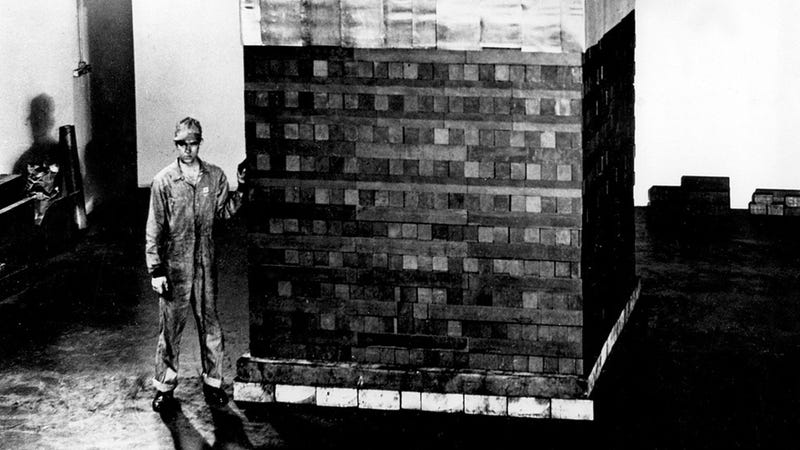
Studying on nuclear reactors, I see that they are quite dangerous to contain in such a way that they don't melt down. Back in the early days of the Manhattan Project, how did they go about making the first reactors, and what problems/incidents did they encounter?
Same question can apply to the Soviet program shortly afterwards as well, if relevant.
The first experimental reactors were quite crude — they were called "piles" for a reason, for they were structurally pretty simple, just layers of graphite bricks with uranium in them. The scientific approach was to both develop small models (like the photo linked) that would give some indication of the nuclear properties without going critical. They could use that to refine their understanding of these properties, and see how their new theories matched up with the data they got from subsequently larger piles. The first nuclear reactor, Chicago Pile-1 (which I wrote about not too long ago), was a very crude thing, but the result of several thousand scientists' work for several years. It was manually controlled, had only rudimentary safety checks, and frankly was pretty dangerous by modern-day standards. The only reason it was done this way is because this was part of what was then perceived to be a race against the Germans to develop nuclear weapons, and so corners were cut in the name of expediency.
The work on these first, early "piles" was then used to build the world's first industrial-sized nuclear reactors at the Hanford Site. These were considerably larger but based on the same basic ideas: graphite lattices with metallic uranium fuel. The difference is that these reactors would take much large fuel loads and generate much more energy, and they would have their fuel cycled through them very frequently so as to breed as much plutonium (for weapons use) as possible.
As for problems and incidents: they were dealing with new technology. They went from concept (1939) to prototype (1942) to industrial operation (1944) in what is practically no time at all, from a technological standpoint. (Usually such things take on order of the decade.) That meant they were still researching the bigger reactors as they were assembling them.
There are several famous issues they had with them. For example, they discovered a phenomena known as reactor "poisoning," where a product of atom splitting (fission products, specifically an isotope of xenon) turned out to absorb neutrons and slow the reaction down, and that for awhile caused them a lot of grief. It turned out they had added enough capacity in the reactor fuel load that they could sort of over-stuff it with fuel, and that overcame the poisoning effect.
They found, after the war ended, that there were significant unanticipated structural problems caused by neutron exposure to the reactor apparatus itself, and that caused them to operate the reactors at half-power in the immediate postwar, until they found better ways of running them. There were other fears about dangers as well (they were very afraid that continual exposure to neutrons and radiation would charge the physical lattice of the reactor with energy that could be explosively released); they studied these sorts of things, and suggested ways of avoiding problems, but all in the context of a program that was meant to keep them running as much as possible even with the uncertainties. The fact that it was a weapon-production program first, and a scientific research program second, is very notable and unusual compared to most new technologies.
They had all of the kinds of construction difficulties and even accidents (non-nuclear) that you'd expect from a large, fast construction project. They also were very hasty about storing the nuclear waste, anticipating (incorrectly) that some later group of people would make sure to dig it all up and do it right (for this reason, Hanford is one of the most radiologically contaminated sites in the United States).
For the Soviet case, it is all of the above, plus a little better understanding going into it (because they had knowledge of what had worked for the Americans), plus perhaps a little less concern for things like health effects and pollution. The Soviet reactor site of Mayak is also heavily polluted and inhabitants nearby were exposed to much more radioactivity on account of accidents they had there.
If you want to dig into this, look at Kate Brown's book Plutopia, which is a comparative history of Hanford and Mayak, both from their early days through the Cold War and its end. It is great reading.