Context: I'm a weeaboo and a Fate/stay night franchise fan. This adorable piece of fanart of Arthur and Mordred (both female because Fate loves its genderswaps) was posted to the Fate/stay night subreddit. I love it, it's very cute, but the tiny Mordred wearing a tiny set of plate armor was really distracting. Why would Arthur commission a set of armor for what looks to be a 7 year old child when she's just gonna outgrow it in a year? Was this common, or even uncommon, among nobility in any era of European history?
Thanks for your time!
Armour was made for children in late medieval and early modern Europe. It was, as the kids say, totes adorbs You are absolutely right that it was expensive and impractical to make armour for kids that they would just outgrow later. They are not, as far as I can tell, the practical protection of someone who is expected to fight (very young men did fight in medieval battles, but not nine year old princes). Nor are they some kind of training equipment, as far as I can tell (since most people who would become knights did not have them). Nor are they toys. They are for display, to show that the heir to the throne (or the child king, even) is ready to adopt his fundamental duty defending his realm and upholding the honor and power of his country and his house. The transition from one king to the next was a chancy business, and it was important to establish continuity and ‘build up’ the crown prince when he was still a boy so that when his father died people would be willing to follow him. This symbolic roll of children’s armour is seen in the prominence of armour in the royal portraits of heirs in armour.
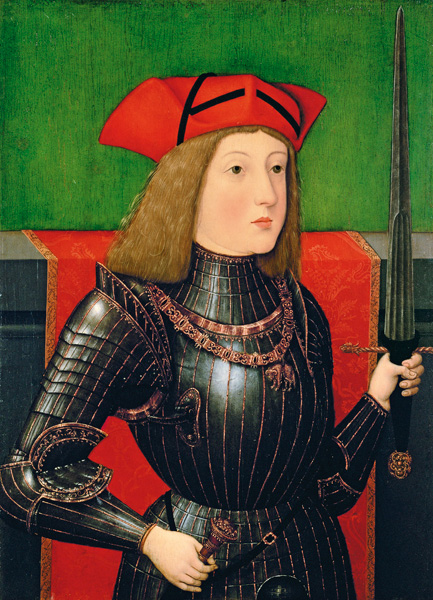
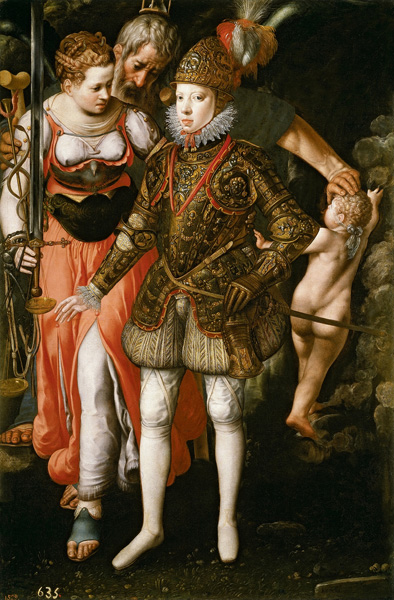
It is also worth reflecting on the circumstance of various one famous to see how armour and the symbolic legitimacy it conveyed could help a young claimant. For instance, before the young Charles V was Charles the V (or as I like to call him, Chuck V, master of Europe or sometimes, ‘Jawbone’) he was the son of a mad mother and a recently deceased father. One grandfather served as his mother’s regent while she was insane, while another was still in his native Austria trying to make sure his grandson inherited all the lands three generations of prudent marriages had bequeathed to him. It was then, with his father dead and the eight year old Charles heir to much of Europe (but not master of it yet) that he was painted in armour with a sword. His general posture is similar to a mature, reigning king, the armour and sword symbolizing his role as warrior-monarch, even before he stepped into it. The armour from this painting does not survive. But a number of other armours from his youth do survive - some of these were gifts of his grandfather, Maximilian I, who perhaps wanted to present his grandson as a fitting heir to the thrones of Castille and Aragon as well as the Burgundian Neatherlands and the Holy Roman Empire. Speaking of Royal portraits, 80 years later Charles’s grandson Phillip III was a young crown prince when he was shown in armour flanked by allegorical figures of Justice and Time, wearing a parade armour embossed with images of the warrior goddess Minerva and allegorical figures of Justice, Prudence, Fame and Victory. At the hands of mannerist painters and mannerist armourers, the subtext of the young prince’s armour becomes text.
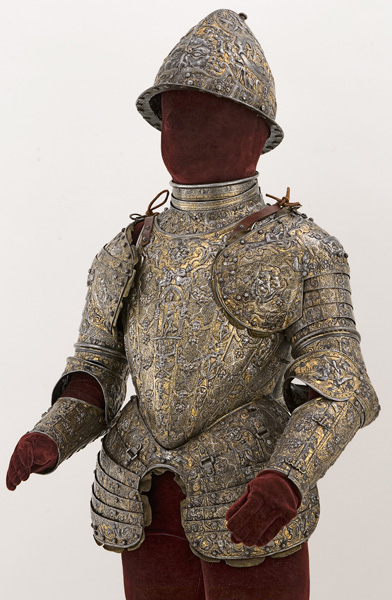
For the reasons cited above - expense, impracticality and their fundamentally symbolic purpose - most child’s armours that I am aware of are the armours of royalty, or perhaps the very upper nobility. These are people who already have new armours made for a single tournament or a single campaign, much as the very wealthy might have a new dress made for a single gala. For them, the expense was not an object compared with the cost of running a kingdom of fighting a war. Indeed, extravagances like armours for their 10 year olds were one way medieval and early modern monarchs showed their power and wealth - Philip II of Spain could afford to outfit his young son in a gilt, etched and damascened armour and he ought to show it.
Now that we’ve discussed the purpose of children’s armour, what is its history? The earliest surviving example that I am aware of is from the late 14th century, and probably belonged to the future King Charles VI of France when he was Dauphin. The surviving pieces of the armour includes a jupon for wearing over the armour, a leg harness, parts of an arm harness and abascinet. Judging by the size of the jupon, the armour was made for him when he was about 7 years old - the armour historian Claude Blair refers to it as a ‘little boys armour’. The leg harness retains a bit of the original gilt decoration, and the bascinet has the ghost of a crown wrapped around it. This decoration, and the silk damask covering the jupon, is in line with the sort that one would expect on a later 14th century royal war harness (if anything, it is rather restrained compared the gilt brass gauntlets of the Black Prince). Indeed, this armour takes the -form- of a war armour, unlike the 16th century examples cited above. This does not mean that it was seriously intended for war, just that in an era before parade armour no one thought to put the prince in a non-functional harness. It was important that he looked ready for war.
These ‘mock harnesses for the field’ are seen into the 15th and 16th century as well. For instance, this armour for a 10-year-old Philip I mirrors the style of the latest in armours from Innsbruck, and uses the best methods of heat treatment for hardening. I have read, though I have not confirmed, that while made of hardened steel this armour is very thin, since it is not meant for war. But in general the armours of children mirrored the armours of adults, since their ‘grown up’ look was part of their purpose as symbols (showing the child as being prepared to become a man). It is only when true parade armours are introduced in the 16th century that you also see parade armours for children - for instance the extravagant armours of young Charles V, or the embossed armour of Philip III, above. By contrast the armour that Charles V was painted in or the damascened and etched armour of Philip III both take the form of war harnesses (complete with a lance rest in the case of young Charles.
A particularly interesting child’s armour is this one from around 1550. It is a medium cavalry armour (without a lance rest/arrest for really heavy cavalry use) in the ‘anime’ form, where even the cuirass is made of many flexible lames. It may be the armour of King Edward VI, in which case it is the armour not of a prince but of a boy king - a young man who would particularly need to project power in every way he could.
To conclude, child’s armours were absolutely A Thing from at least the later 14th century (possibly earlier) to the end of the age of armour. They were showpieces to establish children as legitimate heirs to the military power of royalty, and as such they were never particularly common. But they’re adorable and awesome.
Sources and Resources
Claude Blair - European Armour c. 1066-1700
Edge and Paddock - Arms and Armour of the Medieval Knight
Matthias Goll - Iron Documents (unpublished phd thesis)
Allan Williams - The Knight and the Blast Furnace
The Art of Power - Armour and Portraits from Imperial Spain - National Gallery of Art (exhibition book and catolog) - see also their useful online gallery.
Tasha D Kelly - The Tailoring of the Pour point of King Charles VI of France Revealed - found here