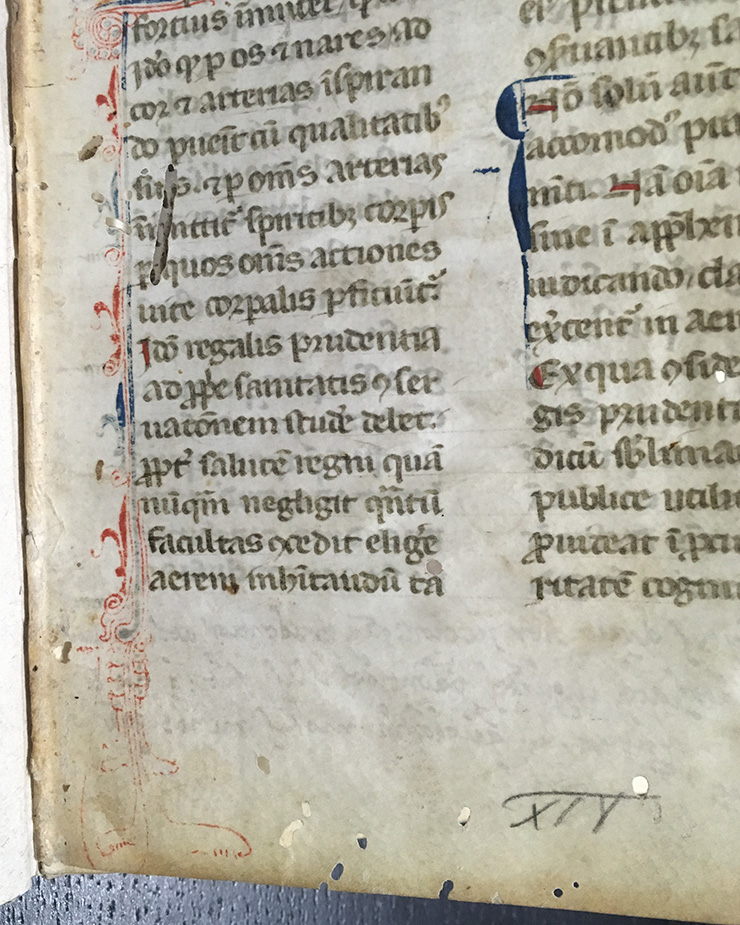
For example, the Lex Alamannorum - https://en.wikipedia.org/wiki/Lex_Alamannorum
Which mentions that there are copies dating to the 11th and 12th centuries. How do historians know when pieces are copied? Didn't they have to be copied constantly? Or was there a period when they finally figured out how to preserve them to prevent decay? If so, why not earlier?
Were their periods of interruption (for lack of a better term), when they were being preserved, but the area was sacked by barbarians (or whatever), and the texts were lost, only to be partially recopied later (maybe as a result of other copies that were partial to the original or most complete copy)?
Now this is my kind of question! Most of what I’m able to talk about applies to the European Middle Ages, but some of it has wider application elsewhere.
I’ll try to quickly answer some of your other questions by way of context before getting to the main issue of the dating of manuscripts. Yes, manuscripts were constantly recopied, for a number of different reasons. If there was more demand for a text than supply, manuscripts would be copied. If a text remained of practical use – like a chronicle, a calendar or a charter – long after its initial production then it might be recopied to spruce it up a bit. Antiquarianism comes into play too; we know from the work of individuals like the “Tremulous Hand of Worcester”, a thirteenth-century monk who glossed Anglo-Saxon manuscripts, that some people had an active interest in old books.
The fact is that although parchment is much sturdier than modern paper, it isn’t indestructible. If you get it wet, it will start to buckle and bend as it shrinks back to its pre-stretched size. (Just look at British Library Cotton MS Tiberius A. XII, which conservators have had to carefully slice in order to let the rumpled pages lie flat!) Bookworm damage tends to be more severe in later paper books but they’ll go for parchment too, as they did inside College of Physicians of Philadelphia MS 10a 210. Ink is a more surprising eater of books; if it’s poorly prepared, as in Balliol College MS 156, the acidity of iron gall ink will slowly dissolve the parchment beneath. All this is before you take into account ordinary wear and tear. We have precious few medieval bindings because the outsides of books take a lot of beating, and inevitably the first and last pages of books and even individual quires pick up dirt and wear in the course of being bound, damaged and rebound again. As a result, the manufacture of new manuscript copies was absolutely ubiquitous throughout the Middle Ages.
But how do we date these copies? How do we look at an eighth-century manuscript and a twelfth-century manuscript of the Lex Alamannorum, tell them apart, and assign specific dates to each?
The answer is deceptively simple. A significant minority of manuscripts from the whole sweep of the Middle Ages have dates written inside them. I’ve written a little in the past on some forged dates in manuscripts, but the majority can be trusted. There are also more arcane ways to date manuscripts. When scribes write titles and colophons (short sentences relating to the production of the book, usually at the end), for instance, they sometimes refer to a specific event or person which can be used to put a broad date to the book. Occasionally a little inference will provide such a date; the first quire of British Library Royal MS 18 D II, for example, contains illuminations of the silver boar and unicorn which were the arms of Henry Percy, fifth Earl of Northumberland, as well as his motto “ma comfort”. (In fact, the manuscript is full of corroborating Percy references, except for a text in the middle that was originally a separate, older, manuscript!)
It is what scholars have done with this minority of “hard-dated” manuscripts that is really important. By collecting them together, it is possible to identify patterns in book production that can be used to broadly date manuscripts that are not datable based on internal evidence. This is the rationale behind the four (so far!) Catalogues of Dated and Datable Manuscripts held in British libraries assembled by Andrew G. Watson and Pamela Robinson, and I gather there are similar endeavours for books held elsewhere. These catalogues amass data on all datable manuscripts in one place and provide sample plates from the manuscripts themselves. The result is essentially the dataset from which scholars can construct a coherent narrative of the evolution of the book over time – and in fact much of this work was already being done before the Catalogues collected this evidence in one place.
Because books, like any technology, evolve. Most obviously, they do so in the presentation of their handwriting, the study of which we call palaeography. By looking at all the datable manuscripts in sequence, we can get a good idea of what particular scripts look like at a specific point in history. Obviously, this sort of dating is always limited and conjectural (some scribes live a long time preserving “older” scripts, urban scribal technique tends to evolve more rapidly than rural, more formal scripts are less prone to change, etc.), but such is the nature of much historical evidence in which we must nevertheless trust. Carefully handled, most medieval handwriting can be safely dated within a period of about fifty years – and where possible one tries to corroborate this against other internal evidence in the manuscript.
It would be tedious to go through all of the sorts of changes one can use to date medieval handwriting, although if you’re interested then a book like Jane Roberts’ Guide to Scripts Used in English Writings Up to 1500 (for English scripts) or Albert Derolez’s The Palaeography of Gothic Manuscript Books (for Continental scripts) will have everything you need. But what follows are a few examples that illustrate the practice.
We tend to split the Anglo-Saxon minuscule of the ninth-through-eleventh centuries into three distinct phases with three rough dates: the pointed (c.890), the square (c.920) and the round (c.1000). Look at Bodleian MS Hatton 20 (890x897), Exeter Cathedral Library MS 3501 (950x1000) and British Library Cotton MS Julius E. VII (c.1000x1030). See how a changes from a narrow, almost triangular shape (occasionally with a little “stem”) in the first, to a much rounder shape in the other two. Notice how e goes from tall and thin to flat and boxy, and then in the last image the line of the top becomes rounder. See how the ascender of d goes from upright, to flat, then starts to creep up again. Notice that in line 6, word 3 of the third image the scribe uses a Caroline (ie Roman, like the one we use now) s in ‘swyðun’, a letterform unavailable in this script to the other two scribes. (Although the Exeter 3501 scribe does use it in their other, capital-letter script!) These distinctions, and many like them, allow us to assign putative dates to these manuscripts.
Without going into too much detail, compare the high cursivity, looping ascenders and absurd w of British Library MS Harley 2253 (c.1300x1350) to the set, spiky formality of Harley 2255 (c.1430x1460). They are both what we would call anglicana (ie English cursive) scripts, but increased formality and influence from French documentary scripts has caused substantial changes – you might find something closer to the first image after 1400, but you absolutely could not find anything like the second too long before 1400 in English.
Palaeography is not the only way to analyse the physical book to determine its date. The amassing of datable manuscripts has made other patterns evident in the book’s evolution.
For instance, as parchment is made from animal skins, it has what we refer to a “hair side” and “flesh side”. The standard practice in the earliest insular (usually Irish or Irish-influenced) manuscripts from the British Isles was to arrange the leaves such that the order was a strict hair/flesh/hair/flesh etc (except, necessarily, in the very centre of the quire). On the Continent, meanwhile, the standard practice was to have hair face hair, and flesh face flesh. As Continental influence increased in Britain throughout the Anglo-Saxon period, one sees a corresponding spread of the practice of hair/hair-flesh/flesh in later Anglo-Saxon books.
In a similar vein, the celebrated palaeographer N. R. Ker noticed something very curious about manuscripts of the High Middle Ages (in Celtica 5, 1960, 13–16). In the early Middle Ages, the text at the top of the page started above the ruled top line (ie “on top” of the text box, within the upper margin). Then, quite suddenly in around 1230, scribes across Europe start writing below the ruled top line (ie within the text box, not the margin). There has been some conjecture about a “Gothic” aesthetic of leaving the margin empty and pure that I won’t get into here, but the fact remains that the place in which the writing starts on the page remains a pretty reliable way of establishing a terminus post quem (earliest possible date) or terminus ante quem (latest possible date) for thirteenth-century manuscripts.
Continued below.