Yeh it's over 20 years old, computers aren't new, guys.
The English-speaking world had a near monopoly on early general-purpose computers in the 1940s and 1950s.
Even before that, most of the early theoreticians that developed the theories behind general-purpose computing (Charles Babbage [d. 1871 and Alan Turing [d. 1954]) were British, as was the world's first computer programmer, Ada Lovelace [d. 1854]. (Obviously Lovelace didn't actually have a computer to program on, but she developed program's for Charles Babbage's theoretical general purpose computer, which was never actually built until 2002.)
Early computer programming was not done in high-level computer languages like Fortran, COBOL, or C. It was done in machine code, in which a programmer had to manually set the individual bits (0 or 1) that drove the computer's logic gates to perform actions. This sort of computer programming is defined in pure mathematics and logical notation, and so is human language-agnostic. This is the type of computer programming that would have been done by the US, Britain, Germany, and the USSR during WW2 and into the 1950s. The Soviet Union's MESM computer from 1951 is an example of an early generally programmable computer using machine code from beyond the Iron Curtain.
Eventually, as computing expanded and matured in the 1950s, it became increasingly complex and manually writing machine code became untenable. US Navy Rear Admiral Grace Hopper is largely credited with developing a "compiler". (Even if she had some contemporaries also developing compilers, her compiler for the ENIAC computer was the most influential.). A compiler is a piece of software lets a programmer write code in Assembly Language, and then the compiler automatically translates that into machine language for the computer hardware to understand. Assembly Language is the first thing that might be called a programming language, as it is the first way to program a computer in a symbolic way. Assembly language is unique to the architecture of each individual computer, and so is not universal the way C or Fortran is. It is usually written in hexadecimal (16 possible instructions per bit) rather than binary (2 possible instructions per bit), and so very complex actions can be written much more succinctly. Assemblers still do not use human language.
Hopper would go on to be part of the team that developed COBOL, one of the very first true programming languages in the modern sense. COBOL was one of the first programming languages to use human words to signify instructions to make programming easier. Being developed in the United States, COBOL used English words.
Because of the US and UK's massive head-start in theory and R&D of computing (designing a computer is hard) , combined with the West's more sophisticated manufacturing capabilities, nearly all Soviet computers from the age of the high-level programming language were clones of Western hardware.
They used Western programming languages too. [The Soviet Elbrus-2 computer was mostly programmed with a derivative of ALGOL](https://en.wikipedia.org/wiki/Elbrus_(computer)), an early computer language developed by US and continental European scientists. This trend of Soviet clones of Western hardware and languages continued until the fall of the Soviet Union.
TL;DR -- The US and the UK were so dominant in early computer development, everyone else pretty much used their stuff or cloned it to keep up.
EDIT 1 -- Formatting
EDIT 2 -- Nearly all successful computer language have non-English ports, but to my knowledge no successful programming language was commonly in use that did not have its origins or ancestry in an English-based programming language.
EDIT 3 -- Significantly cleaned up the part about assembly and compilers.
The short answer is that the vast majority of major programming languages have used (and continue to use) keywords derived from English. This has been true even in the case of languages that were developed and initially used in non-English-speaking environments (though these sometimes employed localised keywords before adopting English ones). Most of the exceptions have been minor languages developed for educational (or hobby) purposes, and localised languages that were briefly popular during the period of microcomputers in the 1980s. Still, a Russian-version of ALGOL 68 did get more serious use in the USSR. There are also a number of Chinese languages with significant communities, such as 易语言 (Easy Programming Language), but these are outside of the scope of this question as they are too recent.
There are a few reasons why English-language keywords have become so dominant.
A big factor was the early dominance of the US in computing research. Of the four big early languages, three were American (Fortran, COBOL, LISP) while one was a joint American-European project (ALGOL). Two of these (Fortran and ALGOL) were particularly influential, with many subsequent languages deriving directly from them. So too were the (ALGOL-inspired) C and Smalltalk, also developed in the US. As a result, certain English-based keywords became virtually standard across computer languages, such that even more novel languages will typically employ terms such as RETURN, IF, WHILE and FOR.
A second factor is that historically keywords were only a small part of the language. Since comments, function names and variable names could be localised (script-support permitting), there was less incentive to translate the few terms that needed to be memorised. Since the 1980s, this has been offset somewhat by the use of standard libraries, containing collections of predefined functionality that are typically also presented in English. However, this links to the third factor, which is that the use of English is typically required for a language's user community to grow to the point where it can implement and maintain such libraries. As languages got bigger, and with the introduction of online collaboration, it became less attractive to maintain independent, localised variants.
A final point concerns the ubiquity of ASCII and the lack of early support for non-Latin scripts. 7-bit ASCII, which for a long time was the standard in telecommunication, only supports core Latin letters. Support for letter-diacritic combinations or non-Latin scripts was patchy and non-standardised, which was a disincentive to producing languages that relied on them. This was only solved by the gradual adoption of Unicode over the last 25 years.
To illustrate these points, it's worth looking at a few examples of programming languages that were developed in non English-speaking environments.
Simula is a typical example. Developed and implemented in Oslo during the 1960s, it is considered the first object-oriented programming language. However, it was developed as an extension of ALGOL and preserved English keywords. It was also soon exported to several other countries.
Prolog is a more interesting example. Developed in Marseilles in 1972, Prolog was one of the first logic programming languages, and didn't significantly derive from any existing language. While most of its syntax was symbolic rather than lexical, early versions did include keywords in French, such as AJOUT and SOUPP. However, following a collaboration with the University of Edinburgh, and the subsequent spread of the language, these were replaced by English equivalents (assert and retract).
Other French-developed languages were more typical: Coq (1984) and Caml (1985) both derive from ML; Eiffel (1986) derives from Simula and was developed by Bertrand Meyer while working for UC Santa Barbara. Interestingly, a 1983 French implementation of Pascal, a language developed by the German-speaking Niklaus Wirth at Zurich in 1970, supported both French and English keywords, but this variant never took off. More long-lasting was LSE, a BASIC-style language sponsored by the French Ministry of Education and made available on microcomputers during the 1970s and 1980s, though this too disappeared following the rise of PCs.
Like France, the USSR also had simple, localised interpreted languages primarily used for teaching on microcomputers, such as Рапира (Rapira) and Робик (Robik). However, a more unusual case is the Soviet adoption of ALGOL 68. ALGOL (1958/60/68) was developed jointly by a committee of European and American computer scientists, starting in the late 1950s. While the language is barely used today, its syntax was hugely influential and is a direct ancestor of most modern imperative programming languages. ALGOL 68 was an ambitious successor to the earlier ALGOL 60 and ALGOL 58 variants, which aimed to be wider in scope and more rigorously defined. One of its many features was allowing internationalisation of the language itself. While ALGOL 68 never really took off in the West (the 1968 Report has been described as "one of the most unreadable documents which has ever been printed"), it was widely adopted in academia (and to a lesser extend industry) in the the USSR, especially following the creation of the Leningrad compiler in 1976. The Soviet versions used Cyrillic exclusively: for example the case/in/out/esac statement was rendered as выб/в/либо/быв. In 1988, it was standardised as part of GOST 27974-88 (Язык программирования АЛГОЛ 68) and GOST 27975-88 (Язык программирования АЛГОЛ 68 расширенный).
Finally, it's worth mentioning Lua (1993) and Ruby (1995), which were developed in Brazil and Japan respectively. For a few years both languages were used almost exclusively by Portuguese and Japanese speakers. Nevertheless, their keywords, borrowed from languages such as Miranda and Perl (and hence ultimately from ALGOL and C) are all in English.
References
Here are a few references, though most only touch lightly on the language issue.
Perhaps surprisingly there have been very few languages developed with keywords in other languages than English, even though some have been translated.
The reasons for this is:
Many early languages simply didn’t use keywords.
English early came to dominate computer science in the first world (USA and its allies).
The Soviet computer program lagged far behind.
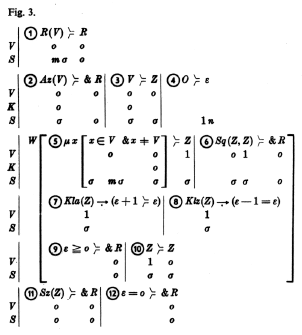
In 1945, the first programming language, Plankalkül, was developed by Konrad Zuse in Germany. (The same Konrad Zuse had also invented the first computer*) This certainly didn’t have English keywords, but it didn’t have German keywords either. It used a strictly mathematical (and two dimensional) notation with single letter variables. But he never created a compiler or interpreter for the language, and in general his work didn’t influence later developments.
Here is a picture of how it looked.
In 1955 FLOW-MATHIC (which later became COBOL) was developed by Grace Hopper (who also invented the compiler, making programming languages actually useful). FLOW-MATHIC was the first language that could be said to use English language keywords. This was followed by FORTRAN in 1956, and LISP in 1958. All three was American in origin and used English language keywords.
In 1958, things get interesting with the development of ALGOL. You see the creators of ALGOL were a mix of German and English speaking computer scientists. So it wasn’t obvious that they would chose English for their keywords. In fact the Swiss, Heinz Rutishauser, had developed a language called Superplan, which did have German keywords. But in the end they chose to use English keywords for ALGOL.
In my opinion this was the deciding stroke that made English the dominating language of computer science in general and programming languages in particular, at least in the First World.
After this all major European languages (Simula, Prolog, Pascal) used English language.
So what about the second world?
Soviet really only produced one major language: Refal developed by Valentin Turchin in 1966. Like Plankalkül, Refal used a more mathematical notation without any keywords. (There is a later version called Refal-5 that has English language keywords. This was developed by Turchin after he defected to the USA in 1979.)
I believe that the reason for this, as I said, is that the Soviet computer program lagged far behind its western counterparts. In the beginning Soviet focused on analog computers. These were not general purpose machines, and as such didn’t use any programming languages. But analog computers turned out to be a dead end and digital computers took over. The Soviets tried to develop digital computer systems independently, Soviet leadership decided that it was more effective to simply reverse engineer IBM computers. This meant that the languages that already existed for IBM computers could be used, and this is what was done.
* Fun fact: The computer was invented independently in Germany, England and America during WWII.
http://www.catb.org/retro/plankalkuel/
Grace Hopper (1978). History of Programming Languages I
Peter Naur (1962). Revised report on the Algorithmic Language ALGOL 60
There are internationalized versions of programming languages that target children. As a kid in the 80s, I programmed Logo in Hebrew. Today you can program Scratch in many languages. Probably the English versions for these languages came first though.