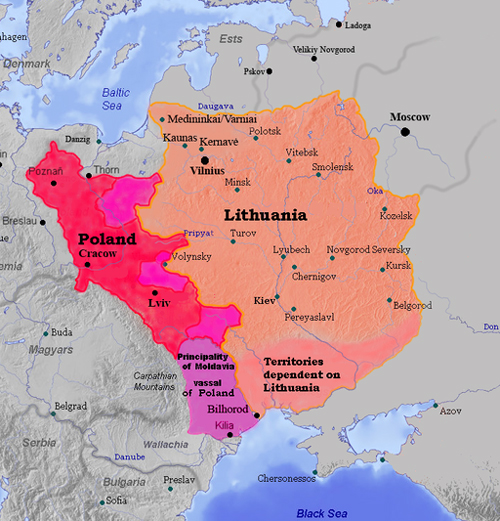
It seems that at the time of the Union most of it was Lithuania. Today it's mostly Belarus and the Ukraine. Would I be safe in chosing to speak Latin?
I assume that you have a typical image of 'winged hussars' or a heavy armoured lancers used predominantly as a shock troops. These are the hussars of 17th century (hussars slowly changed from the light formation based on Serbian Rats/Ratz cavalrymen into the heavy troops now most commonly with 'winged hussars'). The following explanation focuses on nobility, as 'winged hussars' or heavy cavalry in general belonged exclusively to this class.
In 17th century, Polish-Lithuanian Commonwealth encompassed the territory of modern Poland (save for western provinces of modern Silesia, Pomerania and Greater Poland), whole Belarus and Lithuania, majority of Ukraine and small part of Western Russia (lands surrounding Vitebsk and Smolensk). Given that the large part of modern Ukraine (especially Kievan voivodship) belonged to the Crown (Kingdom of Poland), Polish noblemen living in the eastern part of the country were commonly speaking Ruthenian, with Polish being the primary language of the rest. Lithuanian nobles were usually speaking Ruthenian. In 17th century Polish Lithuanian Commonwealth of there were almost as many ethinic Poles as there were Ruthenians (about 5 millions each) because territory inhabited by ethnic Poles was smaller but more densely populated that the Ruthenian-speaking lands.
An important note here. I'm using the term 'Ruthenian' in its historical meaning, to denote the early language used in Central and Eastern Europe that differentiated in late 13th century from Russian and later diverged into Belarussian and Ukrainian in early 17th century. This language, sometimes called 'Old Ruthenian' or 'Slavonic' is distinctly different from modern Ruthenian, an official language of Voyvodina, also spoken by e.g. Lemkos, Boykos and Transcarpathian Eastern European minorities.
Original Lithuanian was in decline due to the influence of Ruthenian propagated as a close relative to Old Church Slavonic that functioned as cultural carrier being a liturgic language of the Orthodox Church. Ruthenian became an official language of Lithuania in the times of Algirdas (second half of 14th century). Since the Union of Lublin that marks the beginnings of Polish-Lithuanian Commonwealth (1569), Polish language became more and more popular among Lithuanian nobles, mostly for political reasons, as despite official equality, Poland was the de facto political centre of the country. After the Muscovite incursion during Second Northern War (1654-1667), many Lithuanian nobles began to identify as 'Polish', alienated by aggressive politics of Grand Duchy of Muscovy dominated by people speaking Russian and Ruthenian. This led to the adoption of Polish as the official language in the lands of the Grand Duchy of Lithuania in 1697.
It should be noted that 17th-century Polish, despite belonging to a different group of Slavic languages was similar to the 17th-century Ruthenian languages to the point allowing rather easy communication (differences were much smaller than between modern Polish and Ukrainian/Belarussian, mainly due to intensive Russification in 19th century when the former lands of Grand Duchy of Lithuania and southern Poland were incorporated into Russian Empire). Furthermore, nobles participating in various political meetings were more or less exposed to the second most popular language in their country what, along with the tendencies to adopt Polish as the dominant language made Polish the most popular language among the nobles. Official documents in the Grand Duchy of Lithuania were written in a specific Ruthenian dialect that merged Old Ruthenian, Southern Ruthenian (proto-Ukrainian), Old Church Slavonic and Polish what further acquainted Ruthenians with Polish vocabulary that.
Knowledge of Latin among polish nobility, although quite common, was usually far from fluent. Most noblemen received some rudimentary education, knew some liturgic Latin (if Catholic) and were commonly peppering their speech with Latin words and expressions, yet fluent conversation (one you could expect from a bishop, Jesuit priest or a Dominican friar back then) was definitely not a given. Jacques Auguste de Thou, desribing Polish diplomatic entourage who came to present Henry III with a results of royal election in 1573 wrote that every Pole there was speaking fluent Latin what was a rarity among secular diplomats in France, but such fluency was usually limited to nobles taking active part in lawmaking or diplomacy. High-ranking officers of prestigious units like heavy cavalry were commonly well-versed in Latin too.
Summing it up, Polish would be the best choice, given that it was the first language of half of nobility in the Polish-Lithuanian Commonwealth, was quite popular among the other half and allowed better or worse communication with those who preferred Ruthenian. Latin, although very handy as an auxiliary language in legal or political discussions was definitely not a safe bet for everyday conversation with a random Polish noble, but with some luck could be enough.