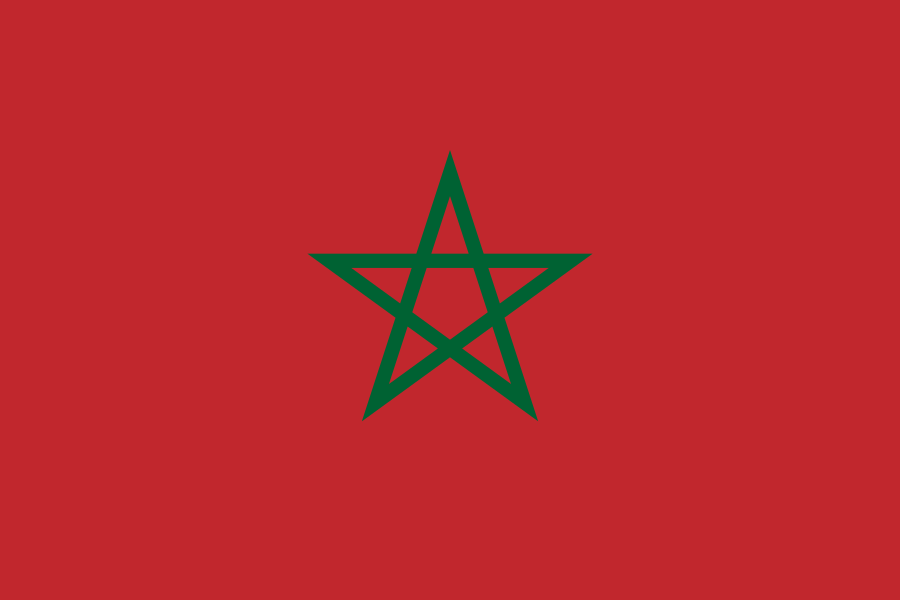
Is there some historical significance to the colors?
What you refer to is generally called the "Pan-Arab Colors" by vexillologists. The four colors that are generally counted to be among them are black, white, green and red, colors that the Arab World has since used rather often in its flags for nation states or political movements.
The color scheme goes back most immediately to this flag used by the Arab resistance fighters that were in a state of uprising against Ottoman rule on the Arabian peninsula.
The colors of the flag go back further than that however. The flag was designed by British diplomat Mark Sykes, who considered Islamic history as well as his artificial desire to actually create some sort of superregional feeling of independence and common culture and thus tried to cram as much Arab history and as many various regions of Arab culture into the flag as possible, and this is what he came up with:
Black is a color associated directly with Muhammad, the prophet of Islam. The Al rayah as-sawdā, or 'black banner', became after Muhammad's death associated particularly with the Abbasids, who often flew monochrome black banners.
White is to the Umayyads what black is to the Abbasids. In early Islamic cultures, flying white banners was not a signal of surrender like we might think today. White in Islam is also a color associated with pilgrims and thus with faith.
Green represents the Fatimid dynasty. It is also the color most generally associated with Islam as a whole.
Red, in the flag in the shape of the triangle, primarily represents the Hashemite dynasty, the ruling family of what was at the time Hejaz. Red "holding" together the various iterations of Arab-Islamic empires as the triangle in the hoist can be interpreted as reinforcing the Hashemite claim to rule this new Pan-Arab state.
So that's the origin of the rebellion flag that inspired the others. It is in that way comparable to the Pan-African colors that were primarily inspired by the flag of Ethiopia.
Since then, the colors have gained local meanings in each country. Sykes' original callbacks to various Arabic empires vanished from most countries' flags, as they weren't particularly interested in these long-gone states.
At this point, trying to make general assumptions about each country's meaning for each color on each flag is rather futile; it is however definitely observable that the countries upon independence at least stayed in the general frame provided by their common ethnic, political, diplomatic and religious connections.
Morocco for example uses red and green to represent bravery, strength and valor on one hand and Islam on the other, choosing the five-pointed star of the legendary King Solomon as their national symbol.
Libya on the other hand uses a red-black-green tricolor with a white star and crescent. Red represents the blood of those who fought for Libya, black the dark days of colonial rule and green represents agriculture. And of course, when talking about Libya's flag, we can always admire the beauty of a flag that the country flew under Gaddafi: this complex masterpiece. While you might think that green represents the super-islamic nature of the country - not primarily; it's about Gaddafi's personal ideology and his green book in which he wrote about it. Islam and in this case actually a callback to the aforementioned Fatimids were nice side effects though.
I could go on; Somalia for example successfully escaped the Pan-Arab trend and instead went with blue as the primary color, being the only country in the Arab World to choose as its main color on the flag a color not part of the Pan-Arab colors. Blue represents the sky and the ocean and its light shade was likely a nod to the United Nations.
I know this is a short little interruption (go ahead and delete it if it breaks the rules) but the Egyptian flag's Red, Black and White color scheme have nothing to do with the Islamic symbolism of the Arab revolt flag of the other Arab countries.The red band symbolizes the period before the Egyptian Revolution, a time characterized by the struggle against the monarchy, and the British occupation of the country. The white band symbolizes the bloodless nature of the Revolution itself. The black band symbolizes the end of the oppression of the Egyptian people at the hands of the monarchy, and foreign imperialism.
I only bring this up because even though Egypt was essentialy the leader of the Pan-Arab movement and for a time adopted a Pan-Arab flag (Syria's flag is the old United Arab Republic flag) it's flag at the inception of the Republic and today is sometimes falsely considered a Pan-Arab flag.