I recently remembered a passage from Roger G Kennedy's "Hidden Cities" (1994), in which he claimed that the Hopewell earthworks at Circleville (including the 1000ft wide circle it was built on) indicated a permanent settlement of tens of thousands of people, suggesting that it might've been comparable to Athens or Rome in the third century BC. Kennedy wasn't a crank, he was director of the parks service and the Smithsonian for a while, but our understanding of Hopewell/Adena culture has changed a lot since then. Was this idea ever taken seriously? What's the current consensus on these earthworks being part of "cities"?
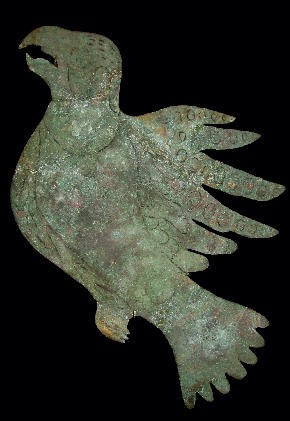
The Hopewell period 200BCE - 500CE is an archaeological tradition in eastern North America that is marked by extraordinary mound building and an exchange system that was both very broad in geographical range and noted for its very exotic materials. Craft specialists demonstrated exquisite artistry in the use of these materials. Trade materials included obsidian, copper, mica, sea shells and a variety of other exotic materials that travelled long distances. These materials were imported to Hopewell sites and crafted into extraordinary art objects. As an example, one common artifact type was the platform pipe. The mounds associated with Hopewell include animal effigies (see Serpent Mound,) burial mounds and various geometric forms that are, in some areas, enormous.
Hopewell has at various times been referred to a culture or exchange system, but for our purposes it can be considered a collection of similar sites in a known area during a certain period, the hallmarks being the earthworks, burial mounds, exotic materials and extraordinary craftsmanship in the creation of a variety of very artful artifact types such as platform pipes animal and other effigies made of ceramics, carved copper and mica, and very ornate incised pottery .
Hopewell assemblages can be found from Nebraska east to the East Coast and from Minnesota to Mississippi, but the central concentration of Hopewell sites is in the Southern Illinois/Indiana and Ohio areas with the epicenter being along the Scioto river in Ohio.
Given that Hopewell exhibits fairly massive public works and craft task specialization, and many other attributes of cultural complexity, early researchers inferred a lot about "Hopewell Culture" by analogy to far more complex societies. And one might naturally infer that cultures that were responsible for such artistry and monumental earthworks may well have resided in nucleated, sedentary sites (towns, perhaps metropolitan areas). This was the conventional wisdom until the middle of the 20th century.
There are, in fact, a few nucleated, sedentary Hopewell period sites along water courses in Southern Illinois, but it has been asserted since the 1960s that the vast majority of Hopewell settlements appear to be small (4-5 houses), seasonal farmsteads, or single use camps with pole structures, covered with hide, thatch or whatever you might find that works (e.g. reed or grass mats). Some were wattle and daub structures with thatch roofs. They seem to be small farmsteads distributed across the landscape, associated with highly productive environments and with little or no regard to where the earthworks are located. There has been a lot of recent research that suggests that Hopewell settlements were much more varied and complex than previously thought, but a salient point here is that Hopewell Mounds did not enclose towns. Hopewell residence sites appear to be dispersed and only occupied occasionally (sometimes seasonally).
So what about Circleville? Circleville is a Hopewell mound complex that later had a city constructed upon it.
The circular earthwork consisted of an outer circular wall 1,140 feet in diameter and an inner circular wall with a ditch between them. This double-circle was connected to a square enclosure 908 feet long on each side. In 1820, the walls were five to six feet in height and the ditch was around 15 feet deep. The square had eight openings and each opening was partially blocked by a mound. These mounds were about 40 feet in diameter and four feet in height. At the center of the concentric circles there was a mound, which was about 15 feet in height and about 60 feet in diameter. When excavated, this mound was found to contain a number of burials and artifacts.
So was Circleville a metropolis? I think we can safely say that it was not. First because Hopewell earthworks do not enclose settlements, at least from what we know now. And, second, there were no settlements that you could reasonable describe as metropolitan in nature within the Hopewell period and range. Specifically, Circleville is located along the Scioto River in Ohio. This portion of Hopewell range did not have nucleated settlements.
William S. Dancey and Paul J. Pacheco, eds. Ohio Hopewell Community Organization. Kent OH: Kent State University Press, 1997
Olaf H. Prufer in "The McGraw Site: A Study in Hopewellian Dynamics. 1965
Hopewell Settlement Patterns, Subsistence, and Symbolic Landscapes. A. Martin Byers , DeeAnne Wymer. University of Florida, Gainsville.
Edit: I don't know why my links arent working.
Edit 2: added more photos