That's quite an interesting question, as, of course, the Taiping certainly saw themselves as Christian, yet diverged in many aspects. The use of the cross as a regular image was not one of their areas of common ground.
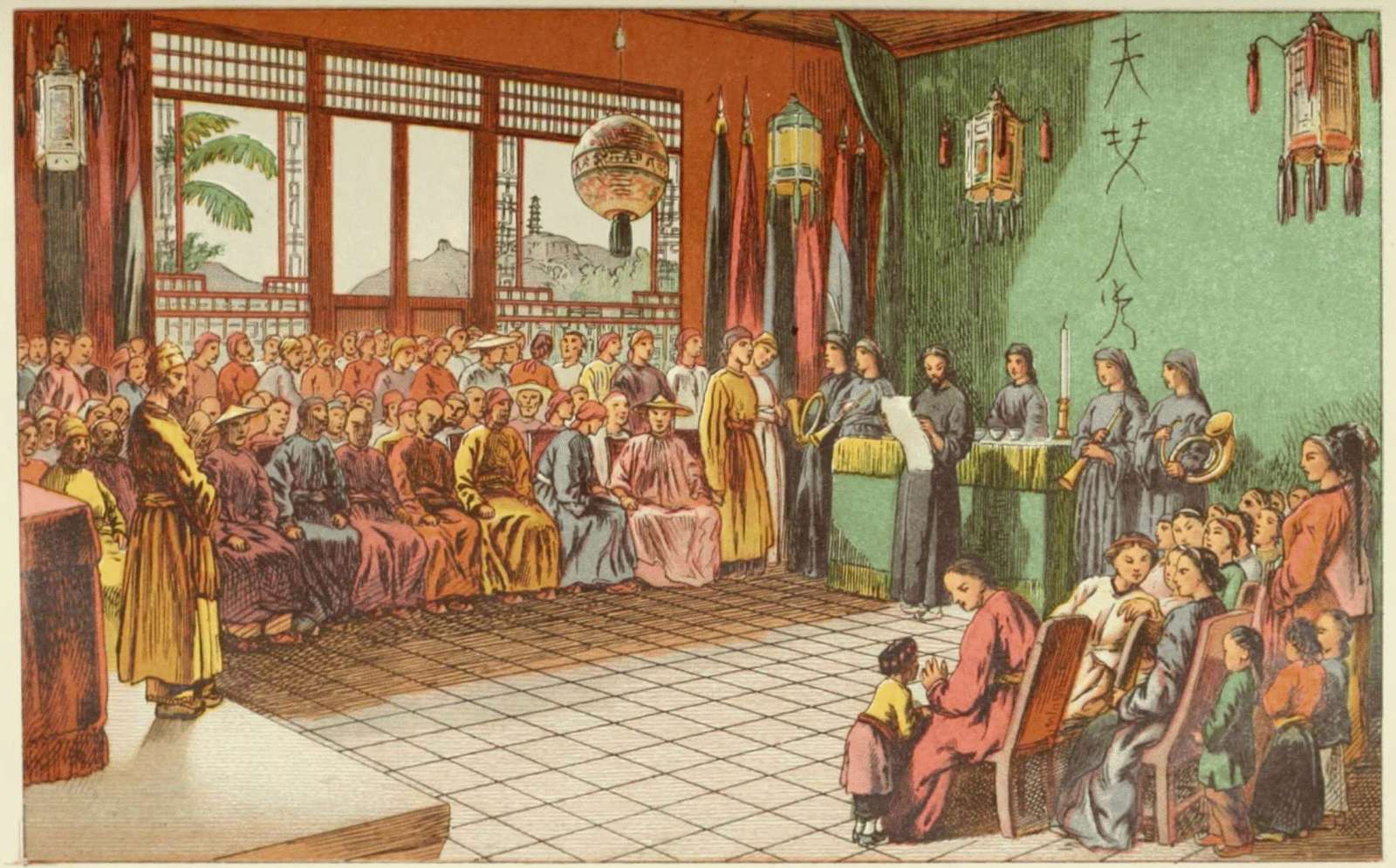
That is not to say it was disregarded entirely as a symbol, as there is some evidence to support occasional use of the cross. Augustus Lindley, the pro-Taiping volunteer, had this to say about the attendees of his friend's wedding in Nanjing:
The Chung, Kan, Foo, and all the other Wangs present, wore their state robes and coronets, while the dresses of many of the ladies were still more beautiful and dazzling. Besides the Kan-wang's chaplain, the principal ecclesiastic in Nankin officiated, dressed in a splendid black silk garment broidered with gold and silver crosses, both of whom, attended by several priests, took up their position before the altar, which was decorated with large garlands of flowers.^1
Sadly, Lindley does not specify if this 'principal ecclesiastic' was Chinese or Western. The latter seems more probable, as the Land System of the Heavenly Dynasty stipulates that ecclesiastical functions were chiefly performed by junior officers rather than possessing a separate organisation.^2 However, it also possible that this was introduced by prime minister Hong Rengan, who was a more conventional Protestant, after his arrival in 1859 (although still unlikely), or, more probably, a holdover from the Catholic minority – around 200 lived in Nanjing before it was captured and 30 were killed in the early days of Taiping occupation.^3
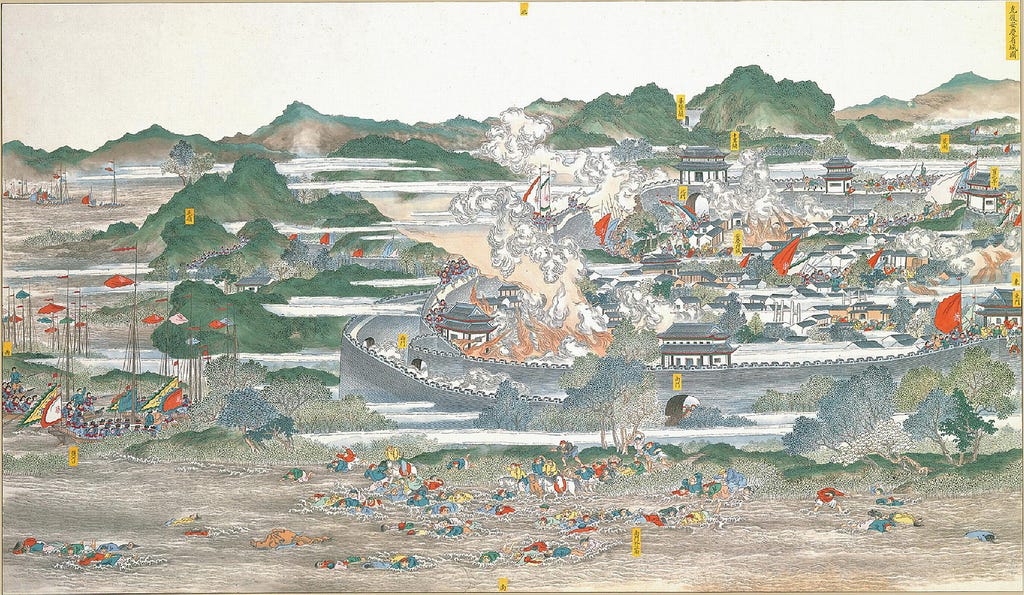
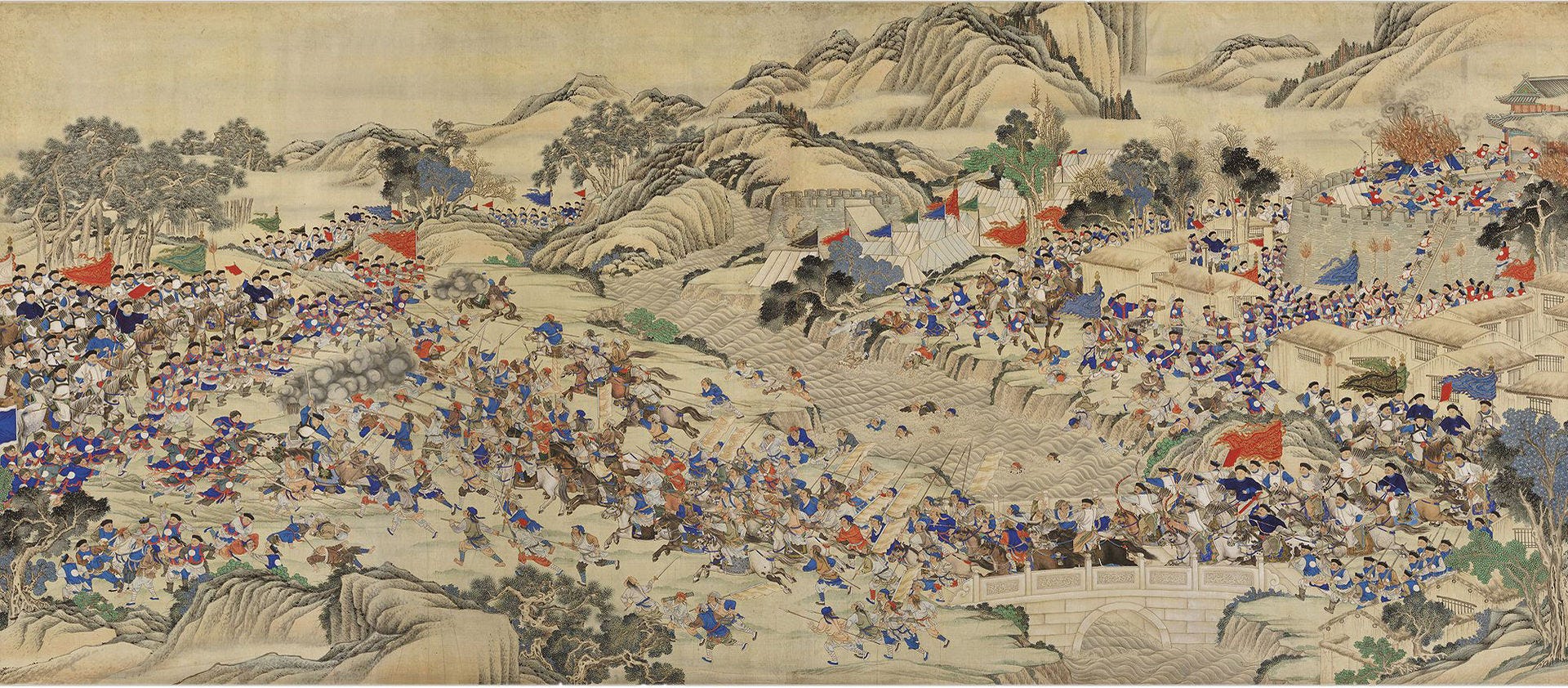
In general, however, it must be maintained that the cross did not see regular usage. Take this chromolithograph from Lindley's memoirs, depicting what is referred to as a 'Taiping Church'. As can be seen on the back wall, whilst there were candles and an altar, and text on the walls (although as far as I can tell the text in the image is nonsense), no cross can be seen. Similarly, when it came to flags, text would be used to indicate the position of a unit within the army's organisation – a look at some of the Qing battle paintings commemorating the conflict, quite clearly shows the absence of any sort of cross motif. In any case, the resemblance to the character for ten (十) would have made it a rather awkward symbol to associate oneself with.
Still, that's not to say that the Taiping had no recognition of the cross. Far from it – their rewritten version of the Trimetrical Classic (《三字經》) includes the lines:
皇上帝,(The Sovereign High Lord (God),)
憫世人,(Out of pity to mankind,)
遣太子,(Sent his first-born son,)
降凡塵,(Into the mortal world,)
曰耶稣,(Named Jesus,)
救世主,(The Lord and Saviour of the world,)
代贖罪,(To redeem sins in [man's] place,)
真受苦,(Truly suffering,)
十字架,([On] the cross,)
釘其身,(His body was nailed,)
流寶血,(Shedding [his] precious blood,)
救凡人。(To save all mankind.)^4
The motif was not limited to the Trimetrical Classic, with the fifth verse of the Ode to Youth (《幼學詩》) beginning with:
His [Jesus'] cross was hard to bear^5
And so it can be seen that the significance of the cross as a spiritual symbol was recognised.
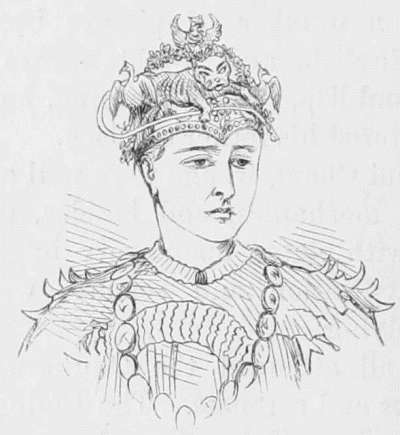
Why, then, did the Taiping not use the cross? Well, the Taiping were strongly iconoclastic and known for their destruction of Buddhist and Confucian imagery. One could therefore suggest that this iconoclasm extended to the use of the cross, with most Taiping imagery being of animals and traditional symbols of kingship as well as some of those of the Ming, which could be construed as more secular – take, for example, this wall painting of a deer or the headgear worn by the Taiping kings. Text, however, was an acceptable medium for describing events of religious significance, and interestingly enough one effect of the Taiping Rebellion on the Chinese populace in Jiangsu outside Taiping control was a grassroots Confucian programme, advocating reverence for the written word as an act of spiritual cleansing.^6
Sources, Notes and References: