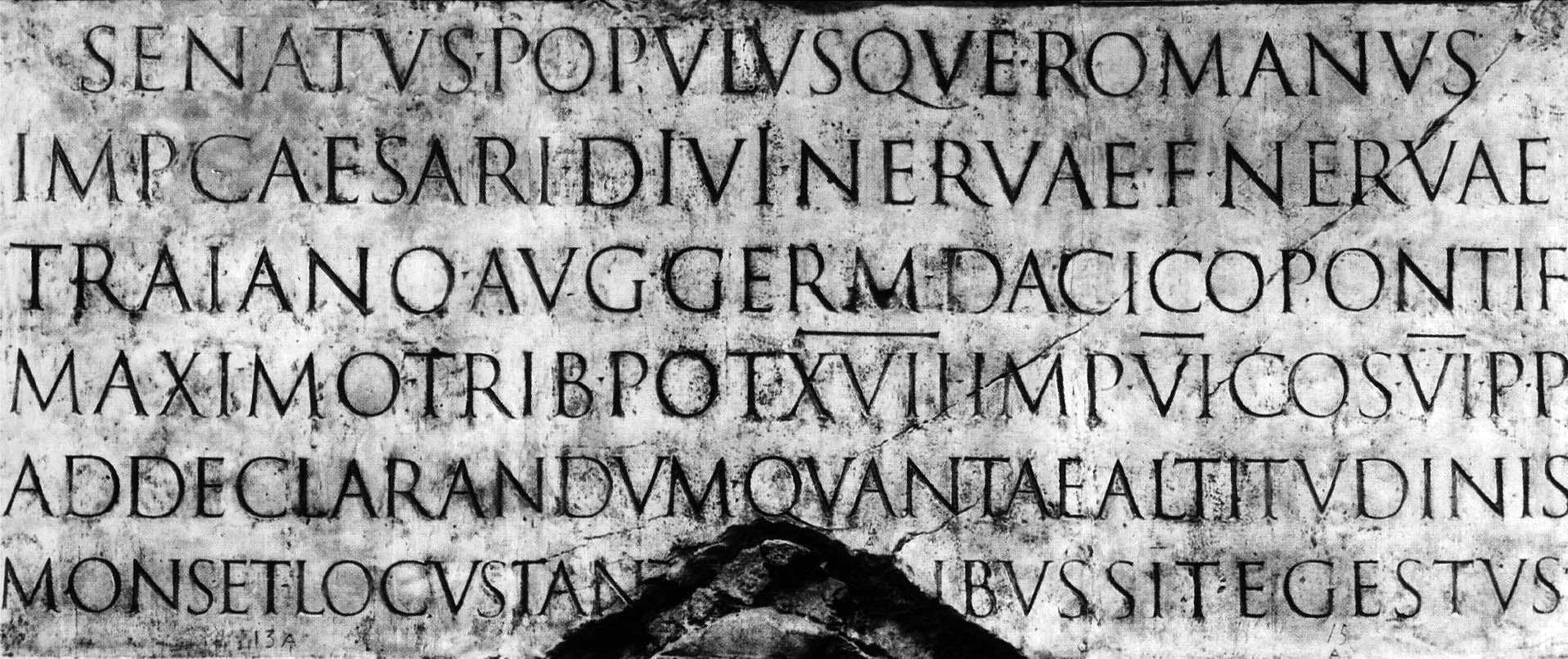
In a word: yes. (In a few more words: Yes, with reservations.)
Majuscules—what we colloquially call "capital" or "upper case" letters—are nearly identical to their ancient Roman origins. [NB: I'm assuming a normal typeface designed for readability and not something decorative.] Take a look at the inscription on the Column of Trajan in Rome, from c. 110 CE: the letters are easily recognizable to us.
Only a few letters would be strange or unfamiliar to them: "J", for example, as well as "U" and "W".
That said, some aspects of the modern Latin alphabet would be harder to recognize. What we colloquially call "lower case letters" might present some challenges, as the forms used today were refined in the 15th century (although they're older than that). And the typeface or style of writing would greatly impact someone's ability to recognize letters: e.g., how many people today can correctly identify the letters of Gothic scripts in medieval manuscripts? Or how many people in younger generations can read cursive?
Some sources on lettering / letterforms:
Michelle P. Brown, A Guide to Western Historical Scripts from Antiquity to 1600 (Toronto and Buffalo: University of Toronto Press, 1990)
Arthur E. Gordon, Illustrated Introduction to Latin Epigraphy (Berkeley and Los Angeles: University of California Press, 1983)
Nicolete Gray, “The Newberry alphabet and the revival of the roman capital in fifteenth-century Italy,” Typography Papers 6 (2005), 5-16
Wardrop, James. The Script of Humanism: Some Aspects of Humanistic Script, 1460-1560. Oxford: Clarendon Press, 1963