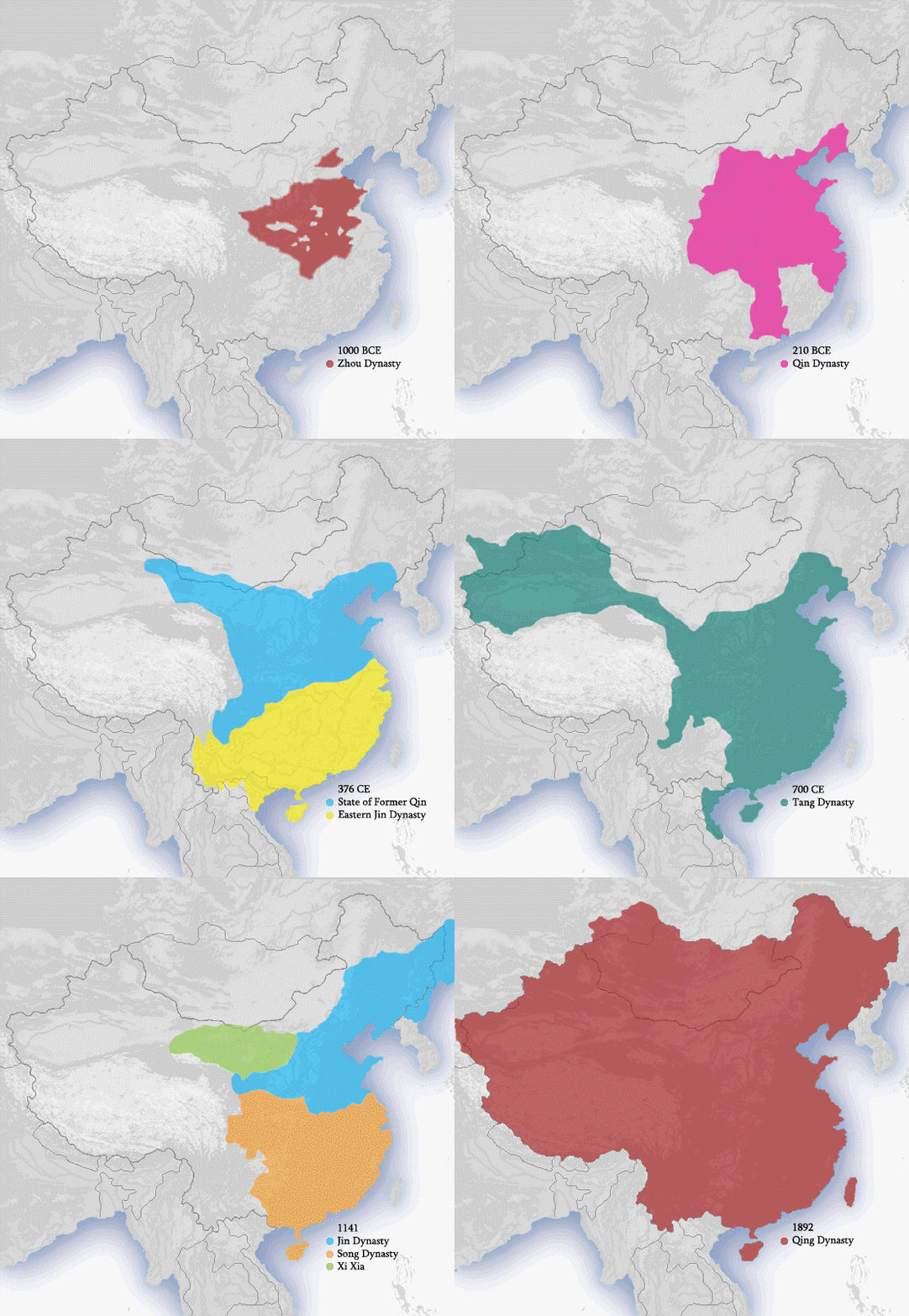
The sentence that precedes your question is incorrect, which means the question itself begs the question. Check any history of China, or any historical atlas of China, to see how its borders expanded and shrank over the centuries. Also, not to be rude, but "overwhelming" is an overstatement. And: what does "cultural... advantage" mean? Lastly: it often did not have "military advantage", which is precisely why they had to build the Great Wall.
This question is a bit flawed. China today is almost the size of Europe, but its modern territorial boundaries were only defined in the late Qing. Traditionally, China was much smaller and this becomes apparent when you look at a map of China proper. A lot of the territories were not incorporated until much later.
For example, the provinces of Yunnan and Guizhou were traditionally not part of China. It was long considered to be barbarian territory. During the Tang dynasty it was ruled by the Nanzhao kingdom and during the Song it was ruled by the Dali kingdom. Its culture was very distinct from China and in many ways is more similar to Southeast Asia than it is to China. It was first incorporated into the territories of China during the Mongol Yuan dynasty when the Yunnan Branch Secretariat was established there. After the Yuan fell, the Ming conquered it and decided to retain it as a province. In fact, Yunnan and Guizhou began to develop during the Ming, when the state settled thousands of soldiers from the inland regions there, along with their families. Towns started to form around these military garrisons, which then attracted inland merchants and boosted Sinicization. But because of difficulties in transportation and communication, the Ming relied on native chieftains there (known as tusi), to govern on their behalf in much of the area. These chieftains were given court titles and were expected to pay tribute to the emperor and supply troops when needed, but otherwise retained great power within their territories. The Mingshi goes as far as calling them "kings within their own territory." Some were so powerful that they even challenged state rule and threatened Ming control over the region (the Yang Yinglong Rebellion, the She-An Rebellion). Chinese control over the Southwest intensified during the Qing, when the Yongzheng emperor vigorously implemented a gaitu guiliu policy of abolishing the tusi and replacing it with Chinese civilian administration instead, but with mixed results. The last vestiges of the tusi system would be not be abolished until the Communists took over. But the point here is that Yunnan and Guizhou was not part of China until fairly recently.
Other examples include Tibet, Xinjiang, Qinghai, Inner Mongolia, Manchuria, and Taiwan, all of which were not considered part of traditional Chinese territory ("China proper") and only came to be incorporated into China during the Qing dynasty.
Not to hijack the question but did they stop growing? The empire of the famed first emperor was the north east of current China. The dynasties afterwards never seemed to stop growing despite the constant rebellions overthrowing dynasties and civil wars. The sizes of the borders of the Chinese empires are very different over the history but they trend to growing larger and larger.
What you might be alluding to as the traditional borders of China were only established during the Yuan Dynasty which was the mongolian dynasty established after bloody wars overthrowing the Song dynasty which happened less than a thousand years ago (and to be fair to the Song Dynasty they ended a period called Five Dynasties and Ten Kingdoms and reunited a fragmented China minus a could of regions).
One good question could be what limited Chinese emperor's from expanding borders and how did Chinese imperial culture affect countries that bordered it?
I wouldn't say that the Chinese have never veered outside of their "traditional territories." You do not get to be a country that size without some aggressive expansion here and there.
https://upload.wikimedia.org/wikipedia/commons/5/54/Territories_of_Dynasties_in_China.gif
Perhaps you are thinking about the Ming Dynasty period in time when they took a "looking inward" approach shutting themselves off from the world. During this period of time the Chinese did have a significant scientific, cultural, and military advantages over the rest of the world. They were on course to circumnavigate the globe decades before the Europeans. The Muslim nations were still recovering from the destruction at the hands of the Mongols and the onset of religious radicalism.
The Chinese leadership at the time were having debates about on further expansion however other factors were involved as well. One was having such a large country with many differing ethnic backgrounds was proving difficult to manage. In the time before trains, planes and automobiles just administering a country with such vast distances was taxing. Pacifying local populations and putting down rebellions was a costly adventure as well. Was further expansion worth it? Land war with the Mongols was draining coffers. The Koreans, Japanese, Thais and Vietnamese would make it very costly to expand there. If military conquest was possible they would still have to deal with a very hostile population. India has natural barriers separating the two countries making expansion there impractical.
Another reason, and possibly the most crucial, for the closing of China was political. The Chinese had a massive merchant fleet and navy that dwarfed every nation on the planet. Its ships outclassed everything in existence at the time. With this, the merchant class was becoming extremely wealthy and a shift in power was worrying the ruling class. By closing ports and burning the fleets the Emperor's civil servants could control the land trade routes and kill off the competition.
In the several centuries of "looking inward" Chinese technology would decay allowing European powers to circumnavigate the globe first, plunder the new world and kick start the industrial revolution. It would take China until the past few decades to finally catch back up.