I was debating whether to post this question to r/AskHistorians r/NoStupidQuestions or r/TooAfraidToAsk. Hopefully it fits here, if not please let me know and I will move it to a more appropriate sub. TL;DR at bottom.
I have always been secretly curious about what sex was like in the Middle Ages, specifically oral sex. As a woman (22F) I get self-conscious about receiving oral sex if I haven't showered in a few hours, let alone days or weeks. I can only imagine how unbearable it would have been to perform cunnilingus back before women were regularly bathing. Therefore, I was surprised to read that back in the Middle Ages, it was widely believed that in order to conceive a baby, both parties must reach orgasm.
Contrary to what you may be getting from medieval romance novels, the medieval scientific theory of sexual reproduction had a pretty strong role for the lady's orgasm. Namely, they thought it was absolutely required if a sex act was going to produce a baby. As an idea, this turns up in a host of medieval texts, from the 13th century onwards. (A Brief History Of The Female Orgasm, From Medieval To Modern Times).
At first I was like damn, I wish I could go back in time and become a medieval surrogate. 75-80% of women cannot orgasm from penetration alone, so I assumed this meant Medieval-era men ate a lot of p**** back in the day. But then I found out that oral sex was outlawed by the Church at the time.
Marital sexual activity had to be intended to be procreative, so certain heterosexual non-procreative positions were outlawed (sex standing up, penetration from behind, woman on top), as were oral sex and anal sex even between husband and wife in a marriage. (Medieval Sex and Sexuality).
If couples in the Middle Ages were only having vaginal sex (in the missionary position, no less) to conceive, how is it possible that both parties were reaching orgasm every time?
Humans obviously did not go extinct in the 1300's, which means there must have been some justification at the time for how these women were able to get pregnant. If anyone could enlighten me about medieval sex and/or the origin of these rumors, it would be much appreciated. How seriously was the oral sex prohibition really taken?
TL;DR - If people in the Middle Ages commonly believed that women needed to orgasm in order to become pregnant, but oral sex was taboo/illegal at the time: were women actually orgasming during sex as much as their husbands and male doctors believed?
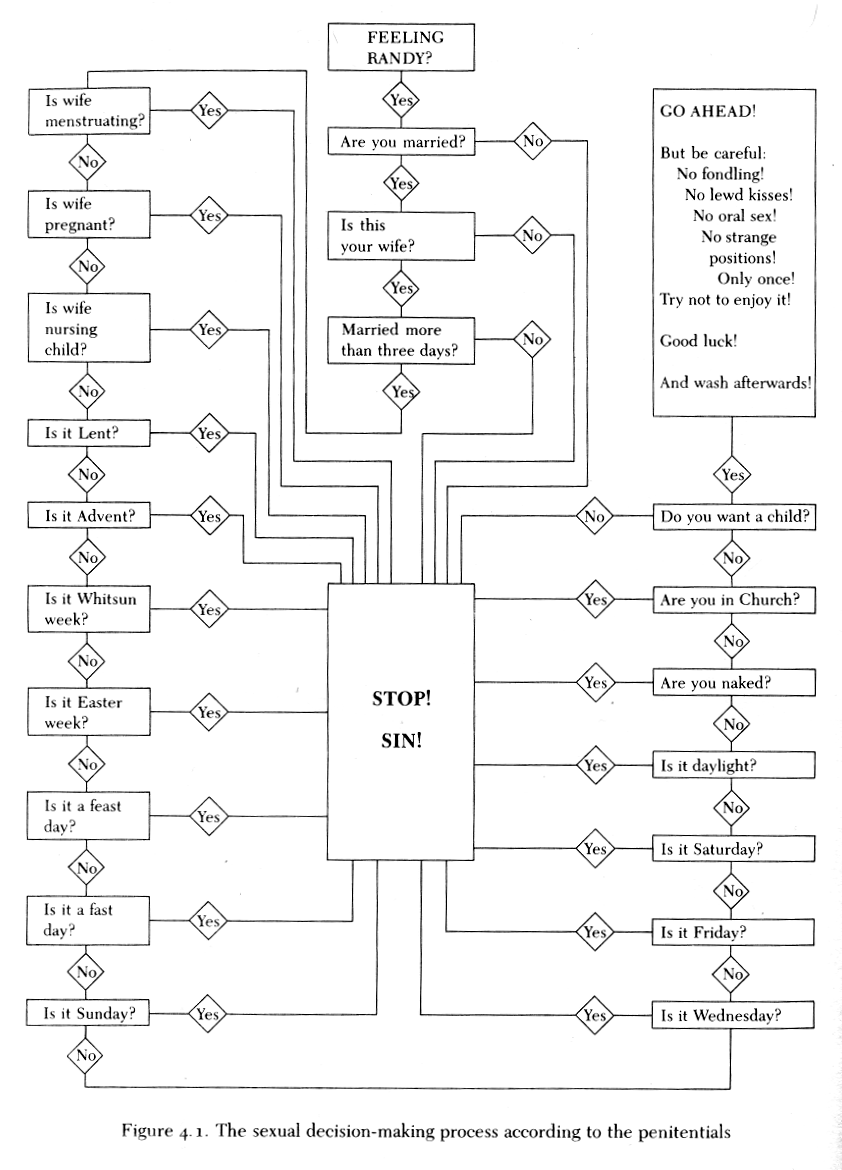
It's true, oral sex was not permitted under canon (Church) law. Neither was fornication (sex between unmarried people), adultery, sodomy between men, sodomy between women, non-PIV heterosexual sex, masturbation, mutual masturbation, intercrural sex/grinding, use of a dildo, use of a premodern Fleshlight, sex on Sunday, sex in churches, and everything else listed on the medieval penitential sex flowchart.^1
Guess what we know from court records, letters, popular literature and similar sources what medieval people were doing? Fornication, adultery, sodomy between men, sodomy betwen women, non-PIV heterosexual sex, masturbation, mutual masturbation, grinding, use of a dildo, use of a premodern Fleshlight, sex on Sunday, sex in churches, and--you guessed it--everything else listed on the medieval penitential sex flowchart.
What you've stumbled on first of all, OP, is the difference between "prescriptive" and "descriptive" sources. That is, just because a law exists or a behavior is promoted in a sermon or didactic text, does not mean people are obeying the law or following the advice. Prescriptive sources only tell us what people thought, not what they did. You likewise cannot apply the "if there was a law against it, that means people did it" logic so simply to medieval sources, alas. However, "descriptive" evidence can fill in some of the gaps. It's still not a complete open-and-shut case all the time, since formulas and tropes comprised such a large portion of medieval legal records and rituals, but the sheer weight of cases with some sexual crimes/sins or the specific details related in other cases indicates a connection to real practice.
Certainly the same principle can be applied to medical texts as well. Yes, the belief that pregnancy was impossible without the woman reaching climax is found in a lot of medical texts in the medieval West. One might well point out that the authors of most of them were celibate men (the Trotula, a compendium of three texts connected to a woman physician, does not discuss orgasm or how to get pregnant), and the reach of academic medicine was almost certainly rather restricted. Rock-bottom literacy rates beyond the clergy and a number of university-trained physicians deeply inadequate for the total population interacted with a world where people might not have seen the need for academic medical knowledge! In late medieval towns, people could go to barber-surgeons, midwives, surgeons, oculists, dentists, herbalists, apothecaries, snakebite healers, a whole host of medical practitioners lacking the university/degree background.
But then again, the belief was inherited from ancient and late antique Greek medicine, which transfers the problem rather than solves it. And with the (still slow) rise of vernacular literacy among late medieval nobles and in late medieval cities, there was a significant demand for translations of the major Latin medical texts. Your fifteenth-century barber might well be quoting Avicenna (Ibn Sina) to you on the proper cure for pestilence! So, while the total number of people who read in books or heard from educated physicians that women needed to orgasm to become pregnant might have been small, it was hardly inconsequential. And more disturbingly, because Christian thought held that orgasm was the voluntary result of lust, pregnancy was held up in court as proof that rape had not occurred--the woman had committed fornication or adultery with her rapist instead, since pregnancy proved orgasm which proved she wanted it.
So what gives?
Believe it or not, none other than Claude Levi-Strauss theorized the answer in Structural Anthropology. Looking at "shamanistic" healing traditions, he found that the key was not the percentage of times that shamans "actually" healed the patient. Rather, it was the belief in the power of shamans to do so that counted--the belief of the community, not just the individual ("social consensus"). Medieval belief in astrology, or cures for pestilence (that would be the Black Death) that were basically spices in rose water, or that if you thought about horses during sex the child conceived would look like a horse, offer other examples of medieval social consensus.
More historically rather than anthropologically, too, Robert Bartlett has argued that trials by ordeal worked on the same lines. The outcome--guilt or innocence--was what the community had already collectively decided; the trial served to confirm what "everyone knew" rather than inform them one way or the other.
So all in all: we shouldn't count out the potential liveliness of the medieval bed, and eventually bedroom. But nor should we see a contradiction between the belief that pregnancy required the woman to climax, and observations that she hadn't.
~~
^1 Compiled by James Brundage in Law, Sex, and Christian Society in the Middle Ages
While I've got some knowledge here, I don't have the qualifications to discuss things, so let me offer some other relevant links for discussing hygiene...
So, with those threads in mind, ahem.. what smells 'good' and what smells 'bad' are rather subjective, and one person's "gross" is another person's "perfectly normal"...