As in, were they ever used in a similar fashion to how, for example, the mongols utilized horse-archers?
Early guns were used on horseback. In most places in Asia, the bow continued to be used on horseback, but some cavalry used firearms. In Western and Central Europe, the gun became a major cavalry weapon.
In some ways, guns were used by cavalry in similar ways to bows (i.e., horse-archers), but there was one major difference: reloading a gun takes longer (and can take longer on horseback than on foot). So, when shooting at an infantry formation, the cavalry might ride into range, fire, and move back to reload in safety (and might then repeat the maneuver). This could be done in an orderly sequence, where the cavalrymen fired in turn, called the caracole, which was most popular in the 16th century. In the 17th century, the caracole was largely replaced by either (a) firing a volley at short range, and charging in to engage in close combat, or (b) firing a volley at short range and retreating as a body to reload. When engaged with enemy cavalry, guns would be used at short range, and then, since the guns could not be used again until reloaded, the cavalry would switch to using swords.
European cavalry armed with early firearms typically used pistols or carbines. Asian cavalry, depending on where and when, might use pistols, carbines, or full-length muskets. Short-barrelled firearms were preferred for ease of loading (thus pistols and carbines). The short barrels meant that these guns had a short effective range. Where cavalry used full-length muskets, they usually carried both bow and musket. Once the musket was fired, the cavalryman would switch to using the bow if a ranged weapon was needed, or sword or lance (or other weapon) for close combat.
Some examples:
Johann Jacob von Wallhausen's military manual, Kriegskunst zu Pferdt, from 1616, has many European examples:
Lancer vs cavalryman with pistol: https://commons.wikimedia.org/wiki/File:Fotothek_df_tg_0000949_Kriegskunst_%5E_Pferd_%5E_Lanzierer_%5E_Lanze.jpg
Cavalrymen using pistols in formation in battle: https://commons.wikimedia.org/wiki/File:Fotothek_df_tg_0000968_Kriegskunst_%5E_Pferd_%5E_Aufstellung_%5E_Kompanie_%5E_Kavallerie.jpg
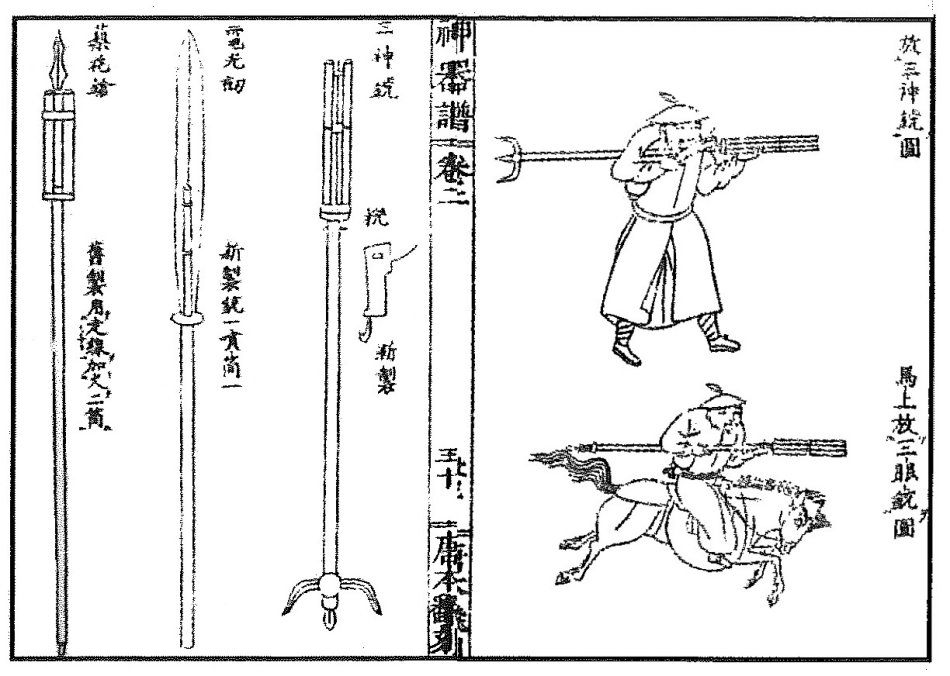
A Chinese cavalryman with a matchlock three-barrel hand-cannon, from Zhao Shizhen's Shenqi Pu, late 16th century (the right-hand gun on the left-hand side has a detachable matchlock mechanism next to it).
Tibetan cavalry armed with matchlock muskets, bows, lances, and swords.
For discussion of Ottoman and Indian use of firearms while mounted, see Robert Elgood, Firearms of the Islamic World, I. B. Tauris, 1995. Ottoman cavalry began using pistols and carbines in the late 16th century. Indian cavalry were using carbines in the 18th century, e.g., under Hyder Ali in Mysore.
In addition to u/wotan_weevil's response, you might be interested in this previous post on the use of firearms from horseback as well as this post which talks a bit more about pistols in particular.
Shooting from horseback played a major role in European warfare during the 16th and 17th centuries with the most common sort of light cavalry by far becoming mounted harquebusiers or carbiners (though they could dismount and effectively on foot as well, mounted harquebusers with their smaller guns were usually in a separate category compared to actual "dragoons" or true mounted infantry).
Shooting from the back of a moving horse typically wasn't very accurate, but cavalry with firearms were useful for skirmishing, scouting, hit and run attacks, disrupting pike squares, screening maneuvers, and more.
A volley fired from horseback typically wasn't enough to stop a determined cavalry charge on it's own however. So over time as cuirassers started to replace lancers in the heavy cavalry role the wheellock pistol started to be used more and more as essentially a melee weapon, with pistoliers being trained to fire only at the last possible moment while charging or even being ordered to wait until they were literally mixed with the enemy horsemen and the barrel of their weapon was pressed against an opponent's armor. ". . . the Reistres are neuer so daungerous as when they bee mingled with the enemie, for then be they all fire."
Towards the end of the 16th century Henry of Navarre began ordering his cuirassers to charge with their swords drawn only and only use their pistols during the actual melee or pursuit, presumably to make sure that they weren't tempted to slow down or fire too early. As cavalry armor became less common over the course of the 17th century there was less reason to draw pistols in a close range melee to crack through an opponent's defenses and heavy cavalry would more often use their swords almost exclusively.