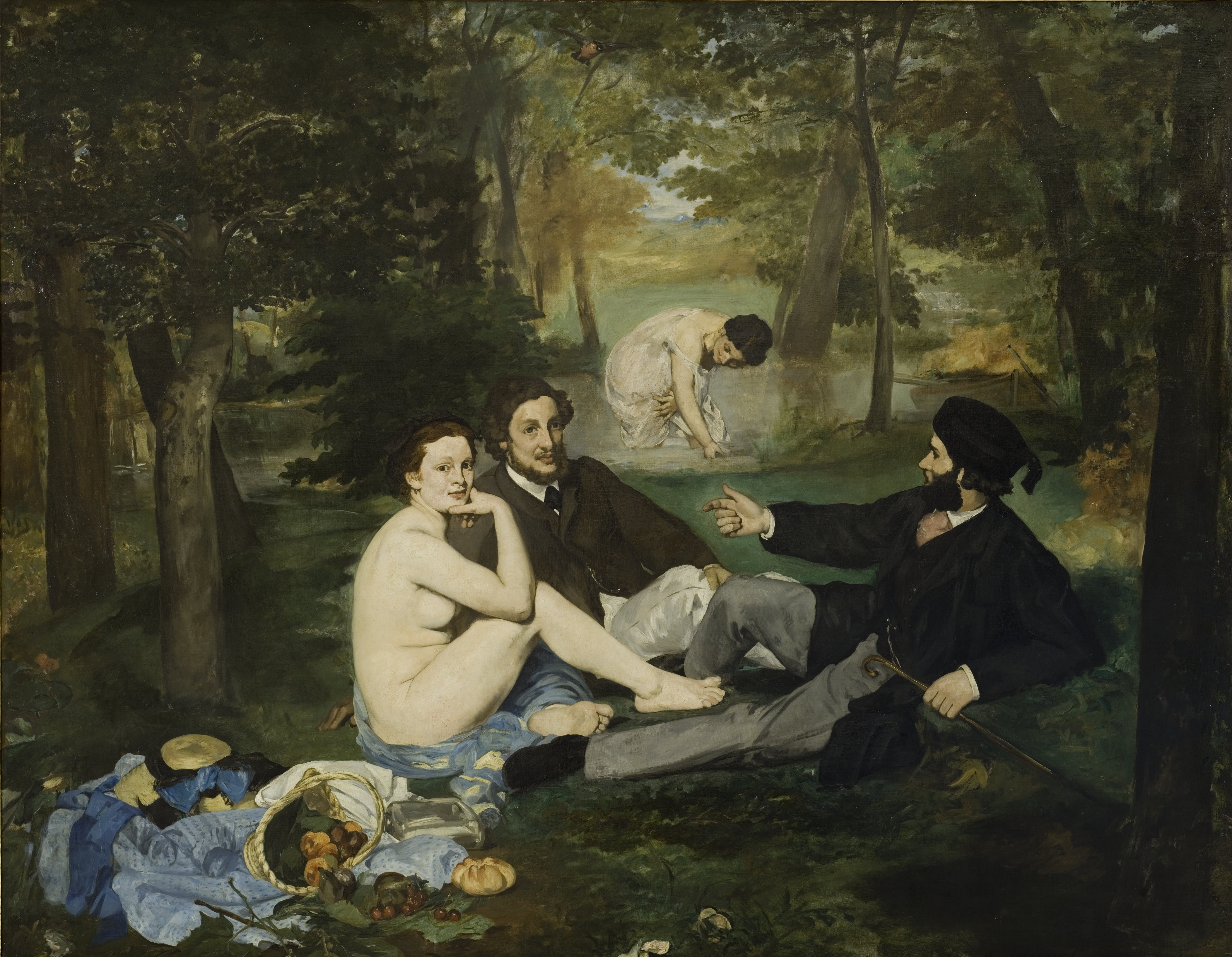
The controversial exhibition of Édouard Manet’s Déjeuner sur l’Herbe at the Salon des Refusés in 1863 is often considered the founding act of modern art. The painting broke away from classical art's insistence on historical or mythological figures, feelings of awe, important themes and noble ideals.
I've also read art historians dating the birth of modern art to earlier works such as Gustave Courbet's 1850 Enterrement à Ornans, which also caused a stir among the conservative public and artistic establishment for being concerned with what some described as "ugliness" and "triviality".
However, an artist like Pieter Bruegel the Elder eschewed bombast as early as the Renaissance and I have never read about him being considered a modern artist. His 1568 Noce Paysanne for instance depicts a rowdy peasant wedding with a somewhat grotesque vibe, the artist's late signature style.
I might simply have missed something. But if that's not the case, then how come artists like Bruegel usually aren't taken into consideration in debates around the birth of modern art when they seemingly broke away from classical conformity centuries before the likes of Courbet or Manet?
.
Links to the mentioned paintings:
Édouard Manet's 1862 Déjeuner sur l'Herbe
Gustave Courbet's 1850 Enterrement à Ornans
Pieter Bruegel the Elder's 1568 Noce Paysanne
Part of the issue is the difference between 'modern' and 'modernist'. Bruegel is a 'modern' artist in the sense that he made secular painting in the Early Modern Period, the limits of which basically come down to the individual historian's stance on when exactly they say the Middle Ages have ended. Briegel is a good artist to show the transition as he uses a lot of Medieval themes (like the proverbs), but frames them in a more 'art proper' setting that hints at how we define art in the modern era.
However, he is not a modernist painter. Modernism is basically how the 19th century artists defined themselves by embracing the modernity and rejecting classicism — both a big no-no for the 19th century, which the artists were supposed to hate with a passion while longing for the good old days.
Now, modernists didn't start all this, of course. Some say the first modern painting was actually "Oath of the Horatii" by Jacques-Louis David because he basically made it for himself, thus suggesting a different kind of relationship between the patron and the artist. But the subject matter is still classical, so it's not modernism.
Then the Romanticists suggested that painting actually has no rules, and they should all work for themselves, and the patrons should buy the artists vision as is. It was very modern, and the subject matter was now modern, but the form was still mostly classicist. Thus still not modernism.
Then the Realists suggested that maybe we should use our new methods to push for stuff like social critique. Courbet kind of started it, but initially it wasn't even on purpose — Enterrement à Ornans was supposed to be an unconventional, but still sort of Romantic (dark, pessimistic) treatment of a conventional subject: a funeral. The way Courbet got attacked was really more than he bargained for, and one might say that kind of radicalized his approach to realism.
Still, however, despite the fact that there's a lot of protomodernist essence in it, it wasn't full-on modernism, because it was still operating within late classicist and romantic paradigms, particularly in form.
Also important is that the same time was seeing a huge revisionist pull, both in theory of art, and in art itself — Pre-Raphaelites are the best example of this. Everyone saw the 19th century as a huge problem — industrialization was destroying everything that is holy, and between the existing art forms the only two ways to deal with this was basically either to dream of the glorious medieval or ancient past, or to look upon the world with hopelessness and disdain.
And then, out of freaking nowhere, there's a bunch of nobody frenchmen who are basically saying that the 19th century is bloody awesome. They say they've got all these boulevards now, and beaches, and boat stations, and picknicks, and you could even paint right there and sell paintings on the spot. What the hell, no, said literally everyone, this is not how art works. Why yes, it does now, they replied.
And that's how modernism was born.