I was just wondering because the thick lances with large hand guards that are always depicted in romantic imigas of jousts look a bit unwieldy for a proper battlefield.
It's fairly difficult to tell as there aren't very many contemporary depictions of 14th Century battles. However, what we do have are depictions of 14th Century conflicts from the 15th Century, and we can learn quite a lot from them, especially in terms of weaponry and armour.
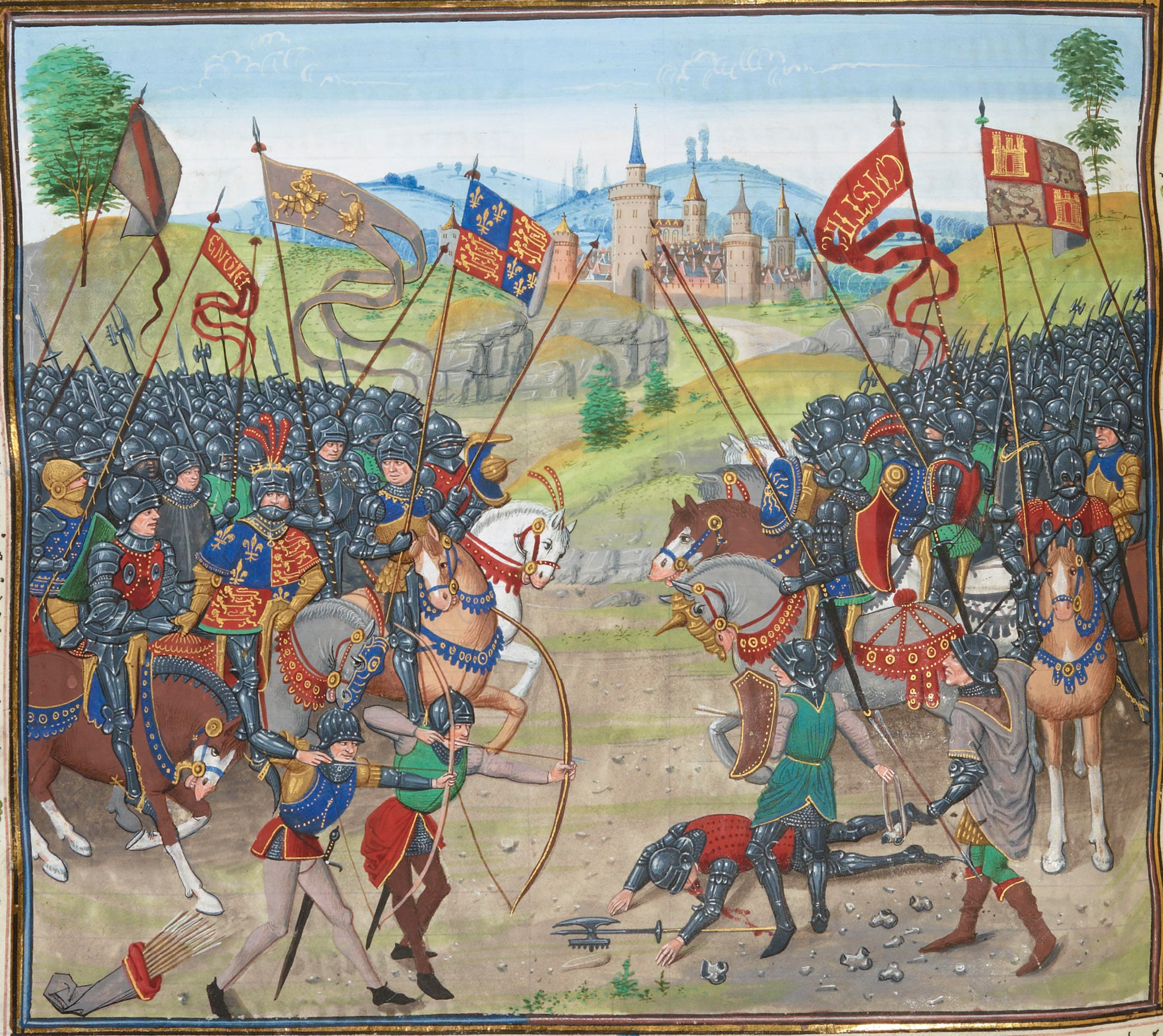
This image is of the Battle of Najera (1367), painted in the 15th Century. There is, helpfully, cavalry present at this battle and it is depicted here. From this image we can see that the cavalry are hold pennants or lances. The Spanish soldiers on the right give us the clearest look at a lance that isn't topped with a pennant, and we can see that the shaft of the lance is straight all the way to the bottom, with none of the flares you are talking about.
So we have that example, but is it the only one? Well, this image is from the Battle of Montiel (1369), painted, again, in the 15th Century. Again, it depicts cavalry on the field, and most are carrying pennants, except for one knight, who has lowered his lance (this knight is the mounted soldier with a kettlehat helmet, beneath the largest of the pennants. He holds a shield with an eagle depicted on it). The lance is similar in colour (black and yellow) to the pennant of the knight just behind the soldier in question. However, we can see that this lance is, once again, completely straight, or it may have a slight flare before the hand that grips it, but it is difficult to descern.
So we've now seen two images dipicting what looks like lances with very simple, straight shafts. Now, both of these images were painted by Froissart for his Cronicles, so maybe this is simply his interpretation? How about we look at a painting by someone else?
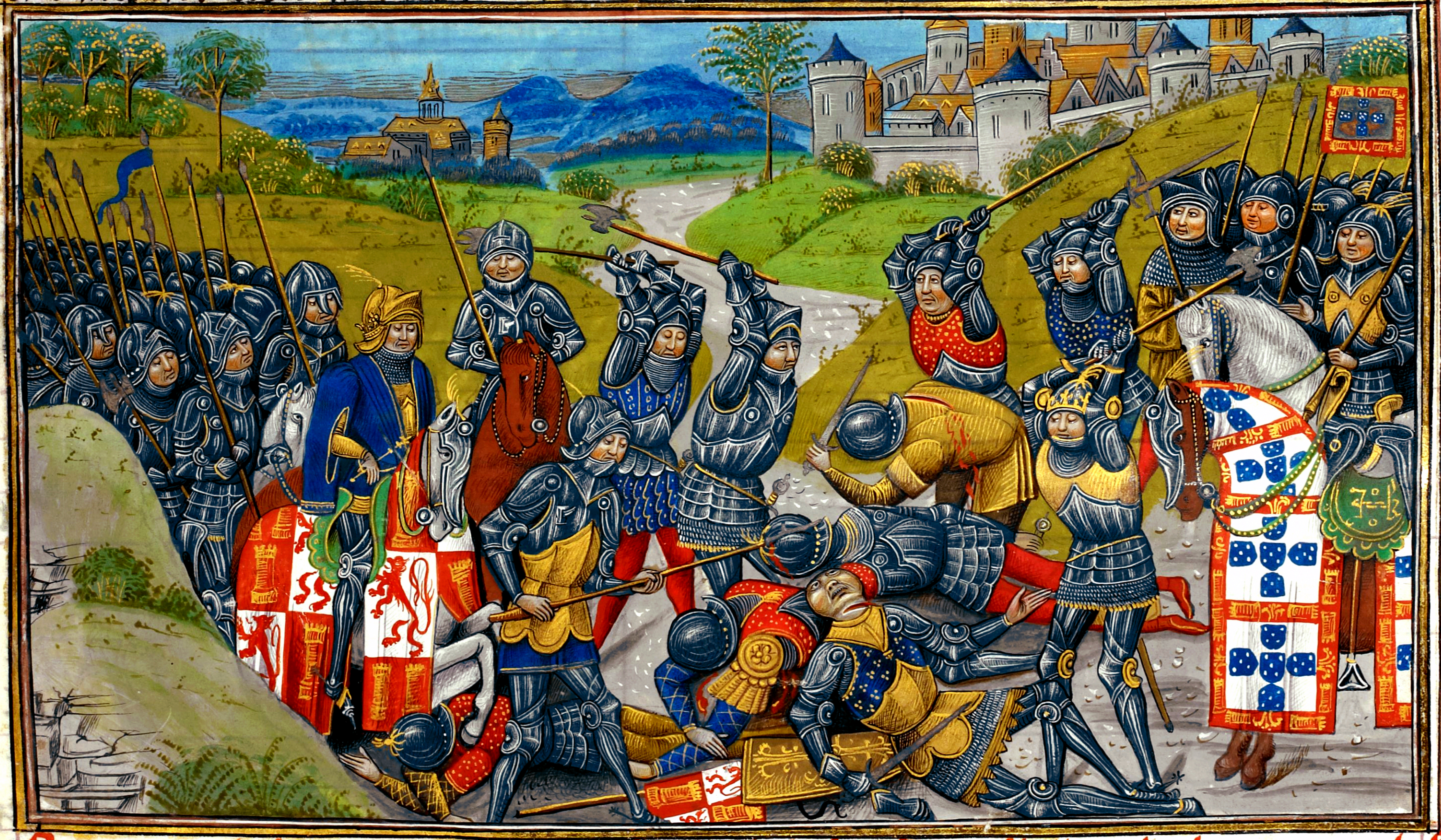
Here we have an image painted by Jean de Wavrin, again in the 15th Century. This depicts the Battle of Aljubarrota (1385), and it is the most helpful so far at seeing lances. We can see that every member of the depicted cavalry is armed, and a great deal of them with what we can assume to be lances. How are these lances portrayed? Exactly the same as Froissart's depictions: no flares of any sort on the lance's shaft.
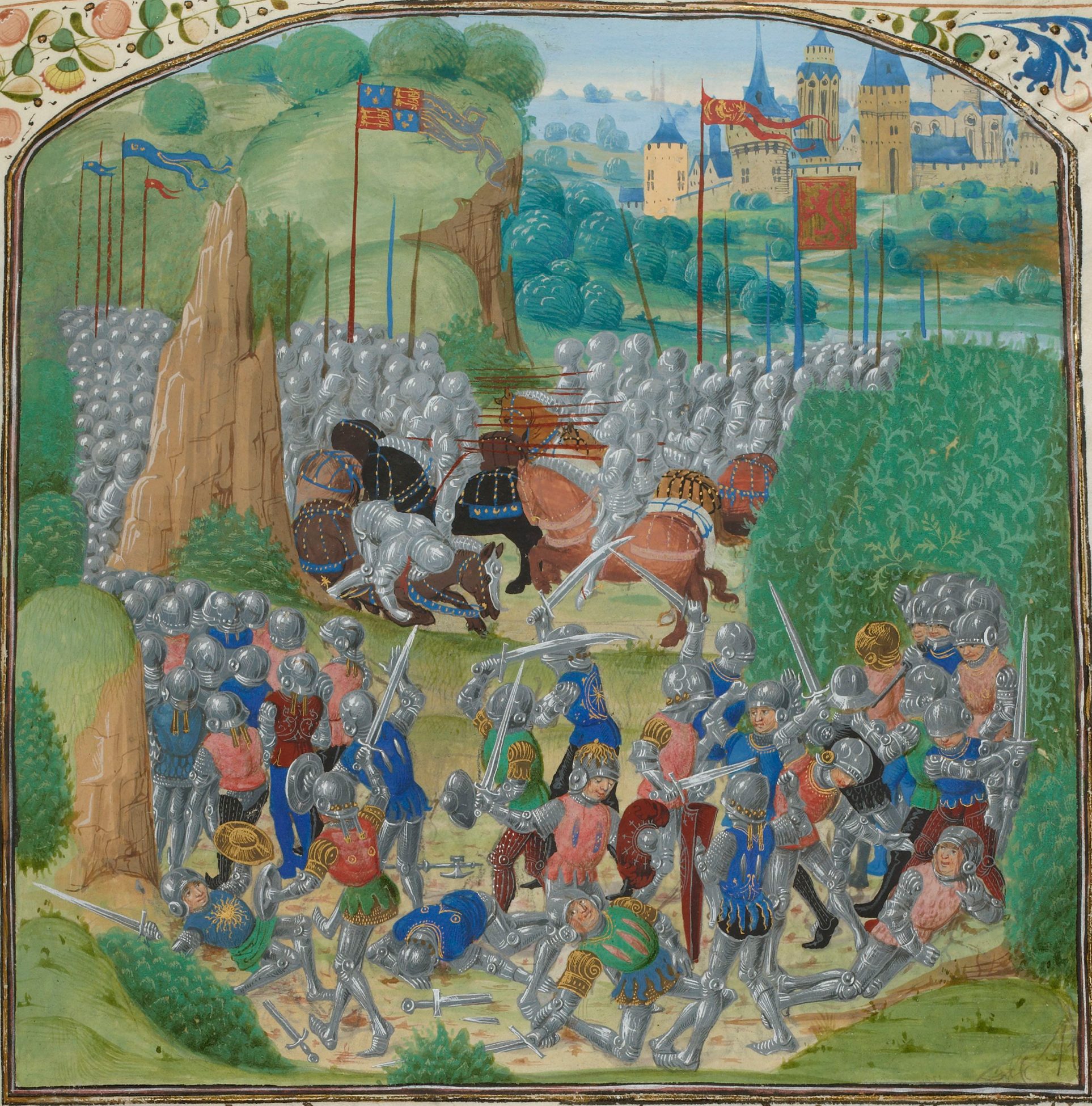
Let's see one more example. This is an image of the Battle of Otterburn (1388). Now, I can't find out exactly when this image was painted, but from the looks of the art, an educated guess would place it also within the 15th Century. The cavalry in the background have engaged each other with lances, all of which are red. Once again, we can see that these lances are completely straight, with no embelishments on them.
From these sources (and there are many more) we can see that the lances used in battle appeared to be much like infantry spears from earlier periods. Indeed, these depictions are almost always painted using knowledge of weapons and armour from the time they were painted in, but such a fact merely informs us that these lances were in use in the 15th Century and there isn't much reason to assume the 14th Century lances were any different.
As for tournament lances, I cannot find useful images on them from the 14th Century, but the classic depictions of them seem to be much closer to the 16th Century ones, as seen here. Meanwhile, war lances from the same period often looked like this and this. Certainly, the 16th Century lances were much bulkier, but the armour of the age actually had a support built onto the breastplate, to allow the knight to hold it steady.
I feel like I should also point out that lances usually were a one time use, as they were usually shatter upon impact or be embedded into their target. It was used for cavalry charges to add the extra shock effect, before the mounted knight would draw his war hammer or mace, so he would not need to deal with a big branch for too long!