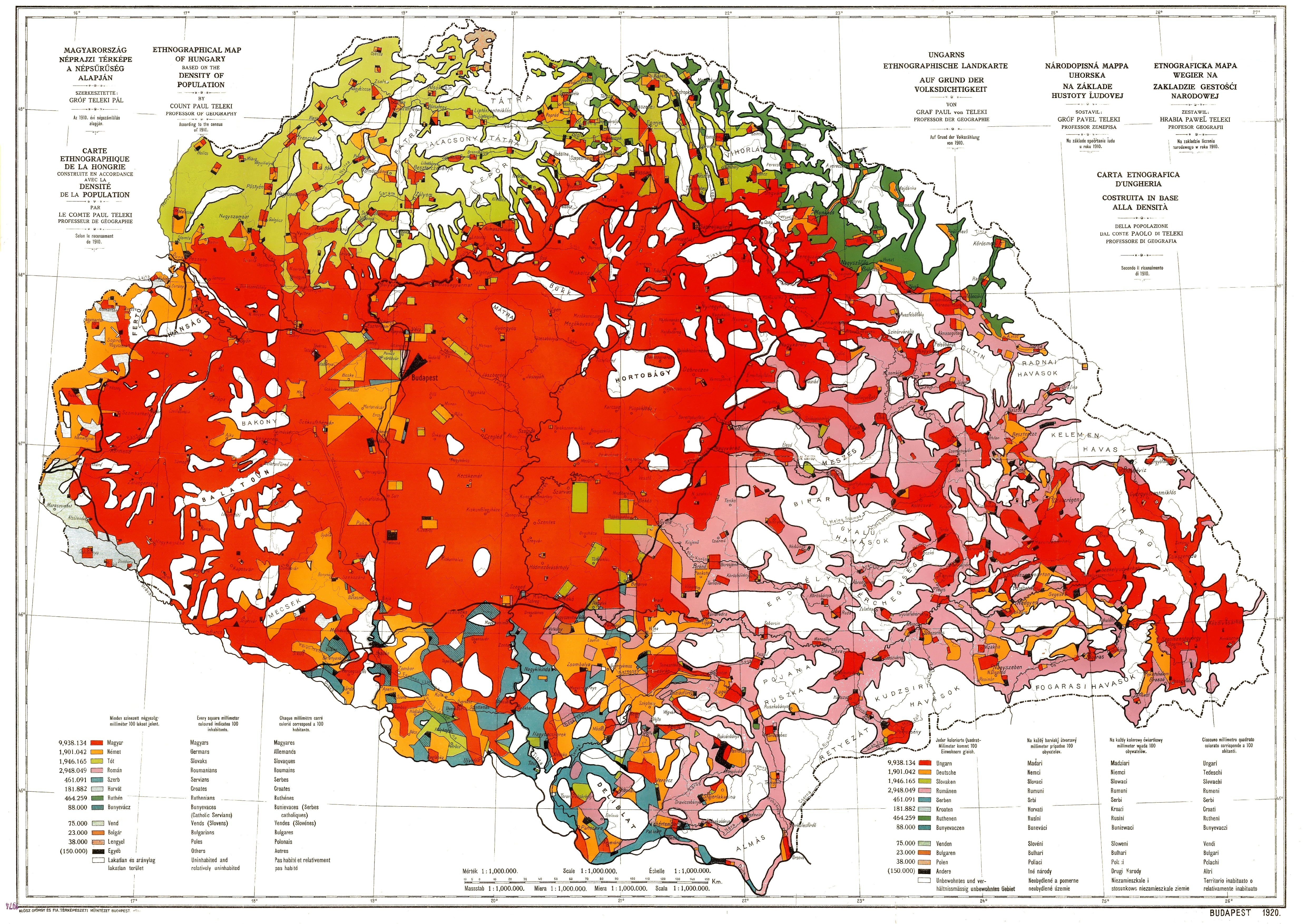
You're absolutely right. But these ethnolinguistic maps were often being produced to legitimize one state or nation's claim to territory, so the bias was often the point. So, for example, the Hungarian delegation at the Paris Peace Conference produced an ethnolinguistic map of the kingdom of Hungary that combined population density and linguistic data and left sparsely populated areas blank. Since there was a significant Hungarian-speaking population in urban areas throughout the kingdom, this worked to support the Hungarian claim to mixed areas like Transylvania. Also, Hungarian speakers were indicated in bright red, while Romanian-speakers got pale pink. Romanian officials argued that this method left out those people living in the Transylvanian mountains (who tended to be Romanian speakers, surprise) and produced maps that were entirely colored in, depicting areas of "unanimous," "absolute," and "relative" ethnic majority in different shades.
If creating ethnolinguistic maps in East Central Europe was a matter of politics, so was creating the data these maps were based on. I'm obviously an English speaker, I learned English as a child, my education was all in English, and English is the language I use most frequently both at home and in public. Even if I do speak other languages, I'd pretty much be lying if I identified myself with any language other than English. This was very much not the case in the 19th-century Habsburg empire. Not that there were no monolingual people or regions, but there were also many areas that were thoroughly multilingual (especially the areas that people were most often arguing about) and people who came from very linguistically mixed backgrounds, so it was often a matter of personal choice what language you decided to identify yourself with on the census. There were political campaigns to get people to identify as speakers of a particular language, and you could face social sanction from members of nationalist movements if they thought you were part of their nation but you weren't acting appropriately. These movements, the conflicts between Austria and the Italian states, and the production of census data and ethnographic maps were all part of the creation of nations in Central Europe.