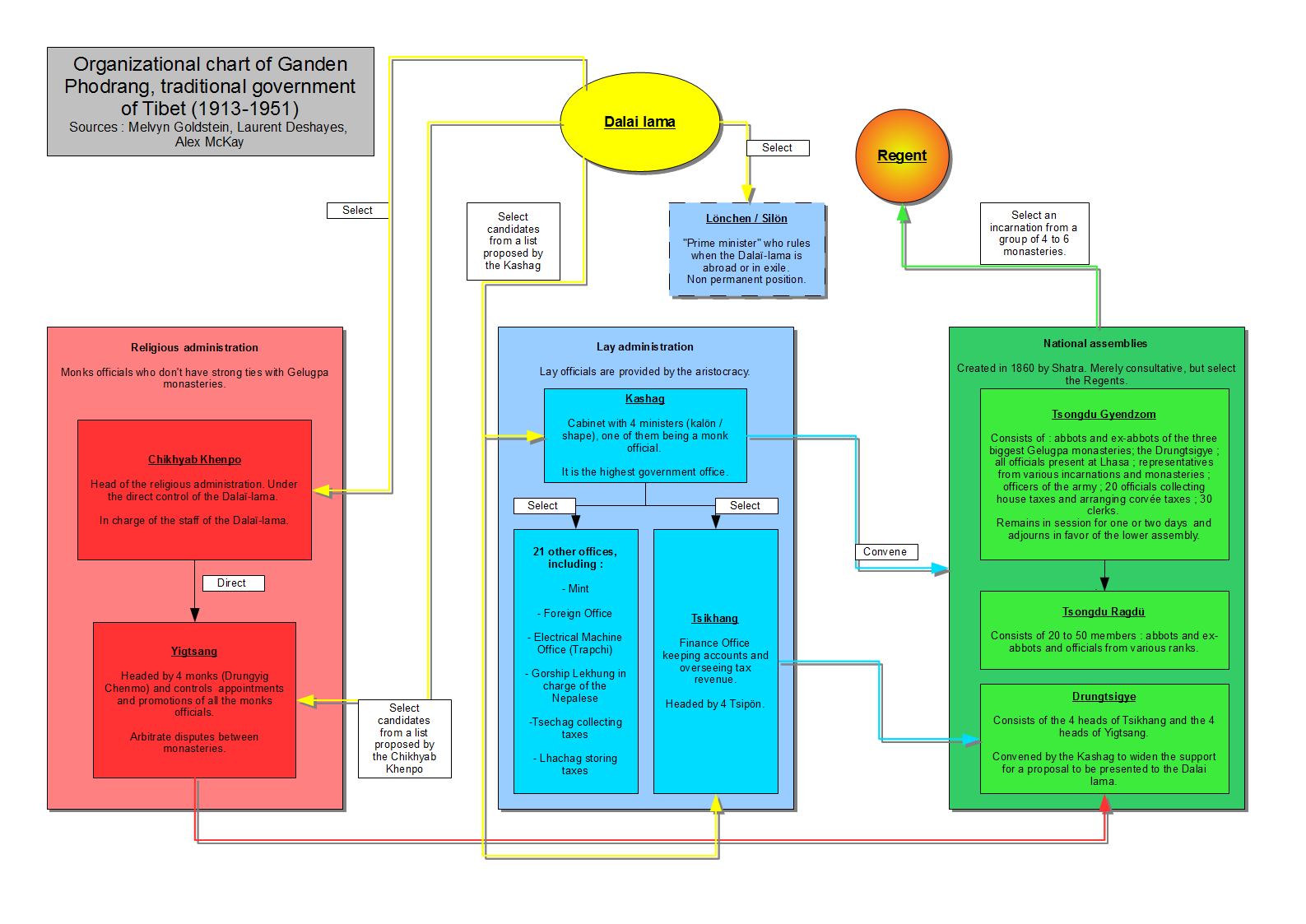
The first and most important bit to know here is that there were two Dalai Lamas in that time, and only one of them had any control over Tibet in the time period specified.
Thubten Gyatso, the 13th Dalai Lama, was born in 1876 and ended up fleeing Tibet twice. First to Mongolia during the British invasion under Younghusband in 1904. Then (somewhat ironically) to India during the Tibetan Revolution, triggered equally by the Xinhai Revolution in China and the invasion of Kham by Butcher Zhao. From India, DL13 provided war support and direction while Lhasa's Tibetans overthrew the Chinese garrison.
After the Dalai Lama (the 13th) returned to Lhasa he did have quite a bit of political control over Tibet. But it should be noted that his control was mostly drawn from tradition, and an attempt to draw how the Ganden Phodrang (the name of the Tibetan government dating from 1642) works is rather hideous. Traditionally and constitutionally, the Dalai Lama could rule as an absolute monarch. Theoretically, his rule should be tempered by strict monastic training, and limited by theological constraints put on him by the Ganden Tripa.
(Brief aside on the Ganden Tripa: the Dalai Lama is sometimes compared to the Pope of Tibetan Buddhism. This comparison fails one two parts: 1. Tibetan Buddhism is composed of five major sects and various subschools, and 2. The Dalai Lama is an important teacher, but he is not the theological arbiter of his own sect, the Gelugspa. In strict religious terms, ignoring politics, the Ganden Tripa outranks the Dalai Lama.)
The 13th is notable not only in that he was the only regnant Dalai Lama for a modern independent Tibet, but that he was also the first Dalai Lama in a century to not die young. His predecessor the 12th Dalai Lama, was just over 18. The 11th died at 17. The 10th at 21. The 9th was 9. You have to go all the way back to 1804 when we reach a Dalai Lama who died as an adult who ruled his country for longer than 2 years: the 8th Dalai Lama was 54 when he died.
This is important regarding the 13th because it provides a frame of reference for what came next:
DL13's primary goal was to build a strong, modern Tibet. This was no small task. Tibet in 1913 still had tribal populations that recognized no authority other than their own tribal chiefs, had small petty kingdoms that paid medieval style tribute to Lhasa, nomadic bandits who traversed distant roads living highwayman-style. And then there was the small, relatively urban core that was Lhasa and Shigatse. Most westerners who ever went to Tibet focused their journeys around this area, with an emphasis on Lhasa. And since the Dalai Lama was technically an absolute monarch, they walked away (and then wrote books) with the impression that all of Tibet was like Lhasa, and directly under the Dalai Lama's control.
Nothing could be further from the truth. The DL13's efforts at modernizing his medieval-style kingdom was an uphill battle. Old traditions died hard. For example, the Dalai Lama recognized that a strong China and an anti-religious Soviet Union next door presented grave threats to his country, thankfully busy with their own affairs for the time being. So what was clearly needed was a modernized army. This meant reforming the tax code to shift funds from the monasteries towards the art of war (horrifying by traditional Buddhist standards). The monasteries enjoyed extra support under the Manchu administration purposely for the opposite reason the Dalai Lama wanted: to shift more of the fighting male population to the monasteries to prevent them from fighting. Now the Dalai Lama needed to reverse that flow. As a result, he had a huge rebellion in Lhasa itself over this change in policy. Of the three main monasteries in Lhasa (Sera, Drepung, and Ganden), Ganden declared for the Dalai Lama's position, while Sera rose in complete revolt. The monks marched across the city, shouting and chanting against him, and entered his summer palace (Norbulingka) and tore up his plants and shat all over the garden. They retreated back to their monastery and (I guess ironically, considering the issue they had decided to revolt over) took up armed resistance against the Dalai Lama's administration. Once Drepung declared for the Dalai Lama's positionm the Sera monks surrendered and were arrested. The Dalai Lama's tax reform went through and the Tibetan army was fully funded. (While we usually think of the harsh and horrors of the 1904 invasion and the 1950 Battle of Chamdo as the Tibetan Army's moments, they achieved some successes against the Chinese and the Ma Clique in the 1920s.)
The Dalai Lama also wanted to modernize his country in other ways: diplomatically and structurally. He sent four boys, called the Rugby Boys, to England to receive modern educations. While all four received western educations and have interesting stories to tell, only one of them achieved anything resembling a success: R. D. Ringang who installed the electricity network in Norbulingka. The other three were either stopped for religious or political reason, and mostly died young. Tibet tended to rely on the efforts of outsiders like Heinrich Harrer or Robert Ford after that instead of spending the massive funds and effort to send students from a landlocked country abroad to be educated only to fail at any change. An English language school in Lhasa opened, however, possibly to mitigate some of these potential challenges.
There was also a diplomatic mission sent across the world using Tibetan passports to try and not only promote Tibetan independence, but also to seek out funding for their financially problematic state. Finance Minister Shakabpa was on this mission and you can see a copy of his passport in his book listed below (hard cover copies included ridiculously huge copies of the document).
DL13's efforts weren't totally a failure, but when the Dalai Lama died, there was an 18 year regency during his minority, when a lot of forces kept under lock and key were released. When the Dalai Lama died, his followers who wanted to continue modernizing the country were persecuted to the point of death. Tsepon Lungshar, who probably intended on becoming Regent after the Dalai Lama died, was captured, tortured, and then had his eyes gouged out by the traditionalist faction. The English language school was closed, and the tax code unreformed so the army was left to rot.
Normally after a Dalai Lama died, the Panchen Lama takes over until the next Dalai Lama (whom he is in charge of locating) achieves his majority. This was what happened in the 19th Century: Tibet was mostly ruled by Panchen Lamas, and for the longest time, it seemed that the Panchen Lama would come out as the dominant lama in the relationship between the two. But now, in 1933, the Dalai Lama was dead, and the Panchen Lama was in exile in China. So it was Reting Rinpoche who took over. Rinpoche was a scion of the traditionalist faction and supported the old medieval framework of Tibet against the Dalai Lama's modernizing efforts.
By the time the future Tenzin Gyatso arrived in Lhasa, he became the head of a half-way modernized Tibet that was sliding backwards while the rest of the world was rocketing forward. By 1950, he had been enthroned for a decade, but still had four years to go before he could take the throne (the current Dalai Lama was born in 1936, and was enthroned in 1940). After the Chinese invasion/liberation, however, they were tearing apart the Ganden Phodrang and replacing it with all sorts of people's committees and other communist organizations (many of them stacked with Chinese). The Tibetan government that had any power left floated the idea of moving forward with the Dalai Lama's full takeover of power from age 18 to age 16. And so in 1952, Tenzin Gyatso became the regnant Dalai Lama of an occupied state. So for the entirety of his reign, the current Dalai Lama had to compete with Mao Zedong for control over his own country (and finish his PhD. in Buddhist Philosophy) until his flight to India in 1959 upon the celebration of the end of his Geshe Lharampa degree.
Sources:
Tibet: A History by Sam Van Schaik
Tibetan Nation by Warren W. Smith
Dragon in the Land of Snows by Tsering Shakya
Tibet: A Political History by Tsepon Shakabpa