The Wikipedia page mentions the campaign in Russia, but doesn't provide much details regarding what he did exactly that made him that much braver than other napoleonic commanders.
The English Wiki page says this about Ney in the retreat:
During the retreat from Moscow, Ney commanded the rearguard (and was anecdotally known as "the last Frenchman on Russian soil" because of it). After being cut off from the main army fighting the Battle of Krasnoy, Ney managed to escape in a heavy fog over the Dniepr, not without heavy losses and to rejoin it in Orsha, which delighted Napoleon. For this action Ney was given the nickname "the bravest of the brave" by Napoleon.
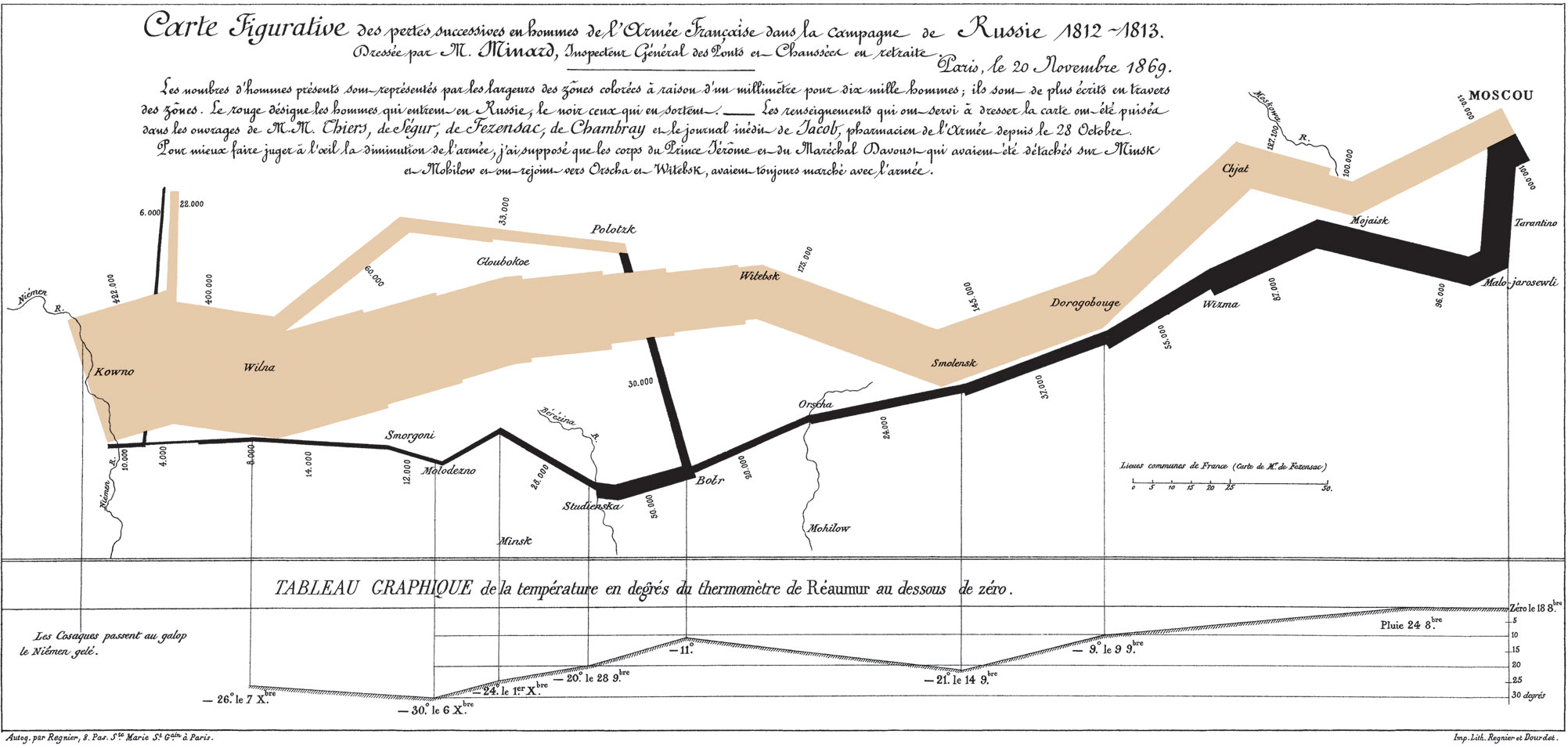
This is a somewhat truncated precis of Ney's actions in the retreat that does not quite do justice to the parlous situation the Grande Armee was in. Napoleon's retreat through what was roughly his own previous line of advance meant there was little in the way of fresh supplies for the army. Minard's justly famous map showing the wasting strength of the Grande Armée. Accounts from veterans of the retreat, produced both during it and after, all attest to the dearth of supplies and growing desperation of the army to reach safety. As a fighting force, the Grande Armée was already wrecked by the time it had reached Moscow and its strength grew even worse.
Thus the French were in real danger of being encircled and trapped within Russia. The Battle of Krasnoi, which was really a series of smaller engagements, was one example of how even a smaller skirmish opened up the possibility of disaster. Over the course of 14-16 November the Russians attempted to pin down and capture three separate Grande Armée corps. The state of the Grande Armee's fighting capabilities was such that none of the corps were able to come to each other's aid. Ney's III Corps was the only one of the French corps that ended up encircled. Napoleon, who was ahead of the Russians' main force had no reports of Ney and many in his headquarters considered him lost. Ney though managed to break out of his encirclement and regroup his shattered corps with the main strength of the Grand Armée. According to Caulaincourt's memoirs, it was at this return that Napoleon rewarded Ney with the title "bravest of the brave," and Ney would continue to guard the Grande Armée's rear as it continued to retreat. Ney's determined defense of the Berezina bridgehead, where he replaced the wounded Oudinot, further cemented his legend in the campaign. Ney would continue carrying up the French rear after the Berezina, and one anecdote spoke to the image of a stalwart marshal who did not give up. According to General Mathieu Dumas, a bedraggled and bearded figure burst into his quarters at Gumbinnen (now Gusev, Kaliningrad Oblast) on 15 December. Dumas thought the man to be a straggler, but Ney retorted,
don't you recognize me, Dumas? I am Michel Ney, rear-guard of the Grande Armee. I fired the last shot of the bridge of Kovno, and then came here through the woods, And I am damned hungry. Get someone to give me a plate of soup.
The Dumas account is impossible to verify, but it did feed into the legend of Ney's actions during the retreat. Ney was a hard-fighting commander whose tenacity meant he would not surrender. This dovetailed into the larger French narratives of the retreat in which French soldiers triumphed over all adversities and survival was a victory of sorts. Ney fit into this quasi-romanticization of defeat by being an example of the type of sangfroid and grit needed to survive this ordeal. The less than heroic details of the campaign became less important in this narrative. For example, although the Russians were in slightly better shape than the retreating French, they were not that much better off than their enemies. One Russian commentator Denis Davydov called Krasnoi less of a battle than "a three-day search for hungry, half-naked Frenchmen." One of the more common post-Napoleonic mythologies that built up around the retreat was that it was a fight against nature. Minard's map fell in with this tradition by visually connecting the wastage of the Grande Armee to the temperature. Although climate certainly was a factor in the horrors of the retreat, this narrative leaves out human agency. The Russians certainly played a role in making the retreat as dangerous as possible and Russian mistakes (or limits) played a role in allowing the truncated Grande Armée to exit Russia. By the same token, focusing on heroic actions such as Ney's obscures the many mistakes conducted by the Allied side in the retreat. Napoleon, for example, nearly brought the army to ruin when he ordered bridging equipment destroyed at Orsha. It was only the foresight of General Jean Baptiste Eblé who saved his tools and forges that allowed the Grande Armée to escape being trapped at the banks of the Berezina. The bravery of Ney at Krasoi would have been for naught had Eblé been more thorough in carrying out Napoleon's orders.
But the legend of Ney and other heroics of the retreat became enshrined in French military culture. Even some of the ultras of the second Bourbon Restoration expressed their regret over Ney's execution for rallying to Napoleon during the Hundred Days when memoirs of the retreat like Segur's appeared. The more complicated and less heroic aspects of the campaign receded to the background in favor of the image of a ragged marshal of France coming in from the cold and demanding some soup.