Current chemistry uses a lot of heat sources to aid chemical reactions, including but not limited to bunsen burners, heating mantles, hot plates, and steam baths. I was wondering what early chemists (or alchemists before them) used to generate heat in a controlled environment. Did they just use wood flames, despite the smoke? Were coals popular? Haven't been able to find much online unfortunately.
Busnen burners are quite recent really, Robert Bunsen was a mid-19th century figure.
If you're going back to the alchemists, then fire, heat, and matter were not distinct things. Which is why I'm going to write a bit about the history of the theory of fire/heat as well. Most of the alchemists believed in the classical Four Elements (of which 'fire' was one), or something similar to it. As you burned something, it loses 'fire', explaining the apparent loss of matter and heat. So heating something up meant adding fire. But different kinds of fires could affect things in different ways. How depended on which alchemist you were talking to - their ideas were eclectic and opaque, to say the least. In practical terms they used wood or charcoal and bellows to regulate heat. Alchemists were almost invariably depicted using bellows. (Bruegel's satirical Alchemist from 1558 is an example, as is this monkey-alchemist from 1650. Alchemists were not held in high esteem in popular culture of 17th century. See Ben Jonson's The Alchemist for instance)
Nicolas Lémery's 1687 "Course of Chymistry" describes the different kinds of laboratory heat/fire in the alchemical terminology that goes back at least to Paracelsus (if not earlier):
To make a Fire of the first Degree two or three Coals lighted will suffice to raise a most gentle Heat. For a Fire of the second Degree three or four Coals will serve to give such a Heat as is able sensibly to warm a Vessel, but so as a Hand may be able to bear it some Time. For a Fire of the third Degree; must be a good Coal Fire. For the fourth Degree, use Coals and Wood together so as to excite a violent Heat. The Fires or Heats of Sand, File Dust and of Ashes have ordinarily their Degrees from the First to the Third but the File-Dust yields more Heat than the other because it more easily receives the Heat and grows red hot. The Ash Heat is most gentle because they retain less Heat than the other Substances.
Note the confusion/conflation of heat and fire and the importance of visuals. For instance, coal and wood does not actually burn hotter than just coal (wood is full of water and has a lower energy density). But because it produced more flames, and more mass is disappearing compared to just coal, and happens faster compared to just wood, it produces 'more fire' in the view of that era..
Several important physicists of the age (Newton, Boyle) were also alchemists, but not much more clear-sighted on these matters Boyle rejected the classical four elements, preferring his own ideas. (which basically amount to elements not existing in reality) But when he observed that heating a metal to form a calx (what we now call a metal oxide) increased its mass, he hypothesized that this was due to fire particles being absorbed by the metal, through the glass of his retort. His contemporary Becher would come up with the idea of fatty earth ('terra pinguis') being the substance of fire. (the 'fattiness' resulting from a remarkable chain of associations from fire to volcanoes to sulphur to its waxyness, the former three were generally accepted by alchemists) This would be renamed 'phlogiston' in the early 18th century and become the dominant theory of both heat and chemical oxidation. Something that burned lost phlogiston. Air rich in phlogiston couldn't maintain life. In the material sense, phlogiston would really be denoting the absence of oxygen. Mysteriously, in the case of Boyle's experiment, it seemed the phlogiston weighed less than zero sometimes.
About the same time you also have Fahrenheit and the first decent thermometers being developed, the first steam engines, and the scientific revolution underway, so the study of heat was about to take off.
By the mid-1700s you have Joseph Black inventing the calorimeter, allowing the measurement of heat from chemical reactions and his discovery of the latent heat of melting and boiling. Lomonosov tries heating metal in a closed vial and notes the mass doesn't change - Boyle was wrong, nothing was going through the glass. As opposed to what's sometimes claimed (mostly in Soviet sources) he did not draw the conclusion (nor believe) that mass is conserved in general though. Lomonosov also suggests heat is the motion of particles, but his argument were rather bad and it didn't get much attention. (he wasn't first either)
Just to skip ahead a bit, it was Antoine Lavoisier (and his wife Marie-Anne) who did more than anyone to found chemistry as a science and get rid of the last vestiges of alchemy. While the rest of Paris was storming the Bastille back in 1789, Lavoisier wsa starting his own revolution in chemistry, He established that mass was absolutely conserved, devised the gasometer to measure gas volumes to establish that, came up with the first modern-ish definition of 'element', and killed the phlogiston theory, separating chemical oxidation from heat. Lavosier theorized heat as a massless substance called 'caloric', which he incorrectly asserted was conserved as well. (to be fair to Lavoisier though, he did write "strictly speaking, we are not obliged to suppose this to be a real substance")
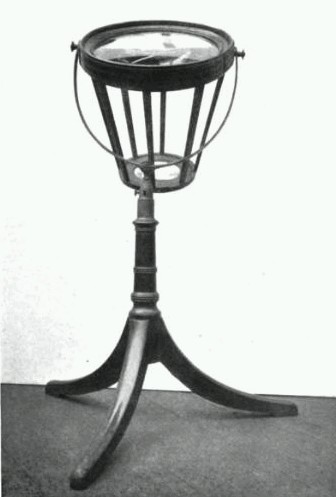
Besides the calorimeter, one of the key innovations that Lavosier and his immediate predecessors (e.g. Priestley, Kirwan) used (during the decade or two I skipped above) was the burning glass. Essentially a big magnifying glass where you could burn things by putting them in the focal point. Here's Lavoisier himself at work with a huge one. So here they had heat without fire, and things could be burned without any contamination from fire (or suspected fire particles going through the glass). It also allowed spot-heating. Priestley used his to produce what he called 'dephlogistated air', and Lavoisier called the element oxygen.
So circa 1800 you had fire, and fire in combination with baths of water, oil or sand for more careful heating if necessary. You had the burning glass, and you had spirit lamps (alcohol burners) as the main heat sources. There were decent thermometers around too.
Berzelius was the greatest experimental chemist of the early 19th century (maybe of all time - it took a century before many of his measurements of atomic weights were surpassed in accuracy), and no small part of that came from his ability to improve the equipment. So around 1820 he devised a new form of alcohol burner with improved air flow, capable of reaching higher temperatures. This invention (the 'Berzelius lamp') would go on to be the main lab heat source until the Bunsen burner (~1855) replaced it in the latter half of the 19th century as coal gas production and networks spread in cities.
As it were, it was also around 1850 that caloric theory died out, Joule established that mechanical work and heat were equivalent, and Clausius laid down the Laws of Thermodynamics, discovered entropy, gave temperature a theoretical description and in short, we finally figured out what the heck heat was. So that neatly wraps up my narrative.
WHat do you mean with early chemists or alchemists? In the beginning of chemistry (3500 BCE), high temperature was mostly needed for the extraction of metals from ores. They used wood or charcoal. Temperature of boiling water was enough for the making of parfumes.
Later (~1550 CE), you have many different types of furnaces, each type for a different process. Destillation, sublimation, melting, calcination, ... every process needed something different, due to different temperatures. They were heated centraly and had a central chimney, too. For more low temperatuzre operation, they used water, sand or ash baths, exposed there flasks to sunlight or buried them in manure (~50 °C for a long time).
Source: Jost Weyer, Geschichte der Chemie Band 1 – Altertum, Mittelalter, 16. bis 18. Jahrhundert, Springer-Verlag GmbH Deutschland, 2018