Why do we separate Upper and Lower Egypt when talking about ancient Egypt ?
Is it because it used to be two different countries ?
If so, why and how do we know that ?
Upper and Lower Egypt, for most of dynastic Egyptian history generally refers to geographical regions and not to two distinct political entities. This is a regional distinction made by the ancient Egyptians themselves, and hasn't been retroactively applied.
Egyptian history has been separated into 'dynasties' since antiquity, and the model is generally associated with the Ptolemaic 'historian' Manetho. Before the king who founds the 1st Dynasty, Narmer, Egypt hadn't been unified at all. Before Narmer (and geographically) ancient Egypt therefore comprised two distinct regions: the interior portions of the Nile Valley being one (Upper), and the Nile delta as the other (Lower). Upper/Lower therefore refers not to relative up/down position on a north-facing map, but to upstream and downstream as the Nile flows into the Mediterranean.
These are two naturally and environmentally unique regions, with settlement and cultivation in Upper Egypt occurring mostly within the immediate vicinity of the Nile, thereby forming a narrow strip of land, as opposed to Lower Egypt where settlement was more spread out because of the greater and broader fertility of the delta.
As Egypt underwent the gradual development of civilisation and kingship in the 4th millennium BC, predynastic kings of Upper and Lower Egypt began to rule over larger territories, eventually coming into more meaningful contact with each other towards the end of the 4th millennium. Dynasty 0 was an Upper Egyptian dynasty, and has gained the name '0' since it precedes the geographical unity which Narmer alleges to have achieved.
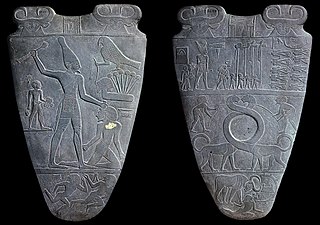
The best source for the 'unification' of Egypt under Narmer is the [Narmer Pallette] (https://upload.wikimedia.org/wikipedia/commons/thumb/b/be/Narmer_Palette.jpg/320px-Narmer_Palette.jpg), which allegedly depicts scenes relating to the two regions that Narmer claimed had dominion over. On one side, he wears the white crown of Upper Egypt, about to strike a captive; on the other, wearing the red crown of Lower Egypt he stands in front of a procession and piles of dead enemy bodies - presumably after conquering his enemies in the north and removing Lower Egyptian rival kings.
Although Egypt didn't necessarily stay united throughout all of its ancient history (for example, 'Intermediate Periods' concern those times when centralised power broke down and Egypt returned to regionalism), the distinction of Upper and Lower Egypt as separate 'political' entities (I use the term lightly since limited sources and primitive proto-kingdoms do not a country make) did not extend past the initial 'unification' which Egyptologists conventionally regard as the beginning of dynastic Egyptian history.
A good reference point and the secondary source for much of this information is Marc Van De Mieroop's A History of Ancient Egypt (Wiley-Blackwell: 2011), which is great for quick reference in answer to a particular query, as well as more in-depth period studies.