Crocodiles were a terrible nuisance, to be sure! In the Tale of the Doomed Prince, the Seven Hathors (divine soothsayers) predicted that the newborn Egyptian prince would die by a crocodile, a snake, or a dog, all of which were deadly threats to Egyptians.
Then came the Hathors to determine a fate for him. They said: "He will die through the crocodile, or the snake, or the dog." When the people who were with the child heard, they reported it to his majesty. Then his majesty's heart became exceedingly sad. His majesty had a house of stone built for him upon the desert, supplied with people and with every good thing of the palace, and the child was not to go outdoors.
A similar fear is expressed in an Egyptian love poem of the New Kingdom. It is a rather lovely poem, as the speaker describes how his love makes him conquer his fears.
My sister's love is on yonder side,
The river is between our bodies;
The waters are mighty at flood-time,
A crocodile waits in the shallows.
I enter the water and brave the waves,
My heart is strong on the deep;
The crocodile seems like a mouse to me,
The flood as land to my feet.
It is her love that gives me strength,
It makes a water-spell for me;
I gaze at my heart's desire,
As she stands facing me!
The Debate Between a Man and His Ba contains a debate between a depressed man and his soul. Throughout the debate, the speaker tries to convince his soul of the pointlessness of life. As an example, he tells a sad story about an Egyptian peasant who lost his family to crocodiles.
There was a peasant who farmed his plot of land. He loaded his harvest into a boat and towed it, for his time of taxation had come.
He saw the approach of the darkness of a storm from the north, so he kept watch over the boat. The sun disappeared, and then came out again, but meanwhile his wife and children had perished on a lake infested at night by crocodiles.
Finally he sat down and cried aloud, saying, "I weep not for the mother, for it is not within her power to go out from the West for another life on earth. I grieve for her children who were crushed in infancy and who saw the face of the crocodile without ever having lived."
A similar attack is referenced in Papyrus Westcar, which contains several fantastic stories set in the royal court of the 4th Dynasty. A woman named Ruddedet has just given birth to three men who will be future kings of the 5th Dynasty, and her maid ran afoul of a crocodile.
Now after some days had passed, Ruddedet had a quarrel with her maid and had her punished with a beating. Then the maid said to the people in the house, "How could she do this? She has born three kings! I will go tell it to the majesty of King Khufu!" She went and found her older half-brother binding bundles of flax on the threshing floor. He said to her, "Whereto, little girl?" Then she told him about the matter. Her brother then said to her, "Is this a thing to do, to come to me, so as to involve me in your tattling?" He tore off a strand of flax and dealt her a bad blow. Off the maid went to draw a bucket of water, and a crocodile snatched her.
Yet another example comes from the Calendar of Lucky and Unlucky days, which predicts death by crocodile for anyone born on a certain day.
FIRST MONTH OF INUNDATION, DAY 3: good good BAD.
Anyone born on this day will die of a crocodile: it is the day of making ipy (meaning unknown) in the river of the gods of the underworld.
So what did the Egyptians do about crocodiles? The most practical solution was to whack crocodiles with your paddles. We have many scenes of fishermen using their paddles as jousting equipment in Old Kingdom tombs, and they could be turned against crocodiles or rocks in the river.
The king and elite Egyptians often hunted dangerous game like hippopotamuses and crocodiles using harpoons. Hunting either animal was an extremely dangerous exercise. The enormous number of mummified crocodiles discovered in Egypt indicates that the Egyptians were more than capable of hunting smaller crocodiles, however.
The Egyptians believed writing could warp reality; in a way, writing was reality, and to write something was to make it so. As a result, scribes were wary of using the intact forms of hieroglyphic signs of dangerous animals like snakes and crocodiles. Snakes were often written with a knife in their middle, and crocodiles were sometimes written with an arrow sticking out of their heads, which suggests the Egyptians used bows and arrows in addition to spears while hunting crocodiles.
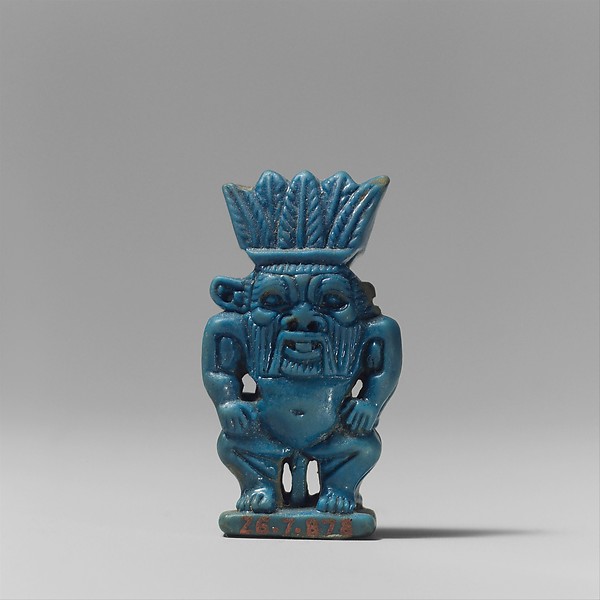
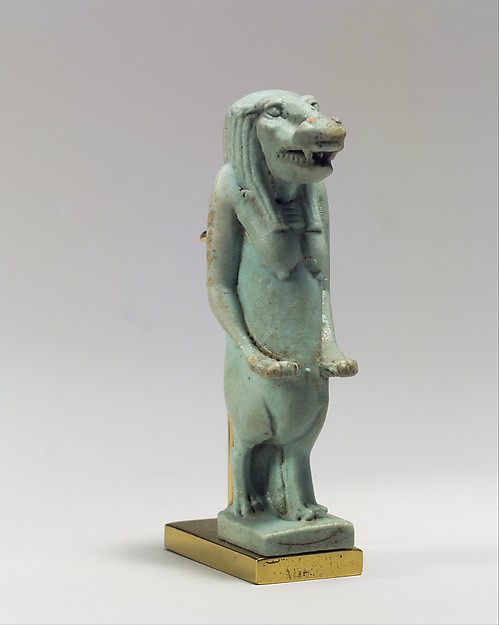
The Egyptians also utilized magical means of protection. Amulets were a particularly common form of protection. These could take the form of a god, such as the dwarf god Bes or Taweret, the monstrous goddess of childbirth and fertility, body parts such as hearts or hands and feet, or divine symbols like the djed pillar and tyet knot. The Egyptians were fond of crocodile amulets intended to protect them from crocodile attacks.
Gestures could be used to ward off crocodiles. Herdsmen pointed with their index fingers to ward off threats as they forded the river. Tomb scenes depicting fording the Nile with cattle are often accompanied by a depiction of this gesture and an accompanying spell.
Crossing the canal by the cattle. Warding off death. Warding off the crocodile by the herdsman: "O herdsman there! Let your face be watchful for this marsh-dweller who is in the water, to prevent those here falling victim to this marsh-dweller. May he come as a sightless one! Let your face be very watchful for him!"
Spells were a very common form of protection against crocodiles. Egyptian magic is a very complex topic, and we have many different types of magical spells, but suffice it to say that the most common spells were protective spells against snakes, scorpions, and crocodiles. Egyptian magic typically took three forms:
Translation - Taking a current situation and providing a mythological precedent. A snake bite, for example, could be compared to the infant Horus being bitten by a snake and healed.
Homeopathic/analogic - Like affects like. Just as you manipulate a ball of clay in your hands, for example, so the spell will allow you to manipulate your enemies.
Contagious - Contact with an object imbued with power.
Egyptian spells usually identified the speaker with one or more gods (translation magic) and incorporated analogic magic.
Here is an excerpt from a rather comprehensive spell from the Metternich Stela:
Come quickly to me on this day like the one did for you who handles the steering oar of the divine barque. May you drive away for me all lions on the desert plateau, all crocodiles in the river, all biting snakes in their holes! May you render them for me like pebbles on the desert holes, like potsherds of a jar along the street! May you exorcise for me the pulsating poison that is in all the limbs of this man who is suffering. Take care not to be negligent when you speak about it! See, it will come for you when you are coming for it, with your words directed against it. See, your name is involved therein on this day! I have created the awe for you through your magic - and you have grown through your magic spells - to keep alive those who suffer from an oppressed throat. Praise is given to you by mankind; righteousness is adored in your appearance. All the gods are invoked in your likeness. See, your name is invoked on this day: "I am Horus the Savior who ensures protection for you."
This spell is to be said over a statue of Horus with a snake in his right hand and his left hand...their heads, and a crocodile under his right foot and a scorpion under his left foot...
A magical spell from the Harris Magical Papyrus (P. BM 10042) requires the user to recite a spell over a clay egg which can then be lobbed like a grenade at any surfacing crocodile or hippo.
"Oh egg of water and earth-spittle - the egg-shells of the Ogdoad gods - great one in heaven, great one in the Underworld, nestling who is prominent on the Island-of-Knives: it is with you that I have escaped from the water. I will emerge with you from your nest! I am Min of Coptos, I am Min, the lord of the land of Coptos!"
This spell is to be said over a clay egg. To be given into the hand of a man at the prow of a boat. If something on the water surfaces, it should be thrown upon the water.
Another magical spell from the same papyrus requires the reader to draw images of crocodiles.
Words to be said over two crocodiles, drawn tail-to-tail within a Neith-hieroglyph...
Finally, the Egyptians used substances like garlic and honey to protect their homes.
...Words to be said over garlic, ground and pulverized together with beer. To sprinkle the house with it in the night, before daybreak. No male snake, female snake, scorpion, reptile, male dead or female dead will enter this house.