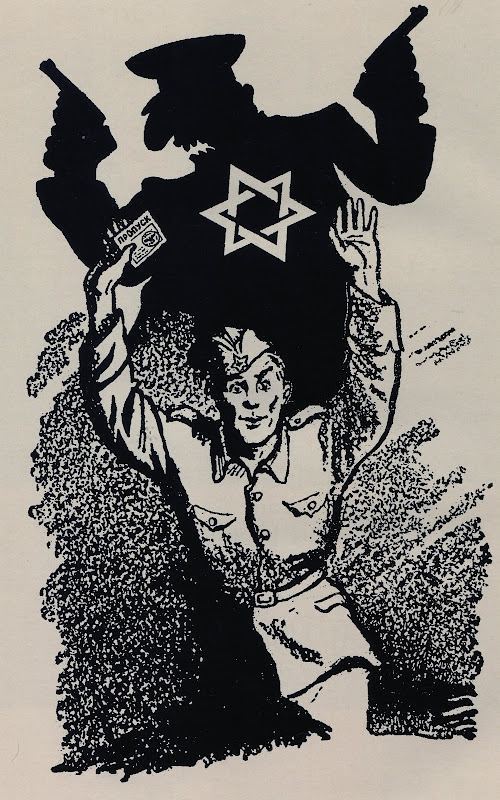
Taken from Finkelstein & Birn's "A Nation On Trial".
In order to asses and understand this statement it is necessary to know its context both in the specific book and in the larger debate this book belongs to. A Nation on Trial by Norman Finkelstein and Ruth Bettina Birn is a book that specifically deals with the so-called Goldhagen debate of the 90s and the controversial thesis by political scientist Daniel J. Goldhagen in his book Hitler's Willing Executioners.
In the late 80s and early 90s through the work of historian Christopher Browning and such events as the Wehrmacht exhibition in Germany, historical research on Nazi Germany and the Holocaust strongly focused on exploring the behavior and motivations of perpetrators of the Holocaust and other Nazi atrocities. Browning's book Ordinary Men was both what lead to this intense focus and one of its most regarded legacies. In it, Browning used the trial records of a German post-war trial against members of Reserve Police Battalion 101 – which had taken part in the Holocaust in Poland – to explore perpetrators from a historical-sociological perspective. Browning reconstructs that the men who were members of this unit were by all indications not committed Nazis – they were not party members, were not the product of Nazi political organizations or culture and were – as the titled suggested – fairly ordinary people. Browning showed that of these men, about 20% could be seen as very gung-ho about committing atrocities, about the same number flat out refused to take part, and the rest went along with the shootings etc. in a grumbling and unenthusiastic fashion. He therefore asserted that what can be gleaned from this is that it was not just ideology that informed their actions but that group dynamics, cultural constructions of masculinity, profit motives and a variety of other factors were at play for the perpetrators of the lowest level. This was rightly regarded as a seminal work in furthering our understanding of perpetrator actions and motivations.
Goldhagen's book – that relied in part on the same sources as Browning – was more or less a direct reaction to the way historiography was going at that moment. Goldhagen disputed Browning's findings. Rather, he posited, what motivated perpetrators was an eliminatory anti-Semitism that was an integral part of German culture. Goldhagen argues that since Luther and the time of the development of a collective notion of German-ness, a unique anti-Semitism in a form that purported the elimination of all Jews from the world had become a – in his words – cornerstone of German national identity. The Germans, in his estimation, were not a "normal" Western people influenced by the values of the Enlightenment but rather that they were in a cultural anthropological sense different from all other Western people. In consequence, historians should not treat them as Ordinary People but rather in a way – and this is also directly from Goldhagen – the same way they treat the Aztecs, who believed in human sacrifice.
This was – as is easy to imagine – a rather controversial position. A whole variety of historians argued that this was a sort of anthropological Sonderweg thesis. The Sonderweg thesis was something developed in post-war Germany that tried to explain Nazism and the Holocaust by purporting that Germany was different from other Western nations, that due to its late unification, it went a special path (what Sonderweg means translated) that lead into Nazism. This has long been regarded as a useless hypothesis when Goldhagen came along and warmed it up.
So, enter Ruth Bettina Birn and Norman Finkelstein with their anthology you mention above and took the quote from. Birn at the time was one of Germany's leading historians on the Higher SS and Police Leaders and was (and still is, I believe), a historian working for the Zentralestelle Ludwigsburg, which is both archive and centralized agency for the criminal prosecution of Nazi criminals in Germany. Norman Finkelstein, who I believe will be more known among American readers, is an American political scientist who researches the Israel-Palestine conflict and the memory politics of the Holocaust and who, like Godlhagen, is no stranger to causing public controversy with his books (The Holocaust Industry, however, occurred after the Goldhagen debate).
So, in A Nation on Trial, published in 1998, two years after Goldhagen's book, they set out to argue against Goldhagen's positions. This all took place in front of the background of an ongoing debate (fight would be the better word) between Goldhagen and Birn that was fought in various journals at the time. Birn f.ex. wrote in German Politics and Society in a reply to a Goldhagen reply to her criticism of his book:
[Goldhagen's] failure to address my main criticisms, and his abusive language interspersed with invec tives and ad hominem attacks make replying to his article quite com plicated. As I consider this style entirely inappropriate in a scholarly debate, I have restricted my response to his factual criticisms.
But on to the quote itself: "Not the Jews but Marxism and Social Democracy served as the prime scapegoats of Nazi propaganda" is written in the book within the context of an argument that Goldhagen makes that Hitler's popularity among the Germans was due to their shared anti-Semitism, which as Goldhagen asserts was the prime selling focal point of the Nazis and ultimately lead to their ascension to power as well as to their enduring support by the German people. Birn and Finkelstein contest this and write regarding the election that enabled the Nazi take-over of power in 1932 that data and sources indicate that anti-Semitism did not figure as a central motive of Nazi voters. Furthermore, in the elections in the 1920s and the early 1930s, Nazi propaganda towards its own voters tended to focus on Marxism and the Social Democrats rather than outright anti-Semitic tropes and stereotypes.
And they are able to demonstrate that indeed, in the late 20s and early 30s the unique selling point of the NSDAP, if you will, was their self-positioning as a strong political force against Marxism and Social Democracy. Their electoral success was indeed not motivated by anti-Semitism but by anti-communism and anti-socialism.
However, while this is true for this specific historic context, it is not be regarded as blanket statement on all of Nazi propaganda and much less on Nazi ideology as a whole, as Birn and Finkelstein make clear within the context of their book. Nazi ideology, being a development of völkisch ideology in Germany, held that Marxism, Social Democracy and "the Jews" were effectively, one and the same thing. They regarded Marxism and Social Democracy as tools of the "Jewish world conspiracy" weaponized to undermine and destroy the German nation and people – a trope heavily influenced by propaganda and stereotypes during the Russian civil war from 1917 onward and imported into Germany with the German revolution of 1918 and the "stab-in-the-back" myth that saw Jews and Social Democrats and communists in league to undermine the German war effort and destroy the German nation.
This trope would feature later massively in German anti-Soviet propaganda all throughout the 1930s and especially after the attack on the Soviet Union. Propaganda poster like this, this, and this would heavily rely on anti-Semitic stereotypes coupled with anti-Soviet and anti-marxist messages.
So, in summary Birn and Finkelstein are right in the specific context they bring up this sentence. In the 1920s and 30s Nazi electoral propaganda operated mainly with anti-marxist and anti-Social Democratic messages rather than outright anti-Semitism. It is however, not a blanket statement since once the Nazis were in power, their propaganda tended to convey one of their central ideological tenants: That marxism, Socialism and "the jews" were one and the same as enemies of the German people.