The key to this question is that while anti-Semitism spread in the following years, hard-core anti-Semitism among the German populace was not what enabled the Holocaust. Apathy and a non-caring attitude was. It sounds like a bit of a trite cliché but the thing is that in order for genocide like the Holocaust to succeed, it is not necessary to have a population the majority of which is willing to slaughter millions of people. What you need is a population, the majority of which is apathetic towards the fate of their neighbors. Who is willing to stand by and do nothing while their neighbors are arrested, taken away, and killed.
The boycott was a failure because it relied too heavily on large swaths of the population being involved, especially in the urban centers where a lot of Jews lived and because a variety of stores and chains that were very convenient in those urban centers were also declared as targets of the boycott such as Woolworth (Woolworth was and is not a "Jewish store", even by Nazi standards).
Historian Janosch Steuwer has focused his research on diaries written in the years between 1933 and 1939 in his book Ein Drittes Reich wie ich es auffasste (A Third Reich how I perceived it) and based on these studies Steuwer writes that for the Nazi regime, their policy of social transformation through the collaboration of vast swaths of said society was heavily dependent on individual actions or rather non-actions. The Nazis' policy of course aimed for active involvement but was happy enough with apathy and a non-caring attitude that focused on an individual's lack of options or lack of care. The boycott represented a crucial learning experience in that regard.
The boycott was a flop because to many a German it represented a major inconvenience, not because an overall opposition to anti-Jewish measure. Something that the Nazis soon realized over the course of the boycott is that many Germans who were not opposed to their policies on principle or on ideological grounds still would retain the idea of their own "good Jew". Meaning that for many a German, they would go along with ideas such as Judeo-Bolshevism being a problem that needed to be fought by the new government but old Mr. Goldziegel where they bought their groceries was not related to that problem to them. They acknowledged that Jews were "bad" in principle with the whole world conspiracy thing and Bolshevism but to them, their grocer Goldziegel or their shoemaker Rosenstein had nothing to do with that. They were "good Jews" after all.
The very core of the Nazi social project was called the "Volksgemeinschaft" (people's / racial community). It represented the idea of a coherent racial national community in which all categories that divided the Germans from each other (class, Catholic and Protestant denomination etc.) would be abolished to form one harmonious community of the people. One of the main obstacles to this utopian community of all Germans living under the guidance of the Führer were those who did not belong: Jews, socialists, communists, so-called asocials and so forth. To achieve "Volksgemeinschaft" it was both necessary to do what essentially boils down to community building but always coupled with the explicit necessity of "cleansing" the community from the "foreign" and the other.
Through community measures, from enabling people who otherwise were unable to drive cars in the NSKK, to organizing Sunday meals with the NS-Frauenschaft, to collective sports, to enabling people to go on holidays through the KdF to hundreds of similar activities, the Nazis build a consensus among the Germans that the regime was good to them and therefore would at least go quietly along with the exclusion of the various others from the community. In 1933, expecting people to boycott their grocer whom they had known for years was, as the regime noted, a bridge too far. But by 1938 when during the November pogrom members of the SA and SS burned down stores and arrested people en masse, what had occured was that the regime had fostered a popular attitude of "the Nazis are doing good stuff for us, so how bad could they be?"
This consent was manufactured through community activities, popular measures by the regime such as arresting communists, political successes such as the re-militarization of the Rhineland and from profiting from the end of the world economic crisis. I have talked about framing before here and the central issue is that via propagating the Volksgemeinschaft, doing community building geared paired with the explicit need of the need to get rid of outsiders, the social and thereby individual frame of what was acceptable to the German population moved towards harsher and more radical measure being at least accepted if people didn't start to participate outright.
The push towards cruelty and criminality was always paired with measure positive for the majority population and clad in a language of necessity and also often security. If Jews were arrested and imprisoned by the Nazis, it was because they were criminals or communists. If they were deported, people told themselves that was because they were going to the East to be resettled despite in many cases knowing better. If an ordinary Wehrmacht soldier was ordered to shoot women and children, kill people by using them as living mine probes, and so forth it was because these people were Partisans, because they were dangerous to the Germans by their mere presence, because it was lawful as he was told.
In 1933/34 when the boycott was called, vast swaths of society were still not ready to forsake something convienent to them for political reasons. The process of moving the frame, of re-framing these actions, of changing individual behavior at large takes time and is largely achieved through measures considered in some way positive to those parts of the population not affected by these measures of exclusion and also by constructing an atmosphere of fear and danger. Bolshevism, for example, was something that represented danger to most Germans, especially those who had lived through the end of WWI and had seen revolution. By constantly associating Jews with Bolsheviks and highlighting how other, un-German, and so forth they were, this atmosphere of fear and danger was created. But at the same time the regime would institute measure beneficial and positive to the majority population because they needed both in order to convince people of the larger concept of the Volksgemeinschaft that was so instrumental on moving individual and social frames of behavior.
In creating a claim to empowerment by actively working towards the Volksgemeinschaft, individual Germans became willing to commit crimes on a massive scale or at least ignore them or be apathetic towards them.
Sources:
Janosch Steuwer: Ein Drittes Reich wie ich es auffasste.
Michael Wildt: Volksgemeinschaft als Selbstermächtigung. Gewalt gegen Juden in der deutschen Provinz 1919 bis 1939.
Detlev Peukert: Inside Nazi Germany: Conformity, Opposition and Racism In Everyday Life.
Ahhhh. Okay, this is the first time I've done this but I will try my best.
Sources:
German Historical Institute, Washington D.C. Primary source documents.http://germanhistorydocs.ghi-dc.org/section.cfm?section_id=13
Robert Moeller The Nazi State and German Society
Willian Carr A History of Germany 1815-1990
Peter Fritzsche Germans Into Nazis
So, from what I understand it was a mixture of many factors. To start off, the treatment of the Jewish people by the Nazis, even admitted by Goebbels, was hard to swallow for German citizens. I'm going to be using a lot of the documents from Moeller's collection of primary sources to make this point. Inge Deutschkron in this book talks about her experience once the boycott began and after the anti-Jewish policies continued. She mentions how at the beginning of the boycott, people from all around her neighborhood were supportive and offered some words of encouragement and support, but as time went on people began to treat her as if she were marked. Nazi propaganda and discourse was relentless about the quality of Jewish people. Coupled with moral hygiene standards, and the degeneration theory, eugenics, and the already established scaffolding of antisemitism, it wasn't a big leap for German citizens to view the now persecuted Jewish people as others as time went on. They were actively being excluded, and in some cases, as was the case for many of the German youths, they were being taught these beliefs as truth.
Meanwhile, the Nazi regime put a lot of energy into trying to get the non-Jewish Germans to cast a blind eye, and it was from what I have read, effective. The Nazi's had a policy called "Strength through Joy", and what this did was it funded social activities for Germans. People would get to go out to Nazi sponsored movies, Nazi sponsored hikes, Nazi sponsored everything. The Nazi's were apart of every organization they could wiggle into, and this surrounded the German people with Nazi ideology constantly. Further, as 1938 came closer, the Jewish people, not only were shunned for being Jewish, and because they were already excluded from society, but they had also began to get arrested for anything that might warrant it. So, this just added to the idea of Jewish inferiority. ("They're getting arrested, so they must be bad people" kind of thing). Also, when looking at the reports on Kristallnacht in 1938, the document mentions a silent, unmoving bewilderment that fell over the German people. Jewish communities were being literally burned down, and no one moved to stop it. And when considering that it's important to remember that the Nazi regime was a regime of fear and violence, even from their very beginnings. Fear, propaganda, antisemitism, otherness, eugenics, moral hygiene, theory of degeneracy, all of these things played a part in German apathy toward the treatment of the Jewish people. Also, I want to mention that the final solution was dictated, created, and carried out by the Nazi regime. The German people were largely unaware to the extent of the violence that occurred against the Jews as a result of the Nazi party. The Nazi party was very careful in trying to keep Germans from being apart of it, from what I've come to read. It wasn't a case of the German people carrying out these terrible things against Jews, it was the Nazis. This leads into the question of Naziism and how the Nazi regime was run. It all runs together in some form or another. It's complex, but hopefully I've answered your specific question with this explanation.
Also, just as an aside, there was a great deal amount of German resistance to the Nazi regime in the form of passive, social, and religious measures. Another very interesting topic.
The specific documents I'm referencing:
Inge Deutschkron "Growing Up Jewish In 1930S Germany"
David H. Buffum "Report On Kristallnacht"
Marta Appel "Jewish Life After The Nazi Seizure Of Power In 1933"
"Reports On The Sources Of Working-Class Support For The Nazis And The Limits To Opposition 1935-1939"
Background knowledge used from sources listed above, specifically referring to the history of antisemitism.
All edits have been for clarity. I'm not a great writer.
Hey all,
If you frequent the sub, you know the drill. If you're here from /r/all, or browse only occasionally, please be aware we have strict rules here intended to enforce the very high bar we expect from comments, so before posting, please read our rules. We remove comments which don't comply, and consider everyone forewarned. If you have feedback or commentary about how things are run here, please don't post it in this thread. We'll just remove it. We love to hear thoughtful, constructive feedback via modmail however.
It can take time for an answer to show up, so we thank you for your patience. If you want to be reminded to come check back later, or simply find other great content to read while you wait, this thread provides a guide to a number of ways to do so, including the RemindMeBot or our Twitter.
Again though, please remember the rules, and keep them in mind while you browse. If you don't like how this subreddit is run, keep in mind that this method has seen us continue to succeed and grow for years, and isn't going to change, so at least try and make your complaint original. /r/AskHistory exists, so complaining about the rules to us is like going into a fancy restaurant to complain they don't sell chicken nuggets, even though Chick-fil-A is nextdoor.
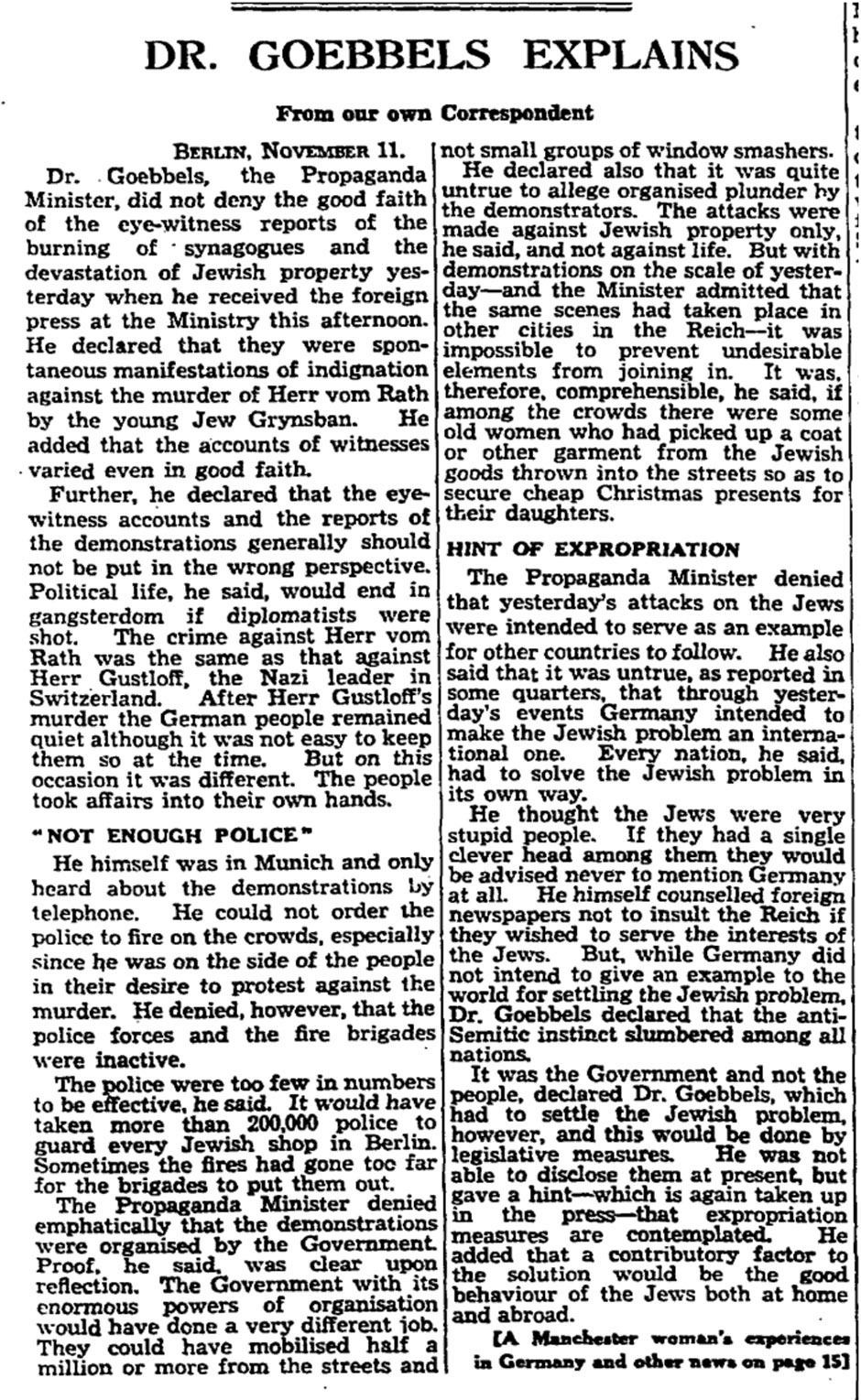
Your question verges onto the topic of psychology, which I will avoid speaking in detail about, but suffice to say it is a question of whether anti-semitism was always there (and the boycott was a fluke) or indifference was the main reason for why the boycott failed and why government action succeeded. To take your question a step further, Kristallnacht is also often considered a flop since it had been meant to be grass-roots movement but was covertly spearheaded by the S.A. The Nazi party denied their role [1] but it has become increasingly clear that this was a "top-down pogrom" to quote Karol Jonca's analysis for the Holocaust Encyclopedia (reprinted with permission to myjewishlearning.com) [2]. This plays into the narrative of indifference, with the German people doing nothing to hinder or help. Some, such as Kater, argue that Kristalnacht is still a decent measure of Germany’s existing anti-Semitism since 10% of young German men were part of the SA [3]. Those who claim indifference end up supporting the idea that the average German knew little about the Holocaust or the death camps, and were pre-occupied with the war-effort [4]. Julie Dawn Friedman's German public opinion and the persecution of the Jews in Nazi Germany, 1933-1945, as reflected in memoir literature discusses these two opinions and concludes “that no single source has so far been adequate in creating a clear, overall picture of the German public's attitude towards the persecution of the Jews” but your paradigm (that anti-Semitism grew suddenly) would be answered better by proponents of the latter theory; the anti-Semitism was always extant beneath the surface, but only welled up when it became safe to be anti-Semitic. One information source which might give you answers (though is highly criticized as biased) is the SOPADE reports produced by the underground German Socialist Part between 1933 and 1939. It provides a study into the public opinions of Bavarians (unfortunately I do not have access to this report or Kershaw’s publication of it in The Persecution of the Jews and German Popular Opinion in the Third Reich [5], only Freeman and Kater’s responses. Freeman describes him as part of the indifference theory set described earlier [4], while Kater criticizes the source as biased [3].
[1] An interview with Goebbels available at https://static.guim.co.uk/sys-images/Guardian/Pix/pictures/2013/11/8/1383904706426/goebbels-001.jpg [2] https://www.myjewishlearning.com/article/kristallnacht/ [3] Michael H. Kater, "Everyday Anti-Semitism in Prewar Nazi Germany: The Popular Bases," Yad Vashem Studies. 16 (1984), 129-159. available at https://www.yadvashem.org/odot_pdf/microsoft%20word%20-%205618.pdf [4] Freeman, Julie Dawn. State University of New York at Buffalo, ProQuest Dissertations Publishing, 1992. 9228046. [5] Ian Kershaw; The Persecution of the Jews and German Popular Opinion in the Third Reich, The Leo Baeck Institute Year Book, Volume 26, Issue 1, 1 January 1981, Pages 261–289, https://doi.org/10.1093/leobaeck/26.1.261