We’re talking about complex systems of trenches, fortifications and positions spanning hundreds of kilometers, with thousands of big siege guns placed throughout. Did the Entente military powers do any cleanup after the war? Or was it left to the locals? Were things like big guns and fortifications deemed too costly to bring back home(especially by the US and UK) and left there(maybe donated to the French)? Were any small arms/machine guns or anything that could be used by individual civilian looters left behind? What would I see if I visited Somme/Loos/Ypres etc. in 1920? 1925? 1930?
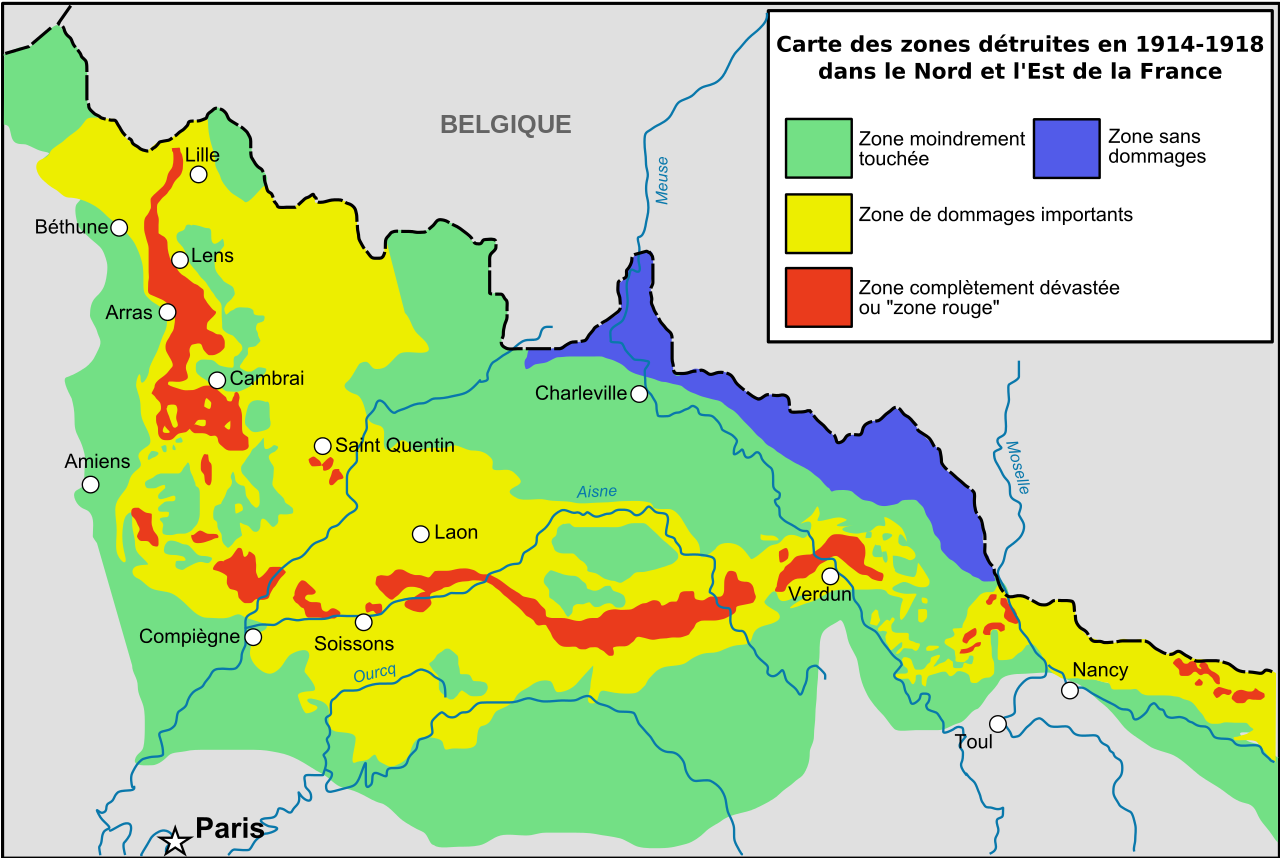
Much of the frontline areas along the former Western Front were treated, in retrospect, similarly to the Exclusion Zone around Chernobyl. The "Zone Rouge" was largely fenced off, with villages relocated and with farming stopped within the zone. The zone has been used for hunting and for forestry purposes, as vegetation grew back fairly quickly. Today, 100 years later, the zone is heavily forested, which is in a stark contrast to how it would have been in 1914, as mostly open farmland. A map of the Zone Rouge and more lightly damaged areas can be found here.
There is cleanup of the millions of artillery shells that still litter the frontlines (both explosive and poison gas shells). There are so many shells in the Red Zone and neighboring areas that they regularly turn up on farms - the haul is known informally as the "Iron Harvest". The Department du Deminage is the French agency, established in 1946, that handles unexploded ordinance, and they remove something like 900 tons of it a year. The rough estimates are that at rate, it will take maybe 300 years to fully clear the ordinance out of the zone. On top of that, the copious amounts of ordinance have caused toxins such as arsenic to leech into the soil and groundwater, which could take many many more centuries to be removed.
"Red Zone: France’s Zone Rouge Is A Lingering Reminder Of World War I" National Geographic. https://www.nationalgeographic.org/news/red-zone/
"The bombs beneath us: Unexploded ordnance linger long after wars are over". Washington Post. https://www.washingtonpost.com/news/morning-mix/wp/2015/08/13/the-bombs-beneath-us-unexploded-ordnance-linger-long-after-wars-are-over/?noredirect=on&utm_term=.4c77feeac652