Surely you are referring to the Irish playwright George Bernard Shaw?
https://www.goodreads.com/quotes/87095-the-english-are-not-a-very-spiritual-people-so-they
First, without getting too deep into the sport's rules (though I'll explain the relevant ones occasionally, as many people are likely mystified by the rules of cricket), some quick notes on the duration of cricket matches. While there are many forms of cricket that feature single-day matches, including limited-overs cricket (a form of professional cricket devised in the 20th century) and many amateur forms, cricket is well known for having matches that stretch for several days. Many sports feature multi-day best-of-x series, of course, where the overall winner must win a certain number of games, but cricket is one of the few high-profile sports where a single match can last multiple days; the only other example I can think of offhand is the two-leg soccer matches that are played in certain tournaments. The amount of playing time per day in cricket is also quite long compared to most other sports. For instance, a modern match of Test cricket (the most prestigious form of international cricket, and the one with the longest matches) is scheduled for a maximum of five days of play, with a day of cricket often comprising six non-continuous hours of play; theoretically, that's as much as 30 hours of cricket for a single match! But let's set aside the issue of various forms of time limits, which have only relatively recently been applied to all the top forms of cricket to ensure a certain logistical stability; as an example of the alternative, a famous 1939 Test match between England and South Africa lasted for nine exhausting days of play, ending in a draw only because England had to catch their boat home.
Some of the reasons that a cricket match can last so long derive directly from the nature of the sport. In its "purest" form (again, setting aside various forms of time limits), the objective of the side that fields first is to get ten of the batting side's eleven players out, which ends the innings (innings, singular, the batting team's opportunity to score runs; each team may have one or two innings in a match, depending on the form of cricket) and causes the teams to switch places. A batsman might be bowled out on the first delivery, or he might stay batting for hours and knock in hundreds of runs. Because the length of an innings can be so variable, cricket is structurally very different from a sport with a game clock. Even baseball, which also has no game clock, gets things wrapped up much more quickly because outs are so much easier to get, and because extra innings are subdivided into neat, three-out, sudden-death morsels, dramatically magnifying the impact of an individual run. (The last, decisive innings of a cricket match may be thought of as a very long, drawn-out version of the bottom of the ninth inning of a baseball game, where the batting team slowly goes through their entire order.)
In its earliest days (finally, some history!), cricket was usually not a multi-day affair. In the heady days of the English Restoration, under the "Merry Monarch," Charles II, Puritan restrictions on sports (and, importantly, gambling on them) fell away. This led to an explosion in interest for what had previously been mostly a pastime for children in rural villages, though its mainstream popularity had certainly been growing prior to the English Civil War. Some nobles began to sponsor and play on county teams, and in the early 18th century we begin to get a few match records, light on details though they may be. The conjunction of nobility, gambling, and as-yet ill-defined rules led to a situation that was ripe for dispute: a noble might play in a game, pay his teammates, wager large sums on the outcome, and simultaneously attempt to act as umpire, claiming impartiality due to his unimpeachable honor as a man of status. Amusingly, some of the first multi-day matches on record were the result of such disputes, e.g., London v Rochester Punch Club (Sept. 1718-July 1719):
This game was unfinished on Monday, 1 September 1718 because the Rochester players walked off in an attempt to have the game declared incomplete so that they would retain their stake money. London was clearly winning at the time. The London players sued for their winnings and the game while incomplete was the subject of a famous lawsuit where the terms of the wager were at issue. The court ordered it to be "played out" and this happened in July 1719.
Such court interventions were not particularly uncommon in this era, considering the sums of money flying around. Less contentiously, London and Kent played a match that began on the 12th of August, 1730, "but being obliged by their Articles to leave off at seven o'clock, they could not finish it," and the match was completed on the 18th. There are other similar records, but the majority of matches in the early 18th century seem to have been completed in a single day. (source)
Over the second quarter or so of the 18th century, nobles began to take on more of the role of sponsor while hiring professionals for their teams, rule sets became more codified (with impartial umpires and such), admission tickets to games began to be sold, and the number of serious disputes declined. By 1745 or so, the proportion of two-day matches was beginning to increase, for reasons that are unclear to me. The general increase in professionalism may have contributed to better tactics, allowing batsmen to grind out longer spells before being given out. Also, this period is the peak of popularity for single wicket cricket, a simpler, faster form where two opposing players take turns bowling and batting, while the other fielders remain in their places (as opposed to two full teams of eleven). I would hazard a guess that standard/first-class/"important"/multi-wicket cricket was differentiating itself from single wicket around this time, deliberately or not, by emphasizing slower-paced tactics and players who excelled in that style, leading to a higher proportion of two-day games.
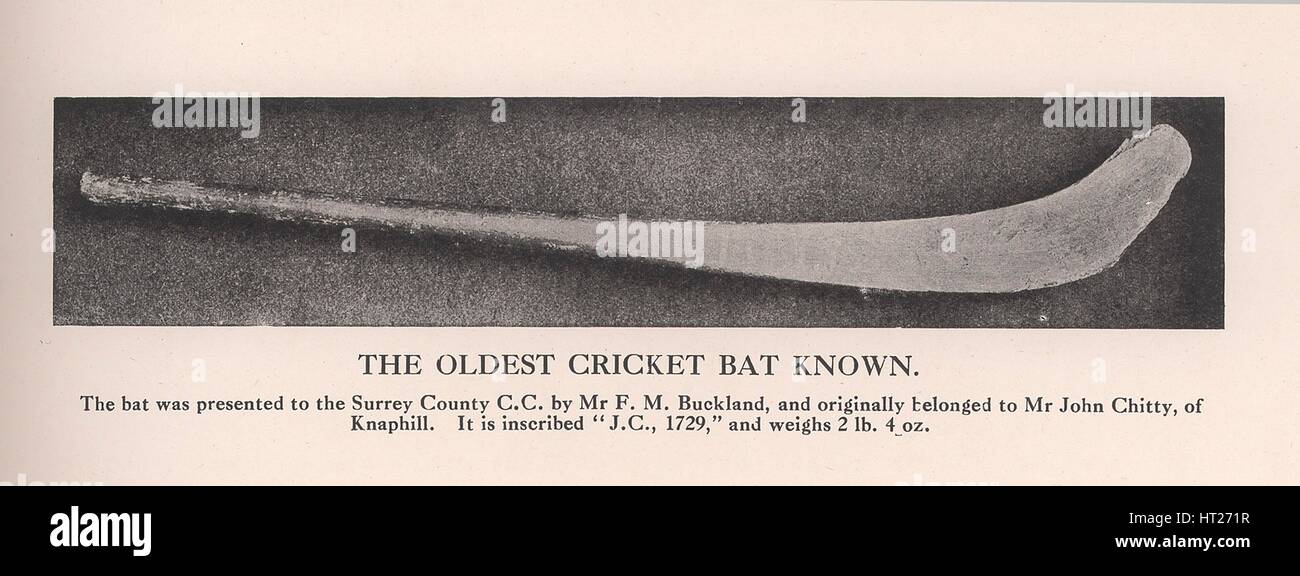
Around 1760, several major changes in cricket rules and style took place, as underarm bowling (where the ball was rolled at low speed across the potentially uneven grass) gave way to pitched delivery bowling (where the ball was thrown through the air). As a direct consequence, older styles of cricket bats, which looked a bit like hockey sticks or curved oars, began to be replaced by something closer to the wide, flat cricket bats more familiar today. A bit more speculation here, but the 1760s and 1770s are also a time when the overall number of runs seemed to be increasing, and when 2-day and even 3-day matches were becoming more standard; it seems plausible that the increased power and finesse afforded by the more modern cricket bat allowed batting teams to stay alive longer, driving up both scores and match lengths. By the late 19th century, when early Test matches began to be played, they were set at a minimum of three days' time, and by the middle of the 20th century they were up to five.
Was there a social purpose? Not really, as far as I can tell. The development of cricket (including its match length) was certainly mediated by various social factors as outlined above, and people certainly can and do make claims about the fundamental Englishness of a sport designed for temperate summer weather that requires a fair amount of patience and has breaks for tea built into its rules, but anything more concrete than that is a bit hard to verify.
The first fairly unambiguous reference to adults playing cricket (according to Birley's A Social History Of English Cricket) occurs in 1611, when in the Sussex village of Sidlesham, near Chichester, two men were prosecuted for playing cricket instead of going to Church on a Sunday. About a decade later, in Boxgrove, north of Chichester, churchwardens complained that six cricketers not only profaned the Sabbath, but 'they use to breake the church windows with the ball'. Records of cricket before this are ambiguous, and it's not clear whether it's referring to the same game or not; there is much greater record of tennis in the medieval period in England.
It seems that cricket was being played in English schools on the 'half-day holiday' in the mid-17th century (e.g., not on the Sabbath, but maybe on Saturday afternoon), and that the game at this point would have been 'something like underarm beach-cricket played with a hockey stick and a non-bouncing leather ball' (to use Birley's phrase), spread by the lower classes to the upper classes in an era where 'public' education was more open to all.
For those confused by all of this, cricket is basically a game where a bowler sends a ball to a batsman, who needs to a) score 'runs' by running across to where the bowler is and b) defend the 'wicket', a set of wooden stumps which the bowler is aiming to hit. A batsman is out, replaced by a new batsman, if the wicket is hit, or if the batsman hits the ball on the full to a fielder, or if the batsman uses their legs rather than the bat to prevent the ball from hitting the wicket. Or if the batsman is outside of the crease when the ball hits the wicket (thus why the batsman will usually only run when they’ve hit the ball to a space in the field where it will take a few seconds to be picked up and sent back to the wicket).
In the modern game there are eleven players on each side, and the sides alternate in terms of which side is batting (all the players on a side batting until they're out is an 'innings'). In first-class, or test match cricket, the team with more runs after two innings wins, though often there are draws (where, in the allotted time, one team might have set a total for the other team to chase, but they ran out of time before it could be determined whether they would have successfully chased the total).
When Birley says 'something like underarm beach-cricket played with a hockey stick and a non-bouncing leather ball', he's referring to some very big changes in the nature of the game over the years. Firstly, batsmen these days use a 'bat', which is a rectangular plank of wood, more or less, with a handle, but the bat has changed over the years, and in the early years of cricket resembled a club, or a baseball bat, or a hockey stick more than it resembled the modern bat. Secondly, the bowler in modern cricket bowls 'overarm', where they run up to the pitch and let the ball go from above their shoulder, and typically where it bounces on the pitch before it gets to the batsman. In contrast, in cricket until the mid-19th century or so, the ball was bowled underarm, and the ball didn't bounce, so it was bowled to the batsman underarm as a 'full toss', which required a different set of skills.
By 1668, we have the landlord of a pub, The Ram, paying rates for a cricket field, and justices waiving excise duties on beer sales at a 'kricketing'. By 1697, we have the Foreign Post reporting that 'the middle of last week a great match at Cricket was played in Sussex; they were eleven of a side, and they played for fifty guineas apiece' (government censorship being lifted in 1697 likely resulted in the reporting of this news, and its previous imposition prevented previous cricket matches from being reported upon).
A 1700 ad in the Post Boy solicits players for a match on Easter Monday:
These are to inform Gentlemen and others, who delight in cricket-playing that a match at Cricket, of ten Gentlemen aside, will be played on Clapham Common near Fox-Hall on Easter Monday next, for 10 pounds per head each game.
Getting back to the length of the cricket match, it's implied here that the match was at most a day long - 'Easter Monday', and that maybe there is more than one 'game' being played - it's unclear how 'a match at Cricket' relates to 'each game' - was there more than one game being played on this day?
By the mid-18th century, rules for play start to appear, such as those announced in 1744, which are quite specific on the size of pitches...and not very specific on the amount of innings, or the length in hours or days which matches are meant to last (at this point, overs are four balls long, rather than the current six...but there's no detail whatsoever on how many overs there should be.) Additionally, the amount of players on the field is also left vague; presumably this is because these were not laws of the game, but agreed upon at the start of the match. Matches in this era generally seem to go over one or two days, however, most usually one; the first 'first-class match' is considered by some to be a match between a Hampshire team and an England team in 1772, which lasted for two days.
The mid-18th century also sees a considerable rise in the extent to which the English gentry was involved in the game of cricket, and there is talk in A Social History Of Cricket of tension between the honest rural origins of the game, and the beer-and-gambling-funded, gentry-involving game being played in London. The current Lords venue was founded as a cricket venue in 1787 (by a Thomas Lord, not by ...titled Lords), and an aristocratic cricket club, the Marylebone Cricket Club (which included the Duke of Dorset and the Earl of Sandwich - and yes, the particular Earl associated with the food), was founded the year after to take advantage of this.
It's in the era of dominance by the MCC that the three-day cricket match starts to become a thing; cricket essentially becomes the leisure activity of the aristocratic classes, and its length is a sort of statement of leisureliness (e.g., some others consider the first 'first-class match' to be held in 1815, between Middlesex and the MCC, and that was a three-day match). In the later 19th century, the lower classes in England catch up to this; the existence of the Bank Holiday, from 1871, enabled working class British to participate in three-day long games. Similarly, in industrialised England, workers tended to get 'wakes weeks' - unpaid annual holidays when the factories closed for maintenance - many workers spent these holidays playing cricket. According to Birley:
Logic pointed to an accommodation with the stern facts of life that all but the privileged had to cope with. Only a tiny minority of even the upper and middle classes had time to play, or to watch, first-class cricket. The working classes had marginally shorter hours, and Saturday half-holidays were now becoming standard practice. This restricted them to games that could be finished in a few hours. In soccer, where ninety minutes was all that was required, the working-class professionals soon came to dominate the game. In cricket, where it was assumed, by MCC, county committees and their membership, public-school and university men and high-grade professionals alike, that three-day games were sacrosanct, the game remained frozen in a neo-feudal posture.
The Victorian era (and especially the 1860s to 1880s) was the era of 'amateurs' in cricket - e.g., there was a principle that, ideally, cricket players should be amateurs (i.e., that they were landed gentry who were so rich that they could spent their leisure time as they chose) rather than professionals who were paid for their efforts; there was a 'Gentlemen vs Players' match every year in England between the years of 1819 and 1962, which was biannual from 1857 (the gentlemen being amateurs, and 'gentlemen' in the sense of landed gentry, and the players being professionals). The English test captain was not a professional until 1952 (when Sir Len Hutton was appointed captain), though earlier English captains like Wally Hammond were only nominally amateurs ('shamateurs').