Legend and fact is unceremoniously mixed in the early history of Venice. Although I wish I could agree with the chronicler Giovanni Deacono's 11th-century narrative neatly placing the first assembly of the people of the lagoons on Malamocco (the modern Island of the Lido between the lagoon and the Adriatic Sea) in last years of 7th century, the reality is that we don't know why or when people decided to permanently inhabit the islands and sandbars in the northeastern lagoons. We do have some context to draw from: in the 7th century coastal northeastern Italy was a Byzantine Exarchate, meaning a military outpost . The evidence (outlined by good old John Julius Norwich) points to the fact that the first ruler of Venice, that is to say the first Doge, Paolo Lucio Anafesto, is probably the same person as Paul, the Exarch (Military Governor) of Ravenna. I'd go far as to justify any confusion about dates (Doge Paolo Lucio was supposedly elected in 697, Exarch Paul was appointed in 723) as being reflections of Paul's military career, moving from being responsible for the lagoon to being promoted in command of the entire Exarchate. John the Deacon states Paulo Lucio died in 727, the same year Exarch Paul was murdered by soldiers angry at Emperor Leo III's decree ordering the destruction of religious icons. Paolo Lucio's supposed successor was one Marcellus, who shared a name with the local Imperial Governor.
Thus evidence of organized government (or, as expected of the troubled times, some sort of military government) must have meant there were people to govern; even if our only sources are commentaries by chroniclers writing three centuries later confusing and conflating dates and names. Norwich dates the consecration of San Giacomo di Rialto as an outpost of the Bishop of Padua as early as the fifth century, and at that point in time the "Rialto" (today the geographic and commercial heart of Venice) was literally a "Rio Alto," a high sandbank of sediment from the Brenta river. To this day, many of the islands of the Venetian lagoon are not densely built up and offer an image of what Venice must have looked like for much of its history.
Coastal northeastern Italy is a land which, until it was drastically altered in the industrial age, couldn't seem to decide if wanted to be land or water. Several rivers, foremost the Po, don't drain into the shallow Adriatic Sea as much as dissipate into it. In the late middle ages, Lagoons dotted with sandbars crossed by deep channels made for perfect sheltered harbors for Byzantine fleets. The small population of fishermen lent themselves as pilots and navigators ferrying soldiers ashore; and naturally where people must pause to change mode of transport communities spring up. These communities provided goods and services as well as small industries, first for the Byzantine military, but soon for their own export and trade. And the use of the plural is no accident, during the migration period and through the lifetime of the two and a half troubled polities calling themselves the "Kingdom of Italy," the community that would become Venice was a union of multiple islands. So much so that in the early history of Venice politics and high society was split between the pro-Byzantine landowners in the community of Eraclea and the pro-Republican merchants on the Island of Malamocco.
Indeed, after the aforementioned Marcellus a man named Orso was proclaimed Dux, a Latin word indicating a leader. This quickly morphed into Doge in the local vernacular. Orso was from Eraclea (sometimes spelt Heraclea) a small town north of modern Venice protected by it's own small lagoon. Eraclea shared with Malamocco the primacy of most important center of the early republic. While Orso was probably expected to organize the locals against Constantinople's repercussions for the local revolt, Pope Gregory was quick to intervene and broker a peace. Gregory himself was protected from the advancing Lombards by by Byzantine soldiers, the last thing he wanted was infighting. Orso and his followers were appeased (the destruction of icons could never be enforced in the west anyway) and Orso was made a consul, or Hypatus in Greek, and would thereafter be known as Orso Ipato, founding the prominent Venetian dynasty known as the Orseoli. After Orso a new leader was not elected: One Domenico Leone was appointed from Ravenna to govern the area and command the armed forces in the northern lagoons. He would be replaced by one Felice Corniola next year. But by the early 740's, the Lombards were rapidly advancing on the Byzantine's chief city in Italy: Ravenna. The Exarch Eutychis sent for help from Costantinople, but the Tagmata (professional regiments) were busy putting down a revolt in Asia Minor and could not be redeployed in time. Hemmed in on all sides, Eutychis could not appoint a Military Commander in the lagoons, so the Venetians elected their own. The Venetians turned to Orso's son, who's name was Teodato, sometimes rendered in english as Deusdedit (or Diodato, or Deodato; transliteration is fun). After the fall of Ravenna and the death of Eutychis in 751, Teodato Orseolo found himself a de facto sovereign ruler, as the Byzantine government in Italy relocated far away to Bari in Puglia, the "Heel" of Italy's boot where it was in no position to offer support, or exert authority, over the people of the lagoons.
There's really a lot that can be said about early Venetian society and how it morphed into such a successful community in the renaissance. After the fall of of Ravenna the lagoon wouldn't have to defend itself from an external enemy for about fifty years, but lack of military activity didn't make life was peaceful: rivalries between the various island communities would flare up regularly, even after Teodato moved the assembly to the more central island Malamocco. Teodato would be murdered by his rival and successor, who would himself meet the same fate a year later. The next doge lasted a good eight years, but was murdered after a failed plot to undermine the tribunes, two officers instituted as checks on the Doge's power. The reasons for the Venetian community's internal conflicts in this early period are varied. Certainly, geography must have played a role: extensive land ownership was more concentrated along the edges of the lagoon, while properties were smaller in the island communities. This led to political and sociological differences: land owners were more in favor of a strong Imperial presence in Italy which might not exactly guarantee stability anymore, but certainly drew conflicts away from the lagoon, while the seafaring merchant classes were largely disinterested in committing resources to supporting an increasingly distant empire; not an entirely intuitive situation, seeing as commercial ties to the east were nonetheless strong.
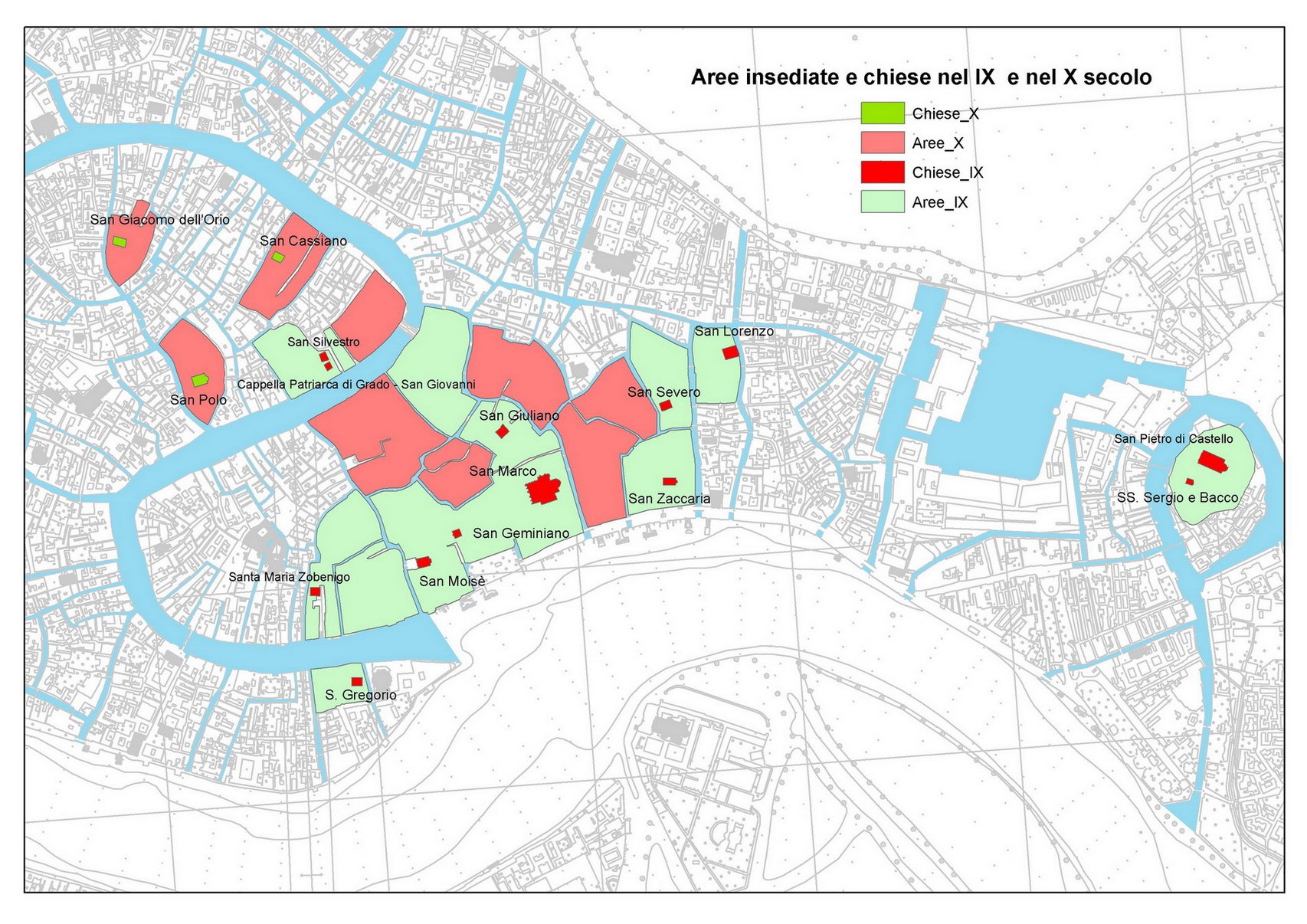
The area now known as the "City of Venice" became the seat of the government of the lagoon because its central position relative to the other communities; indeed peace between the Malamoccans and Eracleans would come with the nomination of Maurizio Galbaio as Doge in 764. Galbaio was a Malamoccan, but he nonetheless claimed "aristocratic" descent from Emperor Galba, making him acceptable to the mora patrician Eracleans. Galbaio would rule for eleven years with a just but unyielding iron fist, and organize the settlement and growth of a number of islands in the lagoon, notably moving the seat of government from Malamocco to the east end of the Rialtine Islands, which at the time low sandbanks of silt from the estuary of the River Piave. Seemingly unable to support a large population (at this point home to only a chapel dedicated to Saints Bacchus and Sergius and presumably a few farms) Maurizio Galbaio nonetheless constructed a cathedral dedicated to St. Peter and a small castle, for seemingly no other reason that they were in the geographic center of the lagoon and a convenient assembly place. These would become the heart of the city of Venice in following centuries.
However, as late as the tenth century is was still only sparsely built up. St. Mark's square was only paved in 1264, and much of the city would remain unpaved until the early modern era. In traditional Venetian urban planning homes were built with their front door right up on the water, with orchards and gardens out back. As the city became more populated, houses lining the waterfront came to enclose individual islands; but in Venetian parlance, these spaces continue to this day to be called "Campi," literally meaning "Fields." It is only in the fourteenth century that Venetian urban construction is sufficiently dense that the individual islands of Venice can be termed a single city.
Some final thoughts continue below.