The Celtic tribes of Gaul, Brittania and Germania demonstrated exquisite craftsmanship, construction, and warfare and had access to the necessary materials and knowledge to create a more organized, well functioning society, yet progress seemed to have stagnated.
You'd think their ability to create some of the greatest iron weaponry and tools that they'd use them for more efficient farming and construction. So what happened?
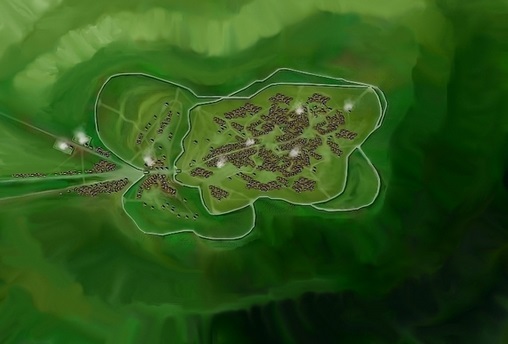
This question is fundamentally flawed, simply because the word "tribal" is utterly meaningless unless given a descriptive definition. Secondly, the "Celts" as a monolithic cultural entity simply did not exist; there were speakers of Celtic languages who inhabited a huge swath of Europe and some of Asia Minor, who lived in a myriad of different forms of socio-political organization and hierarchy. In Ireland, until roughly around the 9th century AD, people were ruled by sacral kings and lived in individual farmsteads dispersed across the countryside, in contrast to Pre-Roman Gaul where Caesar tells us that some Gaulish states were ruled by elected magistrates (ie., they were republics) and contained huge city-fortresses called oppida, which have been excavated across Western and Central Europe.
Finally, the question of why a particular society didn't "progress" to a certain standard is flawed because it imposes with hindsight goalposts which are often derived from other, more familiar societies. I suppose the implicit assumption behind this question is "why didn't the 'Celts' develop societies like Greece and Rome?" Historians often compare like societies to glean something deeper from their commonalities or discontinuities, but never judge them for failing to live up to a given standard of "progress" or "development". Historical societies evolved and developed for a myriad of reasons, but never because they were expected to reach some level of progress like in a video game. Ireland, for example, seems to have preserved very, very ancient Proto-Indo-European social structures until just after the introduction of literacy there, not because the Irish were backwards or conservative, but rather because there was simply no impetus to "progress" into a society with cities, monumental architecture and bureaucratic state apparatuses. Irish society only began to evolve into something new when external factors egged on internal changes - the collapse of the Roman Empire indirectly fueled the slow replacement of sacral kings with warlords and communities organised around cultic worship with stratified, hierarchical ones dominated by warrior-aristocrats. Most of the time, what looks like "historical progress" is driven by factors beyond the control of the people and the societies that it affects.