I wonder what IVs used to be like - I know glass bottles were used. Now IVs sit in the vein with that flexible tubing. When I'm in the hospital for a long-term stay, the plastic pieces nurses use or even leave behind after medication administration are scattered all around me. I can't even imagine living with an IV that weren't a flexible cannula so easily placed anywhere and lived with for so long. Even beyond just IV technology, I'm wondering what it was like in a hospital before the convenience, disposability, and sterile nature of plastics and modern plastic-like materials.
First off -- I'm sorry that you've had the experience of what sounds like multiple long-term stays in hospitals -- that's a very stressful situation.
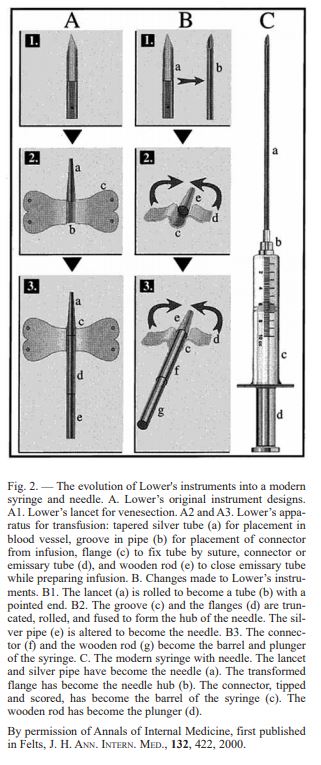
As you're divined, prevalence of modern intravenous therapy is largely part and parcel because of plastics. Routine intravenous therapy is actually relatively modern, dating to the end of the 19th and early 20th century. The first intravenous cannula were used for blood transfusion, and were adapted from lancets used to take blood. The first proto-cannula was by Lower in the 17th century (https://pbs.twimg.com/media/DiuMLZmVsAA4mED.jpg:large -- posted this to my Twitter) and was a silver tube inserted and sutured in place. Note that this would have been used for LAMB'S blood, so not blood transfusions in any modern sense. Intravenous therapy had a short birth in 1834 by Latta and O'Shaugnessy who directly used a saline solution into cholera patients' veins; they used the above method along with a syringe designed for bloodletting. Interestingly, intravenous therapy was abandoned just a few years later for a variety of reasons that I won't go into here (but if you're interested, I did a whole podcast on this http://bedside-rounds.org/episode-25-salt-water/).
Then in 1855, the Wood's syringe (http://www.museumofdrugs.com/Resources/dsc05526.jpeg) was invented, the first widespread HYPODERMIC syringe for placing morphine under the skin (note, not in the blood vessels). By the late 19th century, Wood's syringes would also be used for intravenous injections of drugs like morphine and digitalis. But widespread cannulation was still not done -- the technology existed (and was used in animals), but there just weren't really the treatments that required it. Then in rapid succession, at the turn of the 20th century, Ringer's Lactate, a safe and sterlized IV hydration solution, and then ABO groups, were discovered, which made it necessary to infuse large amounts of fluid (either IV fluids or blood) directly into the veins. The method was still pretty much the same as Lower several hundred years before (https://collection.sciencemuseum.org.uk/objects/co143358/lane-type-infusion-apparatus-london-england-1902-1940-infusion-apparatus), a metal needle and metal cannula, except now rubber tubing was attached instead.
These lasted until c1950. What was it like to use these? Well, just like you get surgical equipment today, you would get a sterile needle and cannula with stylet in sterile draps in an "IV kit;" delivered from the autoclave. These were reused, so the doctor would have to hold the needle up to the light and look for barbs, which as you can imagine would be a disaster going in. If there were any, he'd have to file them down before use. Then he could cannulate a large, straight vessel (since it was a rigid callula), usually the antecubital vein (where they still stick you when you donate blood, in the crook of your arm). After the needle went in, the catheter and stylet would be placed through the needle, and then small stitches put down to hold it into place. Finally, the stylet would be removed and a cap placed. When the catheter was removed, it would be sent back to be washed, autoclaved, and reused.
As you can imagine, plastics changed pretty much everything starting in the 1950s. Now cheap, sterile, single use catheters were available in ALL sizes. And they were flexible, so you could put them in more comfortable veins, and you wouldn't have to force a patient's arm to lie full extended. In the 1980s, catheters came with over the needle introducers, so no more painful sticks with a large needle first. These are now pretty much universal -- when I worked in Botswana, we had shortages of pretty much everything, but always a steady supply of IV cannula.
I realize I didn't really address the second part of your question -- what roughly was it like before plastics, but after we knew about sterility? (so from the 1870s onward, but especially the early 20th century?) And the answer, briefly, is everything was a LOT less convenient. Many more tools had to be autoclaved. There was a lot more breakdown of equipment. And it was a LOT less comfortable for our patients.
I hope that was at least somewhat helpful!