So...I look at diagrams related to DNA, and they make a fair bit of sense to me, like this:
and this:
and this:
OK great.
And I hear reports on how, for example, people in Africa have the highest genetic diversity, and native Americans have the lowest genetic diversity (with less genetic diversity as you get further from the Bering Strait).
Cool, right, makes sense once I think about it.
And then I often hear that linguistic evidence follows similar patterns. And I go to look at the evidence, and mostly find myself confused.
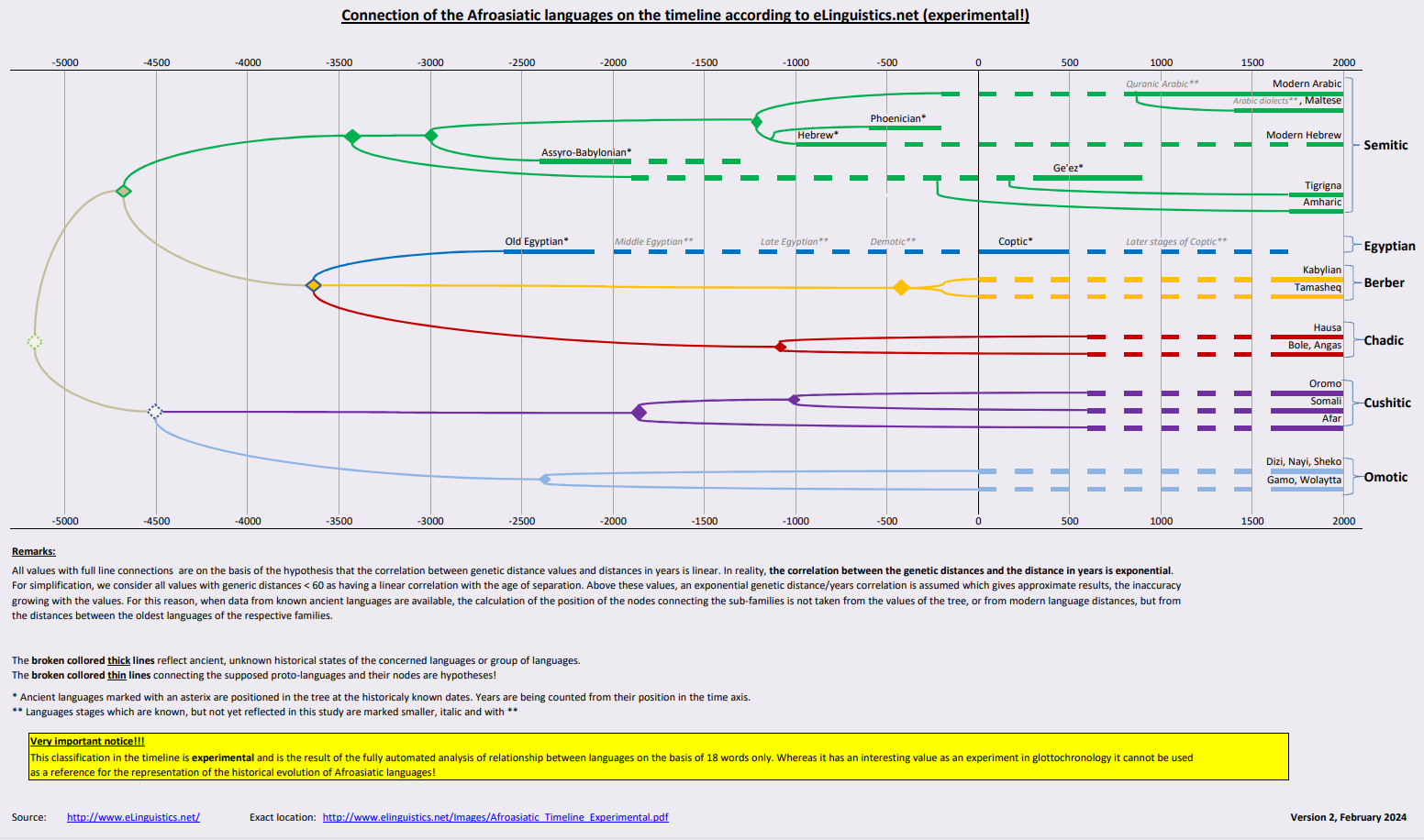
I do feel like I have a decent grasp on the Afro-Asiatic linguistic group, that one makes sense to me:
http://www.elinguistics.net/Images/Afroasiatic_Timeline.png
This chart at least I can follow. The semitic languages are all related (Assyrian, Babylonian, ancient Hebrew, Arabic, Phoenician). There's one branch in southern semitic languages that seems to have crossed back into Africa over the horn of Africa (Tigrigna, Amharic, closely related to some southern semitic languages). Semitic languages are in turn (although more distantly) related to ancient Egyptian. None of them are related to Sumerian (which is apparently outside of any language tree).
Meanwhile, more distnatly related there's Chadic, Cushtic, Berber (not shown on chart), with this split happening earlier. This also makes sense to me, given the timeline, I saw a handy documentary recently on how the Sahara Desert used to be a jungle prior to 3500 BC:
https://www.youtube.com/watch?v=LIAkJg8knTI
Which would cause various people to scatter to various water sources (the nile, Chad which is on a lake)--and then isolate those languages.
Modern day distribution of these languages is mostly Arabic in an area that looks an awful lot like the Islamic Caliphate (minus Persia and Iberia).
OK cool, that one makes sense. Aaand then I go to look at, say, Indo-European and...WTF am I looking at?
http://labs.bio.unc.edu/Hurlbert/langtree.htm
Like...my first instinct is "oh, well yeah, the Achaemenid, Greek, Roman, and Parthian Empires covered a lot of this area" but this tree is telling a completely different story--it's saying most of these languages split off and spread apart 2000-3000 years before the first of these (Achaemenid Empire). Like...I have a hard time putting a lot of the splits in this table into historical context (I can point at the Roman empire, and romance languages that came from that, but I have comparably very little context for the splits that happened 5000 years ago).
OK, but still, at least they're linguistically related right? Let's now go to Asia. What exactly is going on in Asia? Chinese, Japanese, Korean, and Vietnamese are apparently all completely unrelated languages. This is despite all of them borrowing the Chinese alphabet, and having commonalities that I can point at (r/l sounds being equivalent in most of these languages; most of these are tonal languages; Korean's not, granted). So...that's a little surprising right? Are these languages all really unrelated? Really?
And then I look further East to America and things get more confusing for me. So...I've seen it claimed that people have found linguistic similarities between Siberian hunter gatherers and Native Americans. And then I go to try and actually find that evidence and...well, I kind of don't. I mean, National Geographic printed this, and NatGeo is a reliable source right...?
https://news.nationalgeographic.com/news/2008/03/080326-language-link.html
Except, hmm, something's funny about this right? Shouldn't all Native Americans have linguistic commonalities with the one tribe that germinated them? And...turns out there's a much better explanation:
Using computational phylogenetic methods, Sicoli & Holton (2014)[16] suggest that Yeniseian represents a back-migration from Beringia back to Asia.
Well, ok, are there any other theories? Well there's this:
http://humans-who-read-grammars.blogspot.com/2016/07/a-global-tree-of-languages.html
Which...granted that whole blog is critical of the methods of this tree that tries to put every human language into a tree, buuut it seems to suggest that native american languages belong together (ok good start) and also that they are most closely related to...Paupan languages? (So...from what I understand there's genetics to suggest some Paupan influence, with trace Paupa DNA being found in South America, but these are pretty isolated DNA in a sea of DNA that looks a lot more Siberian, so I'd expect maybe loan words from Paupan languages but not the roots of the language).
All of this leads me to believe that--we don't really have linguistic evidence that Native Americans came across the Bering Strait. Archaeological and DNA evidence sure, but despite the claims I've seen around, the linguistic evidence doesn't seem to be there.
TL;DR -- when I look at linguistic trees, I can make sense of them for regions where there's a lot of written history with which I'm already familiar (Egypt and the fertile crescent) but I feel lost trying to extract historical conclusions when I don't have that written history as context (even most of the Indo-European tree is a mystery to me). Any advice?
I'm not really sure what you're trying to glean from it, but in general linguistics doesn't provide this kind of information, it's a fool's errand. Languages change, a lot. Consider the differences between English and Russian and Persian - all less than that of other language families. In just 5000 years they change a lot.
And people can learn other languages, fast. Linguistic data only relates to recent cultural and historical trends. Looking at modern distribution, you would think everyone in France spoke France 200 years ago and that during the French revolution they weren't planing how [to teach it to 7/8ths of the population(https://books.google.com/books?id=jKX1TenIOH0C&printsec=frontcover&dq=Sur+la+necessit%C3%A9+gregoire&source=bl&ots=3hG3zAtBfF&sig=7aqGkOkwSlxt3wRG-3mp4TMDbSg&hl=en&sa=X&ei=1p5MUOGZLoWa9gS_sYHoCQ&ved=0CCwQ6AEwAA#v=onepage&q=Sur%20la%20necessit%C3%A9%20gregoire&f=false), you wouldn't think Germans were scattered all across Central and Eastern Europe making up huge amounts of many cities' populations.
There are enormous (heavily nationalistic and questionable) debates about where e.g. the Slavs first "came from", from which region proto-Slavic speakers appeared from in some way. But this is primarily guess work, going thousands of years beyond any written records.
We have no linguistic data for groups as big and significant as the Huns. Who knows what languages some settlers to the New World 10,000+ years ago spoke, before getting subsued by others or simply learning their languages in the same way Latin and Celtic speaking Britons began to speak Old English.
Sometime in the last year, I saw a yellow flaired user here mentioned an archaeological dig producing evidence from before the commonly accepted dates of migration over the straight, something about new archaeological evidence or the speed of changing common beliefs, but I couldn't find it after a quick search.
Also:
native american languages belong together
No. There are many distinct families, each of which is as distinct as Indo-European to the Japonic family (or indeed to any of the indigenous families...)
Shouldn't all Native Americans have linguistic commonalities with the one tribe that germinated them?
Why only one "tribe"? You're making assumptions and trying to interpret data to fit them.