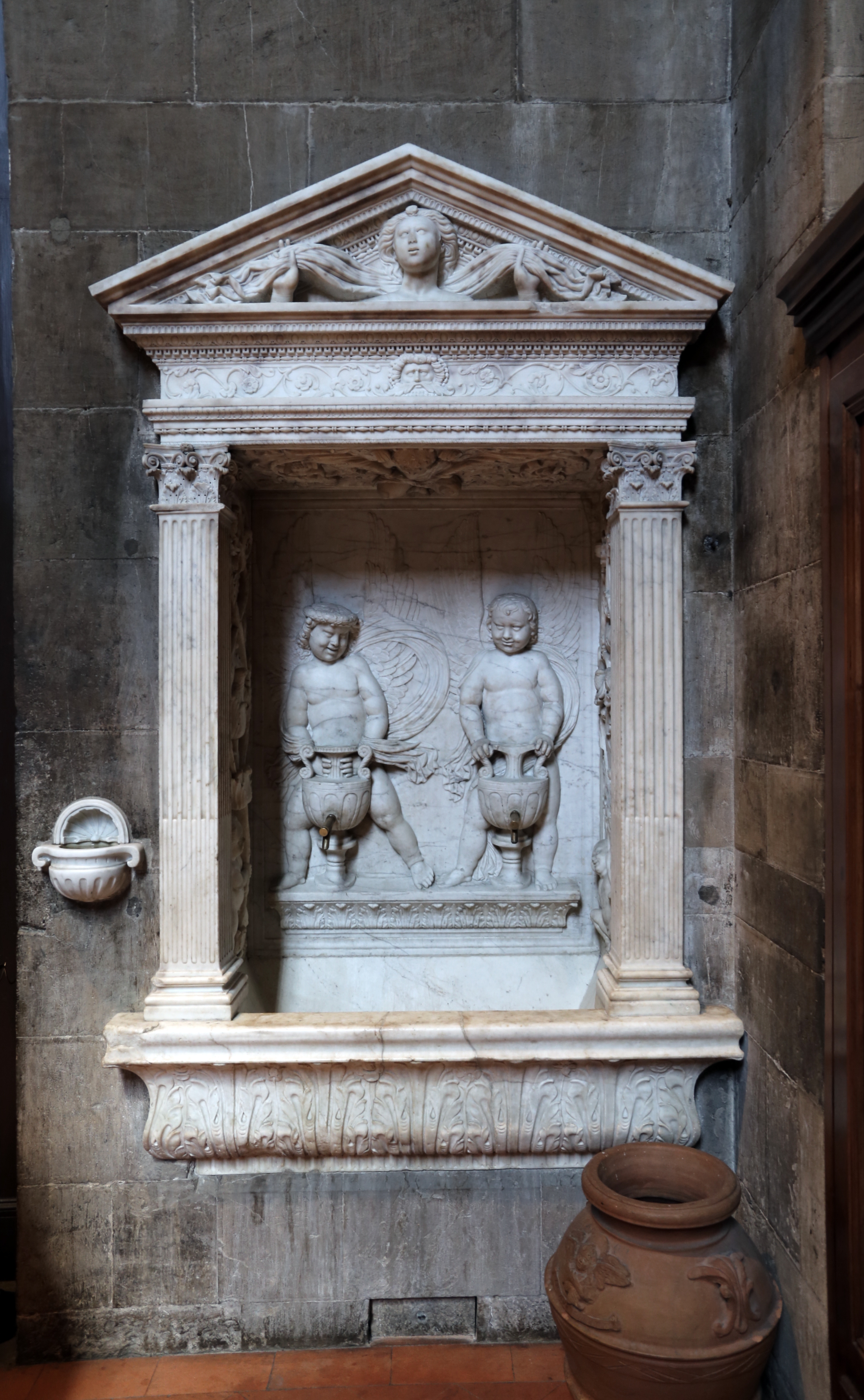
Good question! While there may be earlier examples, my area is the Italian Middle Ages and Renaissance, so I'll share what I know about these statues' significance and resurgence in this period, although I invite others to contribute from different periods/areas. There are examples of peeing youths from antiquity, e.g., in Bacchic sarcophagi and some single figures. But the ones most people are probably familiar with (many of which still stand today) owe their origins to the Renaissance (15th century, specifically).
The statues you're referring to are relatively common in Renaissance Florence (and subsequently elsewhere in Europe). Generally they're fountain sculptures (makes sense given the water), and they survive in marble, clay, and bronze examples. Urinating/micturating youths are found in other media (e.g., paintings, drawings, birth trays, manuscript marginalia) but we'll focus on sculptures here. The term used for such an image is sometimes "putto mictans" or "puer mingens" (both from Latin), although "pissing putto" is more fun. In German it's apparently "Pissmänchen (little piss man). The art historian Victor Coonin (from whose research I'm drawing extensively here) has proposed the term "spiritello d'acqua" to indicate a relationship with the water sprite. Coonin suggests this term based on the work of Charles Dempsey, who argued that the figures we traditionally label as "putti" (young male children in Renaissance art) should really be thought of as sprites (or "spiritelli").
Coonin argues that the pissing putti are best understood as a type of sprites/spiritelli seen in Renaissance art and originally from Greek sources: i.e., male youths representing "tangible embodiments of what are typically abstract concepts." The most common (to most viewers) type of sprite/spiritello is probably the spiritello d'amore (love sprite), associated with Cupid or Love. The art historian Sarah McHam has noted that the young age of these putti (and thus their innocence) "is the perfect vehicle to manifest the uncontrollable and irrational bodily sensations that are spurred by powerful feelings such as fear, beauty, sexual arousal, or love at first sight." (McHam, review of Dempsey, in Studies in Iconography 24 [2003]:248–51)
In this context—sprites/spiritelli as embodiments of abstract concepts—the pissing putti (water sprites/spiritelli d'acqua) can be thought of as carrying connotations of good health associated with the purity of good water. Access to good, clean water was (and is!) a basic and critical need, and so having such access could also be associated with broader ideas around health and welfare, such as good fortune, fertility, and even wealth.
We first see examples of "spiritelli d'acqua" in the first half of the 15th century in Florence. In Florence Cathedral there is a lavabo (where you'd wash your hands) in the North Sacristy that features two sprites, each straddling a water pouch from which a spout issues that provides water. The position of the spout (between the sprites' legs) makes the association clear, even if these sprites are not technically urinating; you can see an image of this, designed by Brunelleschi and carved by Buggiano in the 1430s, here. There is a second example (also by Buggiano but finished by Pagno di Lapo in 1445) in the South Sacristy. Although both examples show youths not creating water through urination, roughly contemporary records use the Italian verb "gettare" (to spout, flow, cast [forth], fling, etc.) to describe what the boys are doing in relation to the water: e.g., the 16th-century Antonio Billi says "these young boys that spout (gettano) water," and this same verb is also found in accounts where putti are actually urinating.
Consider that these two examples were found (a) in a cathedral, and (b) in an object meant for the ritual cleaning of the celebrant's hands before the mass. While the implication of urination might seem odd or out of place here (to our sensibilities), recall that the context of the figures is related to the youthful innocence mentioned earlier and thus to the health and purity of the water. This is not to say there isn't humor (I think there absolutely is), but it's not base or crude humor; rather, it's humor that's sanctioned by the fact that the figures exist outside the normal run of affairs (where bodies are questionable, or can lead to sin, or exhibit lust, impurity, etc.).
Also consider that the display of the penis itself (in a religious or public context) had positive connotations. The penis could suggest power, fertility, and immortality. And in a 15th-century Christian context Christ's penis carried specific meaning: Leo Steinberg has argued that displaying Jebus's penis/sexuality was a critical proof of his full humanity, and the blood of the circumcision, which was the first time he drew blood, could be linked to the crucifixion, and the last time he drew blood (see Leo Steinberg, The Sexuality of Christ in Renaissance Art and in Modern Oblivion, Chicago: The University of Chicago Press, 1996).
Urine was also important within a health and medical context (as it is today, although there are significant differences, understandably), as well as in certain industrial practices. There were diagnostic aspects to urination (important for checking health), and it could be used in balms and extracts. Dyers used urine for manufacturing certain dyes (such as indigo). The 14th-century artist and author Cennino Cennini noted that some artists ground their red lake pigment with urine (although he also noted it was unpleasant to do so). [NB: despite the positive associations with urine, Coonin also suggests that in most cases we're not meant to understand the fluid issuing from the figures as urine, per se, but rather as clean, pure, vital water.]
It's possible to go on, but I hope this answer conveys some of the significance behind the peeing putti: in short, the children exist outside ordinary (e.g., sinful or carnal or base) existence, and can embody abstract ideas with positive associations that would be desirable in a religious, civic, or domestic context. In the case of urination/creating water, there are likely a range of beneficial associations: clean water, good health, fertility, abundance, purity, etc. Also, there is a playful aspect to them that was likely appreciated by Renaissance viewers (art is more fun/funny that most art historians have led us to believe). Thus we can find these sculptures (and images in other media) with surprising (to our eyes) regularity.
For more on this, see especially Victor Coonin's article The Spirit of Water: Reconsidering the Putto Mictans Sculpture in Renaissance Florence. I've pulled from him extensively here, and he's probably the current expert on this topic. On the putto more generally, see Charles Dempsey, Inventing the Renaissance Putto (Chapel Hill and London: University of North Carolina Press, 2001).
EDIT: some clarification and a source
ANOTHER EDIT: From what I've read we don't see fountain images of peeing young girls; when female figures are used in fountains the water issues from their breasts—another indication that there are associations (in both cases) with fertility, abundance, prosperity, purity, etc.