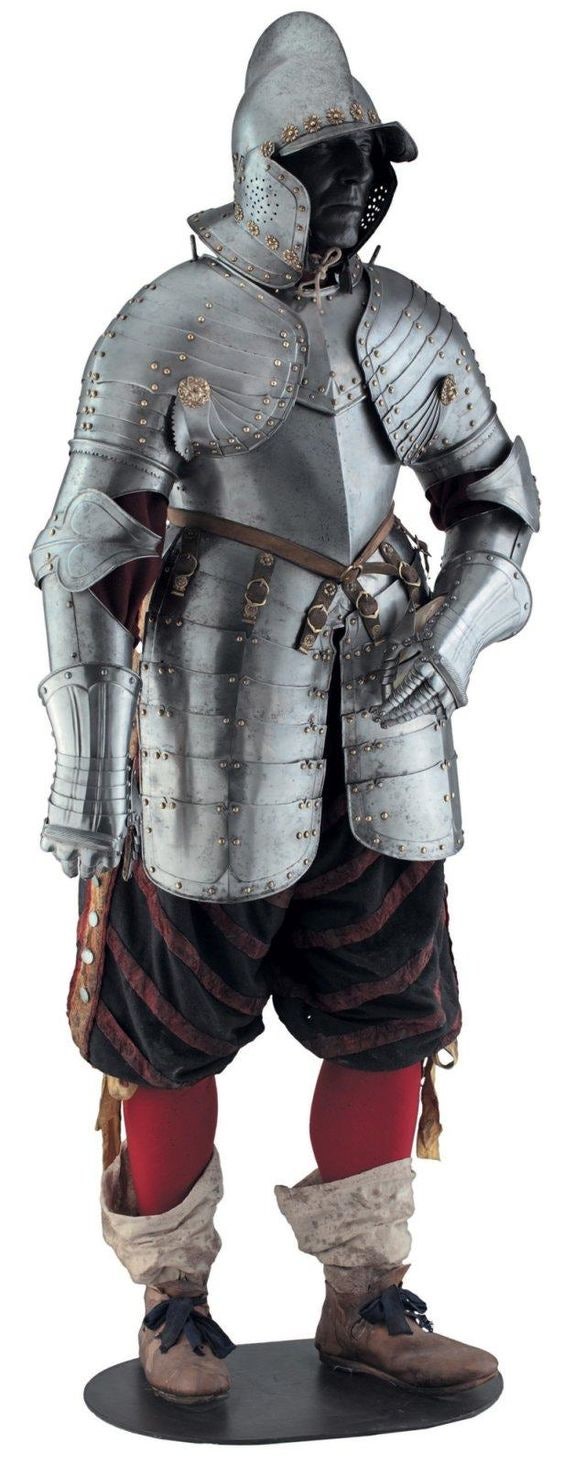
I was at the MET and noticed this. Really curious.
Short answer: no.
Longer answer: honestly the images you link don't look to me much like a Roman Lorica segmentata (and, though it is a small things, these armours are not high/central medieval/12th-13th century - they are from the 17th century, toward the end of the period when armour was commonly worn). While a Lorica Segmentata is made out of multiple segments throughout, these armours have a solid breastplate. However, and this is probably where you saw the similarity, they have overlapping plates at the joints and other places they need to flex - this is called articulation. It can be achieved by riveting plates to each other using sliding or rotating rivets, or by riveting them an underlying piece of leather (I believe this is how the Lorica Segmentata worked.)
In some examples, like 14th century pairs of plates (originally this would have been riveted to a cloth covering/backing) or the 16th century anime cuirasses had breastplates made of multiple pieces (pairs of plates preceded solid breastplates by over 100 years).
However, none of this seems to derive from Roman armour. The only way the most medieval people would have seen a Lorica Segmentata would by by looking at surviving artistic depictions of Roman armour, particularly Trajan's column in Rome, since as I understand it all of the surviving loricae pieces are recent archaeological finds and the main Roman military treatise read during the Middle Ages, Vegetius, doesn't describe them, I believe. But there is no indication that study of Roman armour inspired the articulation of later periods. Instead, articulation is just what you do when you want to make an armour of fairly large metal plates that will be flexible. It existed more than 1000 years before Imperial Rome and it was used again when medieval armourers had to address the same problem.