While perusing the NY Times archives about WWII, I came across this article:
https://archive.nytimes.com/www.nytimes.com/learning/general/onthisday/big/0806.html#article
And this quote: "What is this terrible new weapon, which the War Department also calls the "Cosmic Bomb"?"
I have never heard that term used before. Why was it used? Why did we never use that term to describe the bomb after the event?
So it wasn't any kind of official designation. This is the byproduct of the Manhattan Project having hired William L. Laurence, the New York Times science journalist, to write up a bunch of articles to be distributed by the War Department after the bomb was dropped as part of what was called the "Publicity" program. The idea was the oversaturate the American news media with vetted (and sanitized) information so that journalists wouldn't go scraping for new things (and maybe finding secrets in the process). Laurence was brought on to draft these stories, which were released under a War Department heading and could have any journalists' name slapped on them without fear of repercussions.
Laurence's writing style was not what government releases tended to sound like. He was unusually florid; everything was rendered into hyperbolic terms and kind of crazy neologisms. So he thought that the Hanford plant that produced plutonium ought to be called "Atomland-on-Mars," and he wrote an article, to be released under War Department heading, about how the US would be able to go to Mars now that it had nuclear power, and so on. He wrote endless prose about how man had now entered into the Atomic Age and etc. etc. etc.
The War Department had people who would viciously edit Laurence's text, and remove a lot of that kind of nonsense. (The "going to Mars" story was just entirely spiked with a giant "NO" written across it.) So most of the stories that came out, while still kind of pulpy in their writing, were not as bad as the original drafts. Still some of the true Laurence-isms snuck through and you can find them in the derivative stories that used them as sources. (I mean, how was anybody else to know that Laurence had just made up the phrase "Cosmic Bomb"?)
Laurence is a fascinating character, as an aside. He was a Lithuanian immigrant who had escaped after the Russian Revolution of 1905 by having his mother roll him out of the country in a pickle barrel. He broke into science journalism after just kind of hanging around Cambridge, Massachusetts, for a few years picking up English and talking with scientists. He serendipitously got tapped by General Leslie Groves to be the only embedded civilian journalist on the Manhattan Project, and won a Pulitzer for his story about riding along on the Nagasaki mission. He wrote the fake press releases that were released after the Trinity test, announcing that it had been an accidental ammunition dump explosion, and was given a go at drafting the initial post-Hiroshima statement to be signed by Harry Truman. Again, a taste of Laurence's style:
This greatest of all weapons, developed by American genius, ingenuity, courage initiative and farsightedness on scale never even remotely matched before, will, no doubt, shorten the war by months, or possibly even years. It will thus save many precious American lives and treasure. … The tremendous concentrated power contained in the new weapon also has enormous possibilities as the greatest source of cosmic power ever to be tapped by man, utilizing the unbelievable quantities of energy locked up within the atoms of the material universe. … We are now entering into the greatest age of all — the Age of Atomic Power, or Atomics.
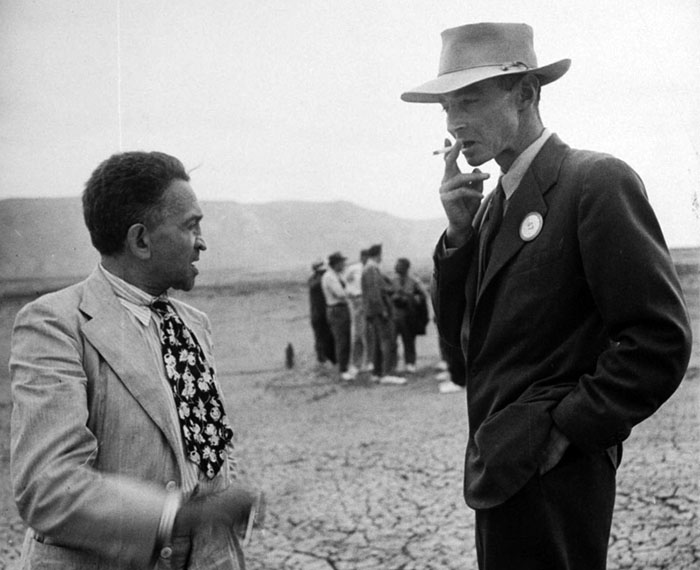
This draft was so poorly received ("too phony," complained Harvard University's James Conant) that the job of writing the President's statement was given to someone else entirely (Arthur W. Page, the Vice President of AT&T), but Laurence was still retained for a lot of other writing. Physically he was about as mismatched a human being as you can imagine — short, slightly lopsided, like a "muckraker New York journalist" pulled out of central casting. Here he is next to J. Robert Oppenheimer — a wonderful study in contrasting physiques.
Anyway. Obviously I find Laurence fascinating; I wrote a blog post about him a few years ago (and lobbied to have a character based on him included in the second season of the fictional television show Manhattan!), which you can read if you want more information. Spencer Weart's Nuclear Fear: A History of Images has a lot on Laurence in the beginning of it. The absolutely most amazing thing is the oral history that he did with Columbia University, which is unfortunately only available on microfilm, but is just wonderful: pure Laurence, full of hyperbole and probably nonsense (he tells a story on it in which he claims to have given J. Robert Oppenheimer insights into the philosophy of his physics.. riiiight). Quite a character. And through a strange twist of fate, one of the first chroniclers of the atomic bomb that most Americans would have had the opportunity to read, whether they realized it or not.