I asked this question here over a year ago (though at the time it specified specifically maces) and despite getting a decent number of upvotes, I didn't manage to get the attention of someone who might have held the answer. But my curiosity still remains!
For whatever reason, the internet in general has a distinct lack of medieval smithing techniques *regarding anything that isn't a sword. Thus, I ask the historians if they know what they were?
In some cases, it isn't obvious, but in some other cases, there are enough clues left on the finished weapon that we can see how it was made. The methods vary a lot, even for one type of weapon.
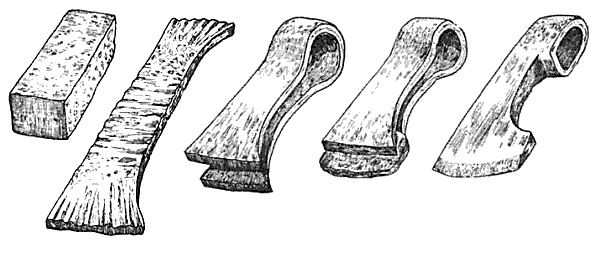
For axe heads, the forging of the main body of the head, typically from iron (or low carbon steel) is straightforward. The fancy parts are the cutting edge and the eye. The eye is usually made by one of 2 methods:
The whole axe is made like a butterfly, where the body of the butterfly will be the eye, and the wings the sides of the head. The "butterfly" is folded so that the two "wings" are against each other; space is kept for the eye. The sides are then forge-welded. A high-carbon cutting edge can be welded between the two halves at the edge. http://www.hurstwic.org/history/articles/manufacturing/text/viking_axe.htm has a drawing showing this process: http://www.hurstwic.org/history/articles/manufacturing/pix/axe_head_smithing.gif
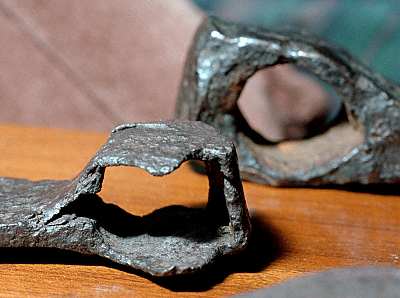
The eye can also be made by folding just enough iron to make the eye, and forge welding the eye closed just in front of the eye. The bottom axe in http://www.hurstwic.org/history/articles/manufacturing/pix/axe_with_thin_blade.jpg has been made this way; this is evident from the visible seam.
The eye can also be made using a drift (like making it with a punch, but pushing the material to the sides of the hole, rather than punching it out); the top axe in the previous photo was probably made this way. This is more common with tools rather than weapons, since tool-axes are often heavier, and the iron around the eye can be thicker (making forging + wrapping harder, and using a drift relatively easier), while a battle-axe typically has a lightweight head (making forging + wrapping easier, and a drift very difficult).
The cutting edge can be inserted between the rest of the head made in two halves as in 1 above, or by cutting a slot in the end of the head and inserting and forge-welding, or by wrapping a high carbon layer around the edge, or by butt-welding a high-carbon edge to the rest of the head (without inserting or wrapping). The head can also be made without a high-carbon edge, in which case, edge retention will suffer. The edge of such an iron axe can be carburised, producing a shallow layer of steel, which can be usefully hardened.
Other types of polearms with eyes are made by similar methods.
For polearms such as halberds, spikes can be made separately from the main part of the head, and forge welded on. Steel tips can be forge welded to the body of the spike. Some halberd spikes are made by partially splitting the body of the axe, and further forging the partly-split-off part into the spike. Sockets and langets are often forged separately and welded on. For example, the welds where the socket/langets of this halberd: https://www.metmuseum.org/art/collection/search/29009 are attached can be seen. In the left hand head here: http://www.clevelandart.org/art/1916.1559 the weld where the back-spike is attached is visible.
Spearheads show a great diversity in construction. They can be all-iron made from a single billet of iron, with the socket made by forging the base flat, and wrapping it around a mandrel. The seam might be forge-welded shut, or left open. The socket can be made similarly, but from a separate piece of iron, and welded to the blade. The blade itself can have welded on steel edges, and can have a decoratively pattern-welded body (so the blade is made similarly to an early Medieval pattern-welded sword blade).
Complex polearm heads like pollaxes are often made in multiple pieces (e.g., spike, langets, the hammer + axe) with the pieces held together by a bolt from side-to-side or a rivet from side-to-side. In the collection of photos of pollaxe and warhammer heads at https://myarmoury.com/feature_spot_poleaxe.html a variety of methods can be seen:
Wallace Collection (A926), Metropolitan Museum of Art (14.25.288): the pyramidal spike on the side of the head is a rivet or bolt head; the rivet or bolt holds the langets, spike, and the rest of the head together.
Wallace Collection (A927), Metropolitan Museum of Art (14.25.465): the langets hold the head together.
Fischer Galleries, Higgins Armory Museum (HAM # 2005.01): both of the above methods, together.
Heads can be attached to hafts by nails or rivets through the socket, eye, or langets. Axe heads can be attached by nails inserted into the eye from the end of the haft, with the ends folded over to keep the head on. Langets can run inside the eye, with the ends folded over similarly. A wedge can be driven into the end of the haft to expand it, to keep the head on (as is common with modern axes and hammers). A spike on the end can be driven into the end of the haft to do double-duty as both a thrusting spike and a wedge to secure the head. This can be further reinforced by the langets being wrapped over the head and spike (with a hole for the base of the spike).
Maces can be made in a variety of ways. For flanged maces, the flanges and the central tube are made separately. If the central tube is initially flat, the flanges can be forge-welded on, and then the tube wrapped. This require a thin tube, and sometimes it is wrapped around a second, already tubular, central piece. If the central tube is heavier, the flanges can be brazed on. This is perhaps the most common method. If the head has low ridges instead of flanges, these can be cut/filed (or perhaps forged) into a thick tubular head.
Mace heads are sometimes made of cast bronze.
Other non-sword weapons are largely wood, with some simply-forged iron pieces. For example, the godendag can be a simple iron spike and ferrule in the end of the haft: https://commons.wikimedia.org/wiki/File:Goedendags_in_het_museum_Kortrijk_1302_9-01-2010_14-20-13.JPG Similarly, iron spikes can be inserted into the side of similar weapons: https://commons.wikimedia.org/wiki/File:Arte_De_Athletica_2b.jpg (perhaps with iron bands around the head to reduce the chance of the wood splitting).
The best single source discussing the construction of Medieval European non-sword weapons is Waldman, John, Hafted Weapons in Medieval and Renaissance Europe: The Evolution of European Staff Weapons between 1200 and 1650, Brill, 2005. This books covers a wide range of polearms, and has many illustrations which show elements of the construction methods.