I just noticed this somewhat surprising consistency the other day, and I wondered how it came about.
You also have Scotland, Shetland, Finland, Deutschland (Germany), the Netherlands. The handful of Germanic countries that have non -land names are still full of those names - Jutland, Lapland, Zealand (and Zeeland), Svealand, Åland, Gotland, Norrland, Nordland, Halland.. the list goes on and on.
So -land was the most common Germanic name ending for regions and large islands. English ended up with a lot of Latin and French influence, and you can tell from things like Russia having the Latin-inspired -ia ending rather than the name Russland (which is in fact the German name), or France being known by its own name rather than 'Frankrice' (in analogy to German 'Frankreich', Swedish 'Frankrike' meaning 'Kingdom of the Franks', in Old English -rice was the word for 'kingdom'). Names like "England" and "Scotland" are older and therefore more in line with Germanic naming traditions.
Greenland and Iceland on the other hand were discovered and settled by Scandinavians, for whom the '-land' naming was also natural (and would remain so since those languages weren't as Latin-influenced). The ending -ey/-øy/-ø meaning 'island' existed too but as a rule it was used for naming small islands, not anything close to Iceland's size, much less Greenland..
So the first two are Old English the other two are from Norse and Newfoundland is a bit different since it was only rediscovered in the 1500s, and is just a contraction of "Newfound land". (The older Viking name of 'Vinland' didn't stick) By that time English didn't use the old Germanic -land endings so much for new stuff, Latin had more prestige. Look at the colony names for instance; only Maryland has the -land ending while Pennsylvania, Virginia, Georgia etc are Latin-inspired.
The -land ending would make a slight comeback in English much later though, when the English were naming places in Africa - e.g. Swaziland, Nyasaland.
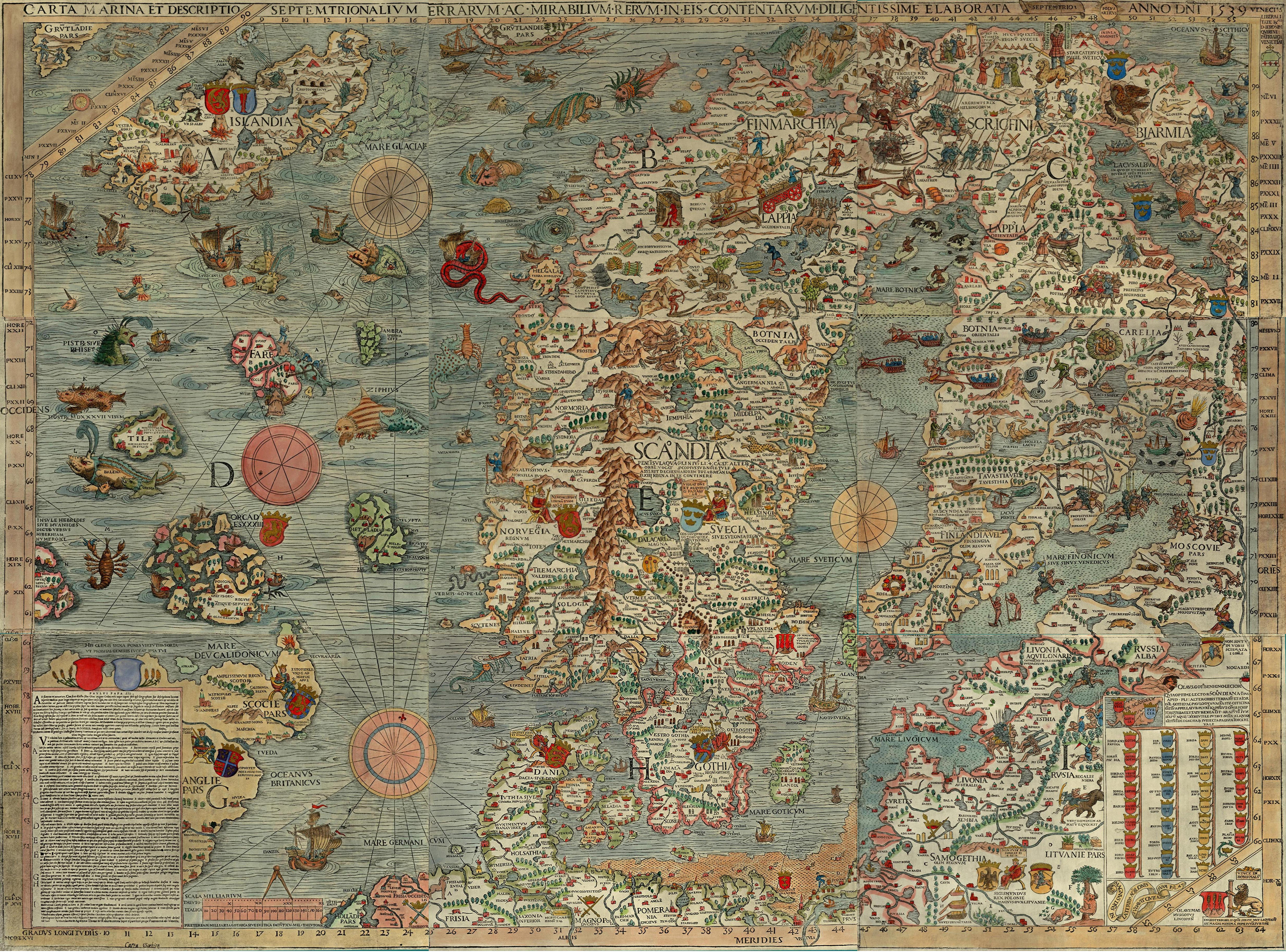
The islands invented by geographers had a bit more fanciful names like Tile (Thule) on Olaus Magnus' 1539 Carta Marina. Since Piny the Elder had written about Thule or Ultima Thule up north, they figured it must've existed, but Olaus being a Scandinavian knew all the places it wasn't, so he stuck it as an island in the Atlantic. Marked with "Hic habitat dominus insularaum!" (Here lives the lord of the islands!")
(edit: spelling)