Lots the novels I've read from 19th century that people would call for a doctor and he promptly comes and charges them a small amount (compared to what would they charge today). When did people start going to a doctor's office instead?
Great question! You're more talking about house calls, rather than GPs; a general practitioner is a non-specialist outpatient doctor, a term used in England, Commonwealth, and formerly colonized territories. In the United States and a lot of the rest of the world, the term is "primary care physician" (PCP), though the training regimen is slightly more complex. But that's neither here nor there. As you can imagine there is some regional variation, and I can really only speak for England, the United, and (to a lesser extent) France. We actually have pretty good statistics on house calls throughout the 20th century, and the 1930's to 1940s seem to be an inflection point -- in 1930, house calls were 40% of all physician encounters in the US. Only twenty years later, they were 10%, and by 1980 they were less than 1%, where they remain today (Kao et al, "Past, Present, and Future of House Calls"). I am not aware of any statistics from house calls in the 19th century, though I suspect they were higher. Some other astonishing statistics, these from Herrit et al, The House Call; American Gps were, on average, making 2.4 calls for a cold, 3.6 calls for the mumps/communicable diseases, 4.7 for nervous diseases -- they were seeing their patients a LOT.
So let's talk mostly about the nineteenth century, which you mention. The frequency of house calls was very geographic dependent -- essentially, the more rural you are, the more likely the doctor would come to you, rather than the alternative. In large cities like Paris, London, or Boston, many prominent doctors would have clinics, similar to today. John Snow, for example, saw patients from from waking until the late afternoon, before embarking on his cholera studies. Rene Laennec would see patients before breakfast, at lunch, and after dinner -- the remainder of the time would be spent in the hospital. In more rural areas, prior to the advent of better public transportation (trains, streetcars, and later automobiles), doctors would come to their ill patients, though it could be rather infrequently. This would be included even for rather sick patients who would otherwise be hospitalized; one of the purported reasons the first opiate epidemic started was doctors leaving large amounts of morphine and syringes with their own patients.
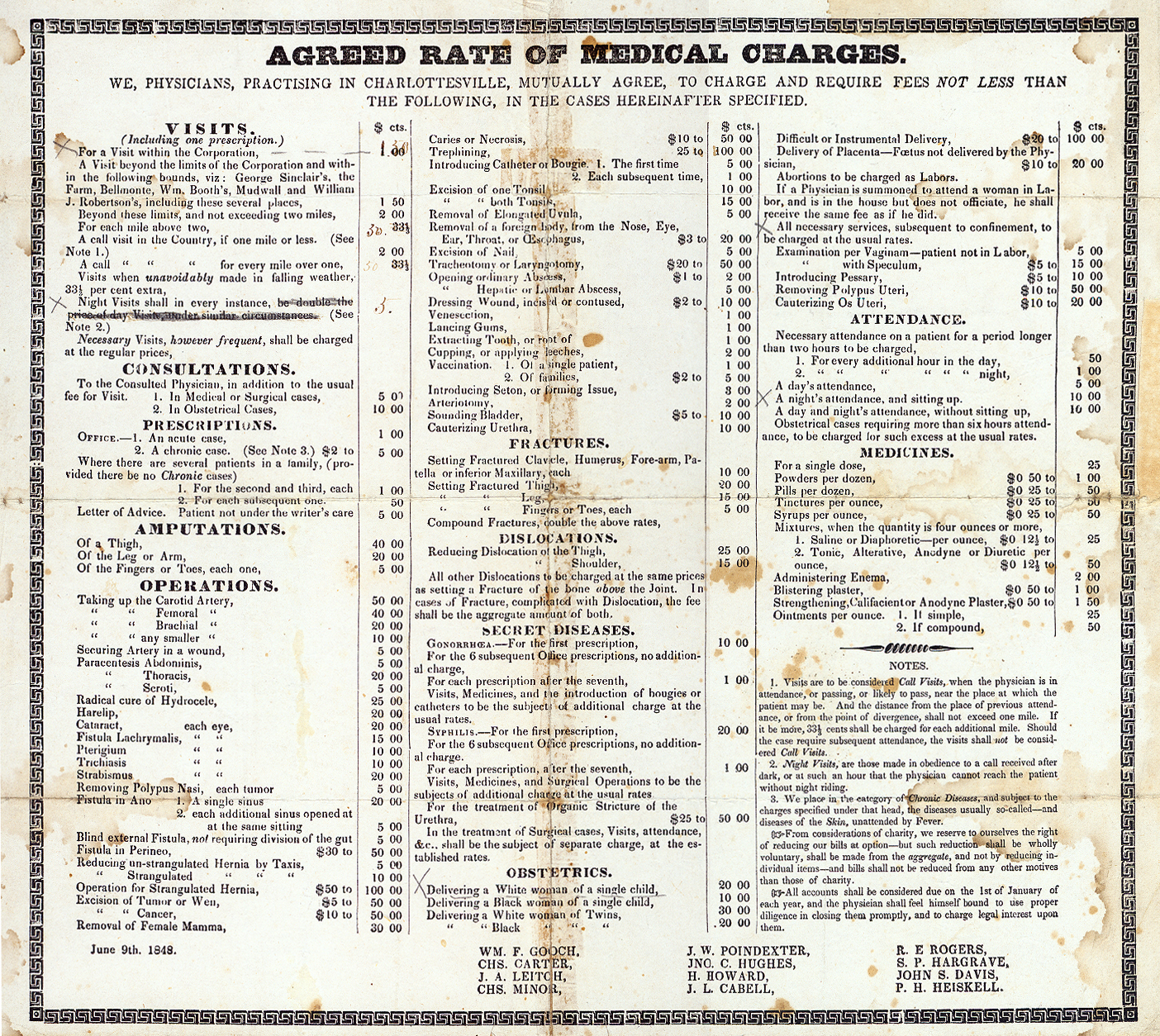
Class also played a part in it; the poor were more likely to seek care, either with a lay provider (an "Empiric" or "Quack"), or with a hospital, which in this period were starting to become the treatment centers we know today, rather than just a place for the poor to die. Seeing a doctor, even in the nineteenth century, still was not cheap. I submit this FASCINATING document (http://blog.hsl.virginia.edu/feebill/wp-content/uploads/sites/12/2011/05/Fee-Bill1.jpg), a fee schedule agreed upon by the doctors of Charlotteseville, VA, in 1848.
To call an initial consultation with a doctor -- well, if you lived within the bounds of George Sinclair's, the Farm, Bellmonte, Wm Booth's, Mudwall, and William J Robertson, that would run you 1.00 for the transportation, and five dollars for the visit. Inflation adjusted, that's 172.69 in 2017 dollars. If you just visited the office, that'd be 143.91. Compared to today, Medicare will reimburse a doctor 63.75 for a 99213, or 96.01 for a 99214, the two most common codes for visits to doctors with complaints (http://gi.org/wp-content/uploads/2016/01/Medicare-2016-RVU-breakdown-Nov-20152.pdf) (you would add your co-pay to this, and private insurance reimburses higher). But you can see, the prices really aren't that different than today (though the patient pays less today because of insurance). Medical care isn't cheap!
With fees this high, poorer people could not often afford doctors consultations, or would have to save up (or rely on the charity care of a hospital). I imagine the characters in the books you are reading are upper class.
So what happened? A couple trends coalesced to decimate the house call. First of all, medical technology improved and evolved -- new diagnostics like laboratory tests and x-rays became a standard part of a doctors visit. Transportation improved dramatically so it was easier for patients to get to their doctors. But both those predated what appears to have been the death knell -- insurance-based systems, and the relative drop in primary care. The 1940s saw nationalized insurance schemes take off all over the world; in 1948 for the NHS (and the US, obvious, has a haphazard system, but this same era still had the U.S. government offer massive tax incentives for employer-sponsored plans). This had two effects -- one, insurance, to cut costs, incentivized doctors to practice in offices. Second, these new insurers preferentially reimbursed towards specialty care, and doctors responded, with more and more specializing, leading to a dramatic drop in the number of GPs and PCPs by the 50s and 60s. All this led to the system we have today.
That was a lot! So TL;DR: over the late nineteenth to mid twentieth century, GPs slowly transitioned from house calls to office visits. But house calls were never cheap (only a small amount of money because of inflation), and there were always a large number of people who either went to clinics (especially in cities), sought out lay providers, or used charity care.
Hope that helped!