We are beginning to do research to inform a documentary about Germanic paganism (origin, practices and rituals, influence, etc), the Vikings (people who practiced such a religion, where they came from, what they did, and so on), and how these things translate into modern day art, music, literature, dance, culture etc. It’s a very broad question, but we’d love any insight! Thank you!
The trouble with pre-Christian Germanic faiths is that we know almost nothing about them. Our literary sources from Scandinavia such as the sagas are written up to centuries after conversion and are thus prone to heavy Christian influence and mythologising. Stories like that of Baldur show clear Christian influence, and it's quite possible that much of what we think of as Norse Pagan 'lore' was completely constructed to attempt to codify a variety of folk practices and beliefs within the familiar context of a Romano-Greek pantheon.
Our contemporary external evidence is often extremely suspect as well. Our go-to author is Adam of Bremen, yet his depiction of Scandinavia and Viking religious practice is almost entirely lifted from Pliny's Historia Naturalis, or ridiculously outlandish. Our archaeological evidence is also often scant. Adam of Bremen described a vast temple complex at Uppsala complete with sacrificial groves and a giant gold statue of Thor, but extensive archaeological site work has found only evidence of a larger building without the hearths that would be expected in a dwelling or long-hall which could be a temple but could also equally be a barn or storehouse.
Norse material culture is a different field, and one that did have more longevity, but neo-Paganism is almost entirely a modern construct based out of ethnonationalism rather than the actual continuation of Norse Paganism through over a millenia of Christianity.
We can say a bit more about Slavic Paganism in areas that are now Germany. Thietmar of Merseburg's Chronicon contains a really detailed account of Wendish religious practices and rituals in modern Eastern Germany.
Edit: so to actually answer your questions as to how these things translate into modern day art, music, literature, dance, culture etc., your best bet is actually to research emerging ethno-nationalist movements across Northern Europe in the 19th and early 20th Centuries and the ways in which these carefully curated, co-opted and even outright created national historic myths as part of fostering a sense of communal cultural heritage.
Well,as I said in another comment the other day - you've got two groups - The Vikings of fiction and romanticism, where the Sagas and Eddas are taken at face value and even extrapolated on, and then the actual Viking Age Scandinavians, about who we know comparatively very little. To be blunt, you'll have to decide which group you want your documentary to be about.
One thing we do know about the Vikings is that they didn't call themselves Vikings as a group - they identified as Danes, Swedes, Norwegians (much the same as now), and as subgroups thereof (not so much the same as now, now that they're more unitary countries and cultures). The term 'viking' was only ever used specifically for the people who went off on trading or raiding trips. The term was unknown in the English language and long-forgotten in the Scandinavian ones (except to handful of antiquarians who started studying runestones in the 17th century). It was re-introduced in Scandinavia by the Romantics, notably the 1811 poem "Vikingen" (The Viking) by Erik Gustaf Geijer, and the introduction into English occurred around the same time. The Sagas were translated and published, adaptations made and art followed, from Wagner's ring cycle to monumental paintings to architecture. The Biological Museum of Stockholm is a great example of 19th century 'National Romantic' architecture - inspired by history but not like anything that actually existed historically.
Now, romanticizing the heathen past did exist in Scandinavia prior to the 19th century, but in a different form called Gothicism. They latched onto the supposedly Scandinavian origins of the Goths and decided their heathen ancestors were the ur-Goths and thereby they were indirectly the proud conquerors of large parts of Europe. Olaus Magnus, who has to be credited for the first published work on Scandinavian runes in the 16th century, called them the 'Gothic Alphabet'.
Anyway, when it came back in Viking form in the 19th century, not only was the movement much stronger and more influential, it was more international - the Germans and English also gained a keen interest in Vikings, and through the British to lots of the rest of the world. (For all about this I can recommend Wawn's The Vikings and the Victorians: Inventing the Old North in 19th-Century Britain ) So the point is the whole image people have of Vikings is by and large a product of the 19th century and not something that's been passed down through the ages. However, the fact that it's not a continual tradition doesn't necessarily mean it's not interesting. It depends on what angle you're looking for. If you want to explain Nazi and Neo-Nazi imagery for instance it's more the 19th century you want to look at rather than the 9th.
So it's also in this era that historical linguistics gets started and also folkelroe studies. The Grimm Brothers for instance, are household names for their recordings of folk tales - but they're also famous as linguists. Another example is that Finnish mythology, the Kalevala is written down now, and like /u/BRIStoneman example with Baldur, there are stories and details in there which are also now thought to be later Christian influences.
Historic (and Scientific) method was not as sophisticated at the time, and there was basically a bias in many folklorists of the 19th century and first decades of the 20th, to assume that every tradition had its roots in time immemorial unless proven otherwise. So many claims were made, often on the flimsiest of evidence or argument, but they still live on in non-scholarly books and articles and not least Wikipedia. For instance, regarding Christian traditions, that the Scandinavian Yule ham would have something to do with Sæhrímnir or the Yule goat would be from Thor's goats, although there's nothing to connect these things other than being the same animals. (Ebbe Schön, Scandianvian folklorist, firmly links the latter tradition to medieval veneration of Saint Nicholas)
Another chestnut is the Swedish Midsummer pole (or maypole) being a phallic symbol, a claim from the late 19th century. Wikipedia goes even further and links it to Freyr and Freyja. This has no support from present day ethnologists here, (see e.g. this piece from Jonas Engman, unfortunately in Swedish) who point out that if anything, it's likely inspired by Christian symbolism.
So your premise is that these things are prevalent in the modern day. But are they? Certainly some pagan/folkloristic believes did survive, in particular ones that were not considered at odds with Christianity, such as belief in non-divine supernatural creatures, like trolls, gnomes, elves, etc. But generally the survival of Norse paganism has been greatly exaggerated and the exaggerations live on. Sometimes even get more elaborate (in recent years I've seen claims on this site that Santa Claus is from Odin, which not even the 19th century Scandinavian folklorists would've imagined, since Santa wasn't a tradition in Scandinavia at that time!) Another example ran into recently is Flowers' "Galdrabók: An Icelandic Grimoire" where the author looks very hard at pagan and possibly-pagan elements, while not putting any effort into comparing the book to contemporary grimoires from the rest of Europe. So this often gets made out to be a Norse symbol online, despite being similar magic symbols common in contemporary European grimoires. (e.g. in Scot's The Discoverie of Witchcraft).
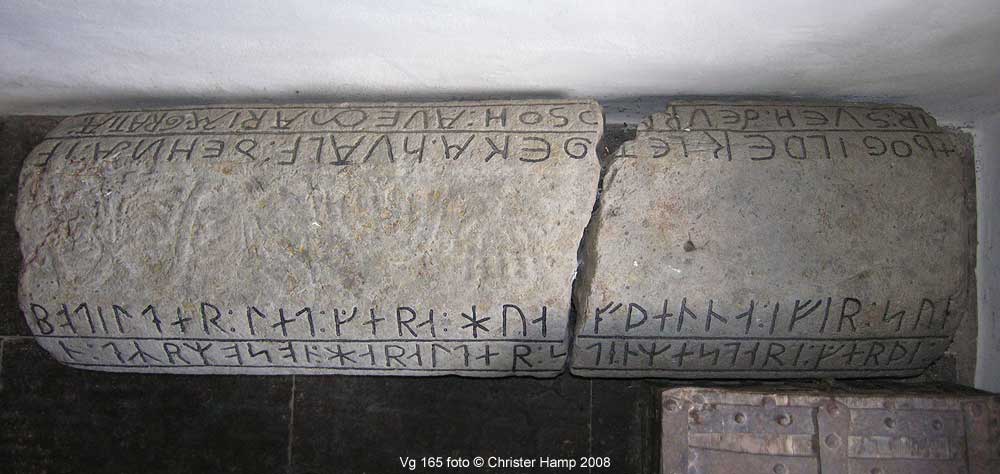
So the continuation of pagan cult was and is rather exaggerated, but the continuation of other cultural practices get far less attention. Runes lost popularity gradually but they continued to evolve and be used on monumental inscriptions until about 1500 and in everyday use among peasants until the around 1900. For instance Södra Ving inscription Vg165 is both in runes and Latin letters, but clearly Christian. ('Ave Maria Gratia' at the top left), there are also baptismal fonts and church bells with runic inscriptions. People think the runes died out with the Vikings, but in reality there was no point in the last millennium where nobody in Scandinavia knew some runes. The academic interest in them began centuries before the folk use stopped. The styles persisted, such as the Urnesstil, on its namesake stave churches for instance, and even fused with Romanesque styles into new things. (of course, in that drive to find paganism everywhere, people have asserted the retention of these style elements imply pagan beliefs too. See e..g. Bertell's essay "Where does Old Norse religion end?" on this)
The technique of building clinker ships like the old longships persisted in things like the church boats. Many woodworking tools and techniques and building styles continued- the contents of the Mästermyr chest, heavy on axes and knives, would all be familiar to a peasant-carpenter in the 18th century Scandinavia. As opposed to the fine woodworkers of the larger towns, who had more sophisticated tools like planes. The tradition and distinction lives on today in that the woodworking taught in Scandinavian schools ( slöjd ) was created (by Otto Salomon) with the express intent of teaching the former tradition, not the latter 'vocational' woodworking.
So there are many things besides religion we know were carried on. Less so with the religion, and particularly, as pointed out, because we really don't know much at all about how Norse religion was actually practiced. Human sacrifice seems to have occurred in some cases (e.g. Elk-man grave in Birka), but not nearly as many as the chronicle of Adam of Bremen would imply. Archaeological evidence shows the religion was not as homogeneous as people think. Burial traditions vary a lot - in the Mälardalen area, people were mostly cremated, and a stone mound built over the ash. In Finnveden in Småland, the dead were cremated but earthen mounds were built instead. Most of Scania buried the dead without cremation.
According to some (e.g. professor Anders Andrén) the whole concept of a single Asatru/Norse Pagan Mythology is in dissolution. The received mythology (to extent the written accounts resembles what was believed) was something carried by the aristocracy, while the religion practiced by ordinary people was less homogeneous, less organized and theoretical, and more pragmatic.
So a broad collection on where recent research is on Old Norse religion, and contains the essay I mentioned: Kristina Jennbert, Anders Andrén, Catharina Raudvere, Old Norse religion in long-term perspectives- Origins, changes and interactions (2006)
Are you looking for specific resources to do your own research or are you wanting us to write up a brief overview of all those topics?