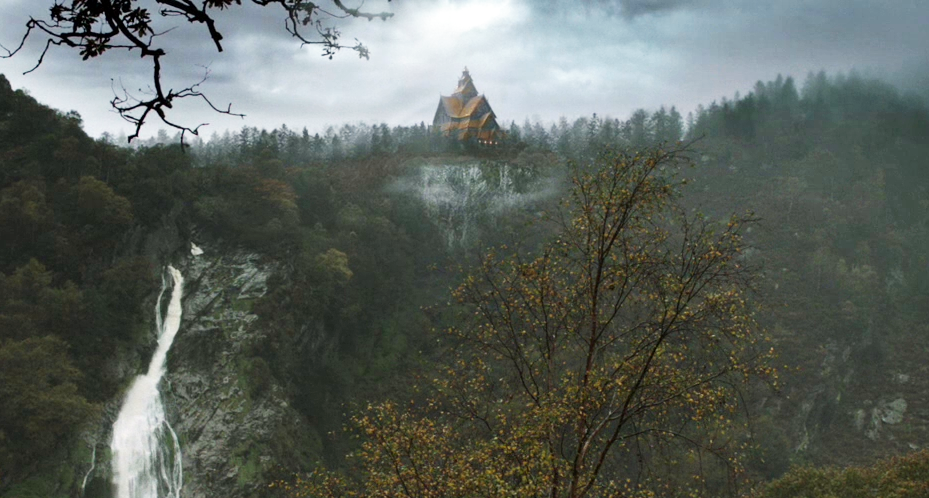
On the little tours I guide, we travel through a village called Danby which comes from Dane+by and I talk a bit about the different names that Those People have had - Norse, Northmen, Danes, Vikings etc. I was curious about the current state of play.
Well, to quote an older post of mine:
One thing we do know about the Vikings is that they didn't call themselves Vikings as a group - they identified as Danes, Swedes, Norwegians (much the same as now), and as subgroups thereof (not so much the same as now, now that they're more unitary countries and cultures). The term 'viking' was only ever used specifically for the people who went off on trading or raiding trips. The term was unknown in the English language and long-forgotten in the Scandinavian ones (except to handful of antiquarians who started studying runestones in the 17th century). It was re-introduced in Scandinavia by the Romantics, notably the 1811 poem "Vikingen" (The Viking) by Erik Gustaf Geijer, and the introduction into English occurred around the same time. The Sagas were translated and published, adaptations made and art followed, from Wagner's ring cycle to monumental paintings to architecture. The Biological Museum of Stockholm is a great example of 19th century 'National Romantic' architecture - inspired by history but not like anything that actually existed historically.
Now, romanticizing the heathen past did exist in Scandinavia prior to the 19th century, but in a different form called Gothicism. They latched onto the supposedly Scandinavian origins of the Goths and decided their heathen ancestors were the ur-Goths and thereby they were indirectly the proud conquerors of large parts of Europe. Olaus Magnus, who has to be credited for the first published work on Scandinavian runes in the 16th century, called them the 'Gothic Alphabet'.
Anyway, when it came back in Viking form in the 19th century, not only was the movement much stronger and more influential, it was more international - the Germans and English also gained a keen interest in Vikings, and through the British to lots of the rest of the world. (For all about this I can recommend Wawn's The Vikings and the Victorians: Inventing the Old North in 19th-Century Britain )
<end quote>So that's the thing: There never was a 'viking people' or 'viking society'. That whole image is largely built on 19th century romanticism, where Eddas and Sagas were taken at face value and elaborated on. And also where the British viewpoint was dominant in the west (the Russian image of varyags being a different matter). It's not a representative one of course - most Viking Age Scandinavians were not vikings; they did not go off on travels. Out of those who did, many were trading not raiding.
The standpoint of modern Scandinavian historians is simple. The term 'viking' is only ever used for people who went off on journeys during the Viking Age. That is, it's used as it was originally used. The term "Viking Age" is used (much as we might be living in a 'computer programmer age' now, but it doesn't mean there was a society of computer programmers). It's defined usually from the first raid on Lindisfarne to the defeat at Stamford Bridge. 793-1066. Or rounded off to 800-1100 or 800-1050. It is a rather arbitrary definition, but there were in fact some significant cultural changes at the start of the Viking Age and culturally, conversion to Christianity marks the end of it. So that's why the term was still used. Raids occurred both before and after. (also Scandinavians were themselves subject to raids from their non-Scandinavian neighbors)
In the Viking Age there were Danes and Norwegians, while present-day Sweden was divided between the Svear (swedes-proper) and Götar (Old English "geats") and Gotlanders (an island off Sweden). The Swedish groups were already in some form of political union, the origin and forms of which are unknown and much debated.
The aforementioned groups were not homogenous as one ight think but further subdivided into groups like Jutes (DK), Östgötar (SE) and Trønder (NO), and those were further subdivided into petty kingdoms.. The Beowulf alone lists a half-dozen groups of Danes. Those may or may not have existed but it does give a hint about the plethora of groups within the nations. There is also archaeological evidence of widely disparate burial customs within the countries. (e.g. bodies were cremated and rocks were placed on them to form burial mounds in Mälardalen, only soil was used in Finnveden, and in a number of places in Scania there was no cremation)
All this is not to say there weren't common features to these peoples. (as there still is) They spoke the same language Old Norse, but that diverged during the Viking Age into West and East Norse branches. Artistic styles like the Urnesstil spread around. It's named for the stave church of Urnes in Norway, but the style is most often found on mid-late-11th century runestones in Uppland, Sweden. (for which reason it's also been suggested that it be called the 'younger runestone style') When these common features are talked about, then 'Norse' or simply 'Scandinavian' is the usual term. It ought to be noted that we don't know whether the religion was really the same everywhere (again, see burial customs) the only group that had similar burial customs across Scandinavia was the aristocracy. Norse Mythology, in the form we've received it, written down by Christians in Iceland centuries later, may have mainly been an upper class affair, to the extent that what we have resembles anything actually practiced. (this is the position of profesor Anders Andrén) We really know very, very little about Norse religion apart from these writings, and I mentioned some of the reason why historians are skeptical of their accuracy. (not just Andrén)
Now British and Irish historians do use the term 'Vikings' for the Scandinavians who came there and settled there. That's not really wrong, since by definition you were a viking if you got there. But then the term refers to that specific group, all Scandinavians on the isles but not all Scandinavians in general. Historically there were also British references to all Scandinavians as 'Danes' but that's obviously confusing and not a wise term to use.
Even if it persists in words like 'danegeld' for the money they paid to raiders - despite more English coins being found in hoards in Sweden than in Denmark. Seriously, it's not even close
Anyway... summa summarum: The term is already retired from any serious history contexts in Scandinavia, even if the term Viking Age is in use and will continue to be. The 19th century romantic image persists in the public imagination, even if the forms change. e.g. TV shows like Vikings are a mixed blessing. They avoid some incorrect tropes (horned helmets) but introduce other silly inaccuracies. * The historians aren't above using it for marketing though. As this ad for the state historic museum in Stockholm demonstrates. (I might add that they didn't even have a permanent Viking exhibit until about 20 years ago, when they relented to tourist demand)
So as for the Danes, they've been Danes longer than there's recorded history in Scandinavia. The first mentions of them we have ('danoi', 'dani' in Procopius, Jordanes) are already from the 6th century, that is a good 250 years or so before the Viking Age began, and a whopping 650 years or so before the Danes started writing down their own history with Saxo Grammaticus.
( * I like Uppsala being on a mountain in a forest because it's almost entirely opposite - it is and was on a sandy ridge in the middle of a flat plain with plowed fields that was relatively densely populated)
Edit: I should add that 'Scandinavia(n)' is an originally Latin term. Scandinavians referred to themselves more or less as 'northerners' or 'northmen' (norðmaðr). Sometimes implicitly - the Elder Västgöta Law distinguishes Götar, Svear, Danes and Norwegians from Englishmen and 'Southmen', meaning Germans. (BTW: The reason for the distinction is that penalties for killing someone from the first two groups was higher than for the second two, which were higher than the last two)