A little context:
My grandmother speaks Old Low Franconian Limburgish as her main language and both "Germany" and "Prussia" have their own names in the dialect, "Duutsjland" en "Pruusses". I've only recently noticed she still refers to Germany as "Pruusses", as do a lot of other older people I know. The reason why I thought it was relatively strange is because not all seniors who speak the dialect refer to the country as "Prussia". A large portion of people just call it "Duutsjland" (Germany) and refer to the people as "Duutsjers" (Germans). It may not be entirely in the subject of "history", but I'm not quite sure where else to ask this question.
Edit: I usually use Low Franconian as a blanket term for the collection of dialects, but it's Limburgish to be more specific as u/Taalnazi pointed out.
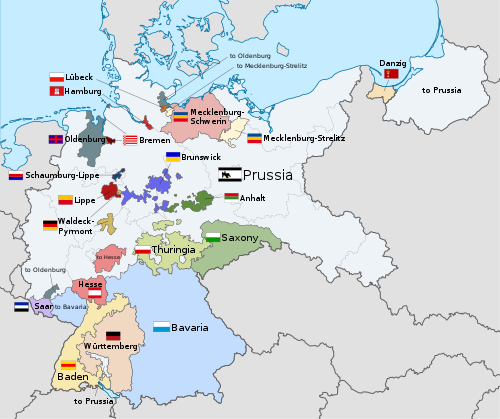
Prussia as an entity survived the collapse of the Hohenzollerns and the creation of the Weimar Republic. Prussia was still the largest state of the Republic at the time of your grandmother's birth, as seen in this map, which made it a very powerful entity within the Republic. Control of the Prussian government became one of the main ways the Nazis managed to create a police state in their seizure of power. The common association of Prussia with the negative traits of Germany such as militarism and nationalism, justified the formal abolition of the Prussian state in 1947, ending the formal existence of this entity.
But the legacy of Prussia still lived on. "Prussia" was a placeholder for an alleged set of negative German characteristics both inside and outside of Germany. These included the aforementioned militarism as well as a certain technical coldness and drab attitude towards life. While these negative traits sometimes get enfolded into the stereotype of "German" in the US as well as the UK (think Fawlty Towers), there was a greater geographic specificity the closer one got to the modern German state. The FRG's political culture often blamed "Prussianism" for Germany's twentieth-century fall. Adenauer in particular threw a lot of shade against Prussia. And this negative legacy remains somewhat low-key but still present in modern Germany.
Old Low Franconian wouldn’t be correct - that would be the language spoken during ~700-1150, also known as Old Dutch.
Does she speak Low Saxon or Limburgish? In Limburgish, the Germans are often referred to as Pruusj.