Interestingly, both iron making and bronze making had reached to Japan around the 4th century BC, through Yan State in China. The oldest known iron object found in Japan is a small axe (forged around the 5 century BC) which chemical compounds are similar to those found in Yan.
(Hisashi Nojima, in Iron Culture in the Yayoi Period from the Viewpoint of the History of Related Studies)
A thing about Japan is that iron and bronze tools were introduced in a relatively peaceful manner at the time perhaps due to Japan being a secluded geographical location a far from what was going on in China. Most of the bronze object seemed to be used for ceremonial purposes, while irons were mainly used for agricultural purposes. Northern Chinese style Dagger-Axe, or Hoko in Japanese, as well as short one hand dagger, had begun appearing around the 3rd century BC, and metal objects has started spreading around Japan with the establishment of the Lelang commandery in 108BC . It seems that we've already using cast iron/bronze technique shortly after, as seen in this photo from Kamigoten Ruin site in Shiga (2000 yeas ago). At this time, the major source of iron and bronze was the southern end of the Korean peninsula, or Kara known at the time in Asia. Iron and bronze were smelled locally into the flat block shape objects called Tettei for easier transportation. These are the Japanese ironwork ruin site from the 3rd century AD.
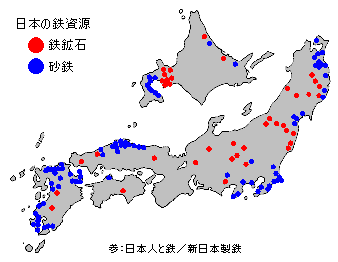
The importing resources from Kara had continued at least until the 5 century AD, but by this time, Japan had begun to use locally produced iron. You mentioned that Japan is lacking in quality iron deposits, but iron sands were abundant in swamps and riverbeds in Japan. This is a bad gif image but it shows iron deposits in Japan developed in the pre-industrialized era (blue dots = iron sands / red dots = iron ores). Japan definitely don't have enough iron resources in quantity if we are talking about the industrialized manufacturing capability in the modern day, we had a plenty of swords and many other iron tools developed during the samurai era... without importing iron ores.
The big breakthrough in Japan was the new technique called "tatara furnace" what was introduced in the 5th century AD. We don't know how this technique had arrived, since the only similar technique remained till today is in India, but the name tarara resembles "tartar" and perhaps it came through the Central Asia. This tarara furnace steel working, which enable the amount of carbon in less than 2%, had became the foundation of Japanese sword making much later time around the 13th century. So you see pretty much all evidences are from the archaeologically studies and we don't have any records to identify exactly when and by who metal working was brought to Japan, but I hope you will get the picture.
Metal and metalworking was introduced into Japan from Korea and/or China, possibly as early as 300BC, and certainly by the 1st century BC. First, bronze and iron objects were imported - iron might have preceded bronze. Later, bronze casting appears in Japan, possibly by immigrants from Korea. AFAIK, reliable dates for the introduction of iron forging and iron smelting are not known. It's possible, likely even, that iron tools/weapons were first made in Japan from Chinese-made iron, so forging is likely to predate iron smelting in Japan.
The dates for the introduction of iron and bronze into Korea are even less well known, with the introduction of iron dated variously from the 8th century BC to the 3rd century BC.
Part of the uncertainty is the relatively poor archaeological preservation of iron compared to bronze - it rusts. Add to that the absence of written records from that time, and there remains a lot of mystery in the dating of early metals and metallurgy in Japan. Nonetheless, we can say that:
Iron and bronze objects first arrived in Japan close together in time. This was in the last few centuries BC, long after the arrival of iron working in China (and Korea). Iron and bronze technologies in China and Korea were well-established and mature, and it's the products of these mature technologies that were imported into Japan. As a result of the late introduction of iron and bronze, at similar times, Japan does not have a long Bronze Age preceding its Iron Age (and perhaps no Bronze Age at all).
Iron forging and bronze casting followed the importing of iron and bronze objects. The earliest iron-working probably used imported iron, but local iron production followed fairly quickly (possibly not before the 1st century AD, but before 100AD). Local bronze production appears to have been much, much later, possibly not before 700AD. The first historical records of copper mining in Japan date to then - the Shoku Nihongi refers to the supposed first discovery of copper in Japan at about that time - and bronze objects of very low lead content appear for the first time in the 8th century. Earlier bronze objects, even if Japanese-cast, were of similar composition to Chinese and Korean bronzes, suggesting the re-casting of bronze obtained by melting down imported bronze.
Due to the local production of iron, and the dependence of bronze-working on imports, bronze remained expensive, used by the elite, while iron was widely used by farmers, woodworkers, etc.
Do we have any records from Japan or China on the exchange and adaptation of Japanese weaponry to iron? What would have been the ramification internally in Japan on these adaptations?
It predates written records in Japan, and I don't know of any relevant Chinese records.
We know that at about the same time as iron and bronze were introduction, wet-field cultivation of rice was introduced, and larger communities developed. This growth of agriculture might have preceding the spread of iron technology, and makes it very hard to see what kind of effect iron/bronze might have had. At least later (late Yayoi Period, 1st 3 centuries AD), when iron tools were common, iron technology would have helped agriculture (notably, it's much easier to clear new fields with iron axes compared to stone axes).
By the time we have reliable written records, Japanese iron and bronze technologies were centuries old (although, as noted above, bronze/copper production in Japan may have been recent).
My understanding is that Japan is particular in how lacking in quality iron deposits it is, leading to novel weapon-making techniques (like folding swords a huge number of times, sorting iron based on quality as an important forging step, etc) to compensate.
Japan is/was not lacking iron by pre-modern standards. Japanese iron only fell short by modern industrial standards, as Japan industrialised in the later 19th century. Before that, iron production was limited by labour and availability of timber (iron smelting needs charcoal, and more labour needs to go into charcoal production than collecting iron sand). The traditional Japanese iron industry managed to produce 20,000 tons of iron per year in the late 19th century (that's only about 1kg per capita, but that's quite respectable for pre-industrial iron production).
The ore that was available was generally good quality ore, and the resulting iron and steel were good quality.
Folding iron and steel was not novel, was not developed in Japan, and was a necessary step in making wrought iron and bloomery steel. Even when methods of steelmaking other than direct steel-making in the bloomery furnace during smelting (such as crucible steel, and the decarburisation of cast iron) were used in pre-modern times, the steel was typically folded. It was not done to compensate for poor quality ore, but a normal part of pre-modern iron-making.
References:
Delmer Brown (ed), The Cambridge History of Japan. Vol. 1. Ancient Japan, Cambridge University Press 1993.
Kurao Kubota, "Introduction of ironware culture into Japan." Bulletin of the Metals Museum 11, 81-92, (1986).
Daniel Sarabia, Dark Age Phases as Periods of Ecological Crisis: An Analysis of the Interplay Between Economy, Nature, and Culture in East Asia, PhD thesis, Oklahoma State University, 2004.