Please Be Aware: We expect everyone to read the rules and guidelines of this thread. Mods will remove questions which we deem to be too involved for the theme in place here. We will remove answers which don't include a source. These removals will be without notice. Please follow the rules.
Some questions people have just don't require depth. This thread is a recurring feature intended to provide a space for those simple, straight forward questions that are otherwise unsuited for the format of the subreddit.
Here are the ground rules:
Top Level Posts should be questions in their own right.
Questions should be clear and specific in the information that they are asking for.
Questions which ask about broader concepts may be removed at the discretion of the Mod Team and redirected to post as a standalone question.
We realize that in some cases, users may pose questions that they don't realize are more complicated than they think. In these cases, we will suggest reposting as a stand-alone question.
Answers MUST be properly sourced to respectable literature. Unlike regular questions in the sub where sources are only required upon request, the lack of a source will result in removal of the answer.
Academic secondary sources are prefered. Tertiary sources are acceptable if they are of academic rigor (such as a book from the 'Oxford Companion' series, or a reference work from an academic press).
The only rule being relaxed here is with regard to depth, insofar as the anticipated questions are ones which do not require it. All other rules of the subreddit are in force.
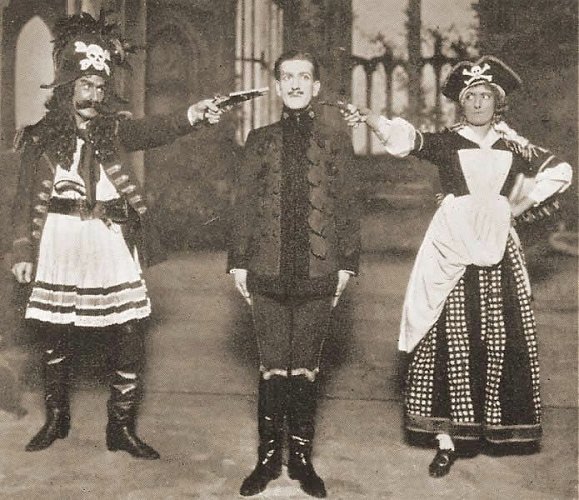
"Said the actress to the bishop" as far as I know is essentially the British equivalent of the American "That's what she said." The British version seems slightly strange to me, and I'd love to learn more about when it began to be used and the social context behind its genesis. How did the phrase "Said the actress to the bishop" originate?
I'll try again here this time.
Every time I read about a ruling house, it usually goes like: the first, eponymous attested member was John Doe, who became satrap/received a barony/built the eponymous castle/whatever in the year x.
But how did John Doe and his Does ancestors climbed the social ladder in the first place?
I tend to assume every noble dynasty started somewhere and at some point everybody was a poor nobody. So, what was the typical peasant -> ruling family progression?
Do we know the composition of the Teutonic Order at its height in the 14th century? X Knights, X Sergeants, X Chaplains, X half brothers, X servants and employees?
Really just the size of the Order and the number of members in Prussia and Livonia vs the Holy Roman Empire and other ‘peaceful’ commanderies.
Did slave owners use the term ‘slave’ in common use? I was listening to a podcast on Lincoln and got thinking how the word slave is so laden in negative connotations.
I know language evolves over time but it made me wonder, did slave owners/traders use euphemism or would they literally refer to other humans as their slaves?
Specifically thinking about the Atlantic slave trade but any answer will be great!
Is there any practical reason why in Japanese samurai archery the archer pulls the bow above his head?
I asked this question 2 days ago but nobody replied. Maybe someone here knows the answer - Why did Soviet Union admit to the killings in Katyn?
I have though myself about the answer for this for the past two days but I am not sure if what I think it is correct as I can't find anything to back it up. I think that maybe Yeltin was the one who somehow(?) managed to make Soviet authorities admit to the guilt in the Katyn killings, as doing so would tarnish the Gorbachov's reputation as the leader of USSR, which in turn helped Yeltin gain more power in RSFSR?
Was there an equivalent call for flogging reform in the British Royal Navy as there was in the US Navy during the 1830s-1840s?
Did ships of the Imperial Japanese Navy ever have ship designation codes assigned to them in a similar way that the US Navy did this? (i.e. USS Iowa being BB-61)
If so, is there a comprehensive list available anywhere online (preferably circa WW2)?
If not, was there any form of short form used whatsoever, or were ships only referred to by their full names?
Hopefully this SASQ goes back up long enough once the AMA is unpinned for someone to see this?
Three largely unrelated questions from me:
What are some good reads on medieval weaponry or Eastern weaponry in general?
I've been reading a lot of Roman History books and early Christianity is fast becoming a new topic of interest based on my time spent reading about Nero. Would Paul Johnson's History of Christianity be a good start? If not are there any other suggestions?
Historians, what do you think of Michael Parenti?
hello,
i came across images of eastern european, (turkish?) militia with really cool, elaborate waistbelts, with swords and other stuff tucked in.
https://i.pinimg.com/564x/02/d2/4d/02d24d04c85a2f4877a427bac4861cda.jpg
https://nebula.wsimg.com/4b9c7d8038dc297a5a7aeeb85dd6afe1?AccessKeyId=028CF9A021764203BD01&disposition=0&alloworigin=1
i was just curious about what sort of stuff they'd carry there, because some of them seem to get really wild. was there some sort of rank associated with them, or were they purely based on functionality?
Were there other races not allowed to vote, other than black people?
How many Japanese Americans left the U.S. permanently after being released from internment?