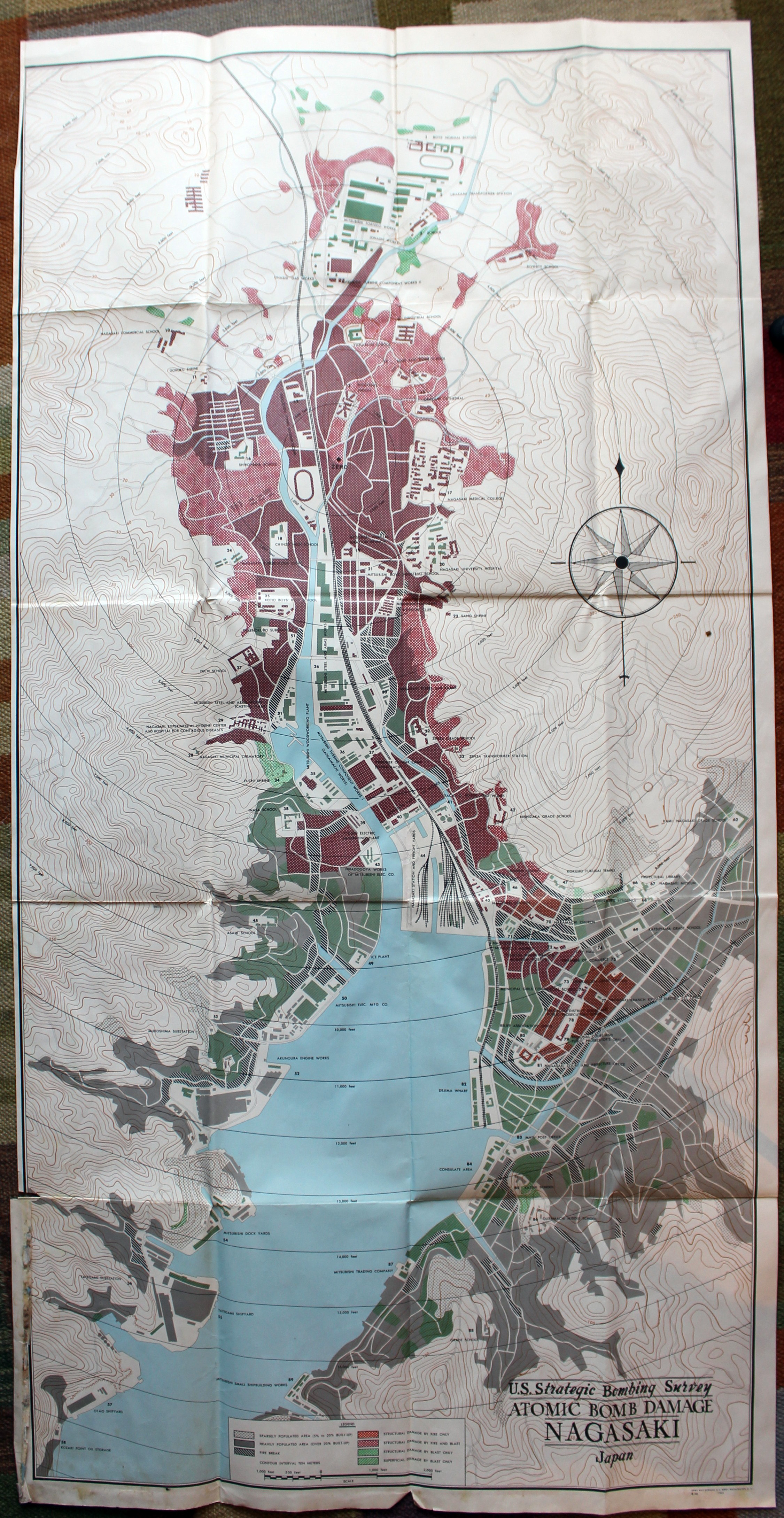
The accounts of Hiroshima I have read all suggest that the people were, after the initial actions of the first two days or so of terror, too dazed and shocked to do anything more than being cooperative with one another and with the authorities who arrived, a day later, from nearby cities. One can read, for example, John Hersey's Hiroshima, for a classic account of what this looked like on the ground. One can attribute this to a number of factors, but the sheer scale of destruction coupled with the almost total confusion seems to have mitigated against anything but a defeated psychological response.
(Whether this is something that can be generalized to sites or times other than Hiroshima in 1945 is not clear; sometimes this is cited as proof that people would react calmly to an atomic bomb going off today, and I am not sure the evidence warrants that conclusion.)
Nagasaki I have seen less about in this respect. Nagasaki, unlike Hiroshima, was not totally destroyed as a city after the attack. Geographic differences between the two, along with the positioning of the bomb, meant that only about 50% of Nagasaki was destroyed, and its administrative center in the urban, eastern part of the city (the dark gray part in the lower right corner of this map) survived essentially unharmed. Whereas Hiroshima was essentially destroyed as an administrative entity, and all order and help had to be brought in from outside.
I have never read any accounts of looting from either. It should be noted that there was considerable looting in Japan after the surrender decision was made clear, by and large by members of the disillusioned military and police forces. Which suggests a different model for looting, for whatever that is worth. John Dower discusses this in Embracing Defeat, which is about the reactions to surrender and rebuilding.
There is more that could be said about the rebuilding of Hiroshima in particular; it was a slow process, and the vacuum created in civil society was, for better or worse, quickly filled with black markets, organized crime, and the like. It took many years for it to become effectively functional again. Today, to the surprise of some who only think of it in terms of its destruction, it is a totally modern city of over a million people. The residents there think of themselves not as the city that was destroyed, but as the city that was destroyed and rebuilt, a testament to the tenacity of the human species and to the lesson of the evils of war. I find the contrast between this and American associations worth probing; it produces some interesting disjunctures of imagery.
You mention the radiation, but it should be made clear that the Japanese were not immediately aware of any lingering radiation, and in fact the claims made several weeks later by Japanese physicians that patients were dying of radiation sickness were vigorously contested by the victorious Allies as well. It was only much later that a truer understanding of radiation at the sites was understood, and in any case, nobody who was a victim there would have had much of a sense of it. It is also the case that hanging around Hiroshima after having survived the bombing is not, itself, probably that much of a health hazard, at least relative to the bombing itself. See this study, which concludes that residual radiation exposure was probably negligible compared to the initial radiation exposure.
Did people at the time know enough about the radiation dangers of nuclear weapons to have thought to not line up?
Maybe someone can answer another question, I heard somewhere a Japanese man put his hand up to shield his eyes from the blast and he could see the bones in his hand, like looking at an X-ray. Is this true? Would that of happened?
This thread is trending high right now and getting a lot of attention, but it is important to remember those upvotes represent interest in the question itself, and it can often take time for a good answer to be written. The mission of /r/AskHistorians is to provide users with in-depth and comprehensive responses, and our rules are intended to facilitate that purpose.
We remove comments which don't follow the rules for reasons including unfounded speculation, shallowness, and of course, inaccuracy.
If you're coming into this thread because it has (at time of writing) 30 comments, and you find nothing but a couple of mod posts, here's what you're missing:
None of this comes even close to providing an answer to the question, and none of it is worth your time if you are genuinely interested in learning about this subject. So please be patient - we find that highly upvoted questions eventually get an answer well over 90% of the time. If you want to be reminded to come check back later, or simply find other great content to read while you wait, this thread provides a guide to a number of ways to do so, including the RemindMeBot or our Twitter.