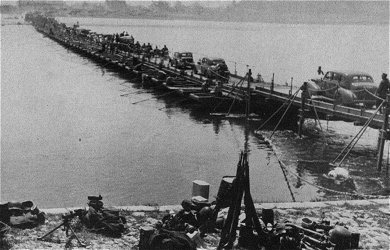
As you can imagine, the simplest thing to do is to just build your own bridge. Indeed, the limitations of what an assault/pioneer bridge could carry put some extremely hard limits on the size of the vehicles an army could field. Weight capacity of bridges was a significant concern in both the US and German militaries, for example, and the combat engineers were always consulted as part of the tank design process. (Though eventually the Germans said 'to heck with it' and decided to go the snorkel route).
To this end, a number of bridges of various types were created, depending on how quickly you needed it built, and how much you needed to transport over it.
Outside of Bruckenpanzers, what we would today know as AVLBs (Armored Vehicle Launched Bridges) https://i.pinimg.com/originals/08/bd/fa/08bdfab7df2f7d8f0748cbfe94f76b37.jpg , the fastest bridges you were going to be able to build in WW2 were ribbon/pontoon bridges. The pontoons could be tied together and used as ferries for individual vehicles as the fastest way to get -something- across, http://i64.tinypic.com/10pu461.jpg , but ideally, you took a little while and you bolted the thing together. http://chrito.users1.50megs.com/photos/france/1geb/geb132.jpg
The German Army started out with 8-ton and 12.5 ton bridges. Fairly quickly, though, the Bruckengerat B became pretty much standard in the Divisional engineering battalions, rated for up to 16 tons for wheeled vehicles, 20 tons tracked. However, there were plenty of other options: Bruckengerat C would be a six-ton capacity, Bruckengerat T 11 tons. (In addition, length and river speed could also affect capacity).
For heavier items, you needed to get girder bridges across, such as the pontoon-supported Bruckengerat K, 27 tons. Then you can go to the J.42 or J.43 bridges. https://forum.axishistory.com/download/file.php?id=393722
The really heavy stuff would be dealt with by the semi-fixed bridges, such as the L.Z. or S. Of course, these took a long time to build.
https://weaponsandwarfare.files.wordpress.com/2018/09/bruke2.jpg
If you are curious as to the practical effect of bridge capacity vs speed, the case of the Ludendorff Bridge ("The Bridge at Remagen") is a case in point. The engineers were able within a day to get the 35-ton Shermans across the Rhine. It took three days for them to build up the bridge to take the 45-ton Pershings, which had to be left behind in the interim.
Check out the Handbook on German Military Forces by Bob Carruthers, it has a lot of tables as to what sorts of bridges could carry what.