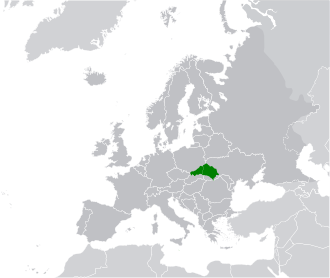
There is a region of north-western Spain called Galicia. There is also a region in western Ukraine and Southern Poland with the same name, this used to be a kingdom in the Austro-Hungarian Empire.
When I asked this question before someone posted excerpts from the Wikipedia articles (the mods deleted this answer because it was plagiarized) which said that Spanish Galicia got its name in Roman times and that Ukrainian Galicia got its name from the kingdom of Galicia–Volhynia, but that is one mighty coincident. Why would peoples from two unrelated language groups come up with exactly the same name?
I think it is very likely that the Slavic name for their Galicia sounded somewhat similar to Galicia and that someone who could write and had a classical education latinized it to the name of the Roman province in Spain, because that would sound fancier and was easier to write, but that's just a guess.
The two words have completely different origins. The Galicia in Spain is from Latin *Callaecia, from a Celtic tribe called Καλλαϊκoί (Kallaikoi) by the Greeks. "Galicia" is just the late reduction of that word.
The Galicia in Eastern Europe is the Latinized version of the Slavic word Halych, an ancient city on the Dniester river in western Ukraine. It used to be thought that the word was related to the very common Celtic morpheme *hal/*gal, which would tie it very very distantly to the Καλλαϊκoί. But modern Slavic scholars link Halych to the East Slavic word for jack-daw, halka, and the jack-daw appears on the city's coat of arms from early on.
Therefore yes, it is just a coincidence, driven by the way Latin commonly identifies places (with the -ia suffix) and the reduction of consonants in Latin, Slavic, and later Spanish.
Καλλαϊκoί -> Callaecia -> Galicia
Halka -> Halych -> Latinized Galic + suffix -ia -> Galicia