If you were to ask anyone to give a description of Jesus, it would be very easy: long, straight brown hair, a thick beard, and always wearing flowing white robes. He is instantly recognizable. My question is, when, where and why did this set of physical traits become so commonplace? The Bible never describes his appearance at all, so it must be conjecture by an artist’s creative license, but it must have been a very influential artist indeed.
I can answer your question about when, but I can't tell you why. If anyone else would like to add, please do so.
The very earliest picture (1st-3rd century) we have of Jesus is entitled "Alexamennos Worshipping God". It shows a man worshipping... a donkey-headed man on the cross. Historians assume this was drawn by a pagan making fun of Alexamennos. https://churchpop.com/wp-content/uploads/2015/03/41.jpg
Other, slightly later pictures (3rd and 4th century) show Jesus as a short-haired, clean-shaven man, though the quality isn't great, so there's not much detail.
Here is Jesus healing the paralytic man: http://www.oldest.org/wp-content/uploads/2017/12/The-Healing-of-the-Paralytic.jpg And Jesus depicted as the Good Shepherd. Notice his short hair and typical knee-length tunic. https://churchpop.com/wp-content/uploads/2015/03/15.jpg
We can see a couple of later examples. Here is a short-haired Jesus with his disciplines, 5th century. http://www.oldest.org/wp-content/uploads/2017/12/Christ-and-His-Apostles.jpg And a rather androgynous Jesus with long curly hair and no beard, again, 5th century. http://www.oldest.org/wp-content/uploads/2017/12/Good-Shepherd-Mosaic.jpg
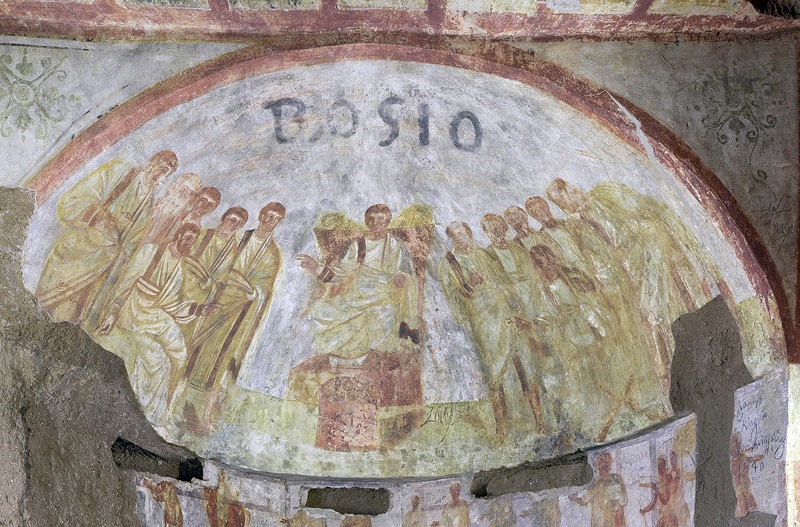
But, in the 4th and 5th century, you also start to get some pictures showing Jesus with a beard and long hair. His disciples also start to be depicted with more beards. Here's one from the 4th century. https://churchpop.com/wp-content/uploads/2015/03/5.jpg
Here's one from the 5th century. http://www.oldest.org/wp-content/uploads/2017/12/Mosaic-of-St.-Pudenziana.jpg
Over time, the depictions of Jesus as long-haired and bearded became more common, while depictions of him with short hair or unbearded became less popular.
This leads us to the most archetypal depiction of Jesus, the 6th century Egyptian work known as the Pantocrator. https://scross-2vqcxi3bqvbq4iaajc.netdna-ssl.com/wp-content/uploads/2015/04/christ_pantocrator_sinai.jpg This becomes the main depiction of Jesus until... well, today. The only changes are regional: in Ethiopia he was often depicted as black, and in north-west Europe, his hair was lighter brown (or, during the height of European racism in the 18th and 19th centuries, sometimes even blonde with blue eyes).
But what I can't tell you is why short-haired and clean-shaven depictions fell out of fashion in the 4th-5th centuries, and long-haired, bearded pictures became more popular.
I can tell you that some art historians theorise that, after the decline of Paganism in the 4th-6th centuries, artists began to depict Jehovah (and therefore Jesus) in the same way as they'd previously depicted Zeus/Jupiter: long hair, beard, white robes, etc. I don't know whether this is a commonly accepted theory though, and if anyone would like to comment, I'd like to add this as a secondary question.
The oldest known depiction is from Syria in 235AD. Early Christians discouraged idol worship often only using a fish or a peacock as a symbol for Jesus. The original depictions of Jesus are based on the average shepherd it was considered sinful to show him as beautiful, majestic, or powerful in anyway. The eastern churches showed him older with a beard depicted as a philosopher like plato. Western churches showed him younger and more youthful sometimes depicted with a wand, often as a young roman emperor as Christianity moved north Jesus' appearance took on lighter hair and skin eventually becoming blonde haired and blue eyed